
How Many Days in a Year? 365, or 366 in a Leap Year
How many days in a year? 365, or 366 in a leap year. See why, the leap year rules, the days in every month and the 176 days left in 2026 as of 9 July.
A year has 365 days. A leap year has 366 days. 2026 is a common year, so it has 365. The next leap year is 2028, when February gets a 29th day.
Today is Thursday, 9 July 2026, which is day 190 of 365. After today, 175 days remain, exactly 25 weeks. Counting today, 176 remain. This guide explains why the number is 365, how leap years work, how many days each month has and what to do with the days that are left.
Key takeaways
- A common year has 365 days and a leap year has 366. 2026 has 365, and 2028 is the next leap year.
- Earth takes about 365.2422 days to orbit the Sun, which is why the calendar adds a leap day.
- A leap year is divisible by 4, except century years, which must be divisible by 400.
- On 9 July 2026, 176 days remain including today, which is about 2,816 waking hours.
How many days are in a year?
The answer is 365 in a common year and 366 in a leap year.
| Year type | Days | Weeks | Example |
|---|---|---|---|
| Common year | 365 | 52 weeks and 1 day | 2025, 2026, 2027 |
| Leap year | 366 | 52 weeks and 2 days | 2024, 2028, 2032 |
In every 400 years, the Gregorian calendar has 97 leap years. That works out to an average of 365.2425 days a year.
If you are counting the days in a particular span, such as your age or a project, the leap days matter. From 9 July 1996 to 9 July 2026 is 30 years, but it contains 7 leap days (2000, 2004, 2008, 2012, 2016, 2020 and 2024). That is exactly 10,957 days.
Why does a year have 365 days?
A year is the time Earth takes to go once around the Sun. That takes about 365.2422 days, according to NASA's Jet Propulsion Laboratory. This is the tropical year, the one that tracks the seasons.
The calendar uses whole days, so a common year drops the leftover 0.2422. That is about 5 hours and 49 minutes. Left alone, the calendar would slide against the seasons by roughly a day every four years. Within a couple of centuries, the start of spring would drift well into winter.
How do leap years fix the extra quarter day?
Adding one day every four years takes care of most of the gap. Four years of 0.2422 days is 0.9688 days, which is almost a whole day.
"Almost" is the problem. The old Julian calendar added a leap day every four years, which treated the year as 365.25 days. That is slightly too long, so the calendar slowly ran ahead of the seasons. By the 1500s the gap was about ten days. Pope Gregory XIII fixed it in 1582. The reform removed ten days, so Thursday, 4 October 1582 was followed by Friday, 15 October, and added a refinement to the leap year rule. The history of the Gregorian calendar covers the details, and adoption was uneven. Some countries switched centuries later.
What are the leap year rules?
A year is a leap year if it passes these three tests, in order:
- It is divisible by 4.
- But if it is divisible by 100, it is not a leap year.
- Unless it is also divisible by 400, in which case it is a leap year.
| Year | Divisible by 4? | By 100? | By 400? | Leap year? |
|---|---|---|---|---|
| 2024 | Yes | No | n/a | Yes |
| 2026 | No | n/a | n/a | No |
| 2028 | Yes | No | n/a | Yes |
| 1900 | Yes | Yes | No | No |
| 2000 | Yes | Yes | Yes | Yes |
| 2100 | Yes | Yes | No | No |
JPL notes that 2000 was a leap year, and that 2100, 2200 and 2300 will not be. The leap years from 2020 on are 2020, 2024, 2028, 2032 and 2036.
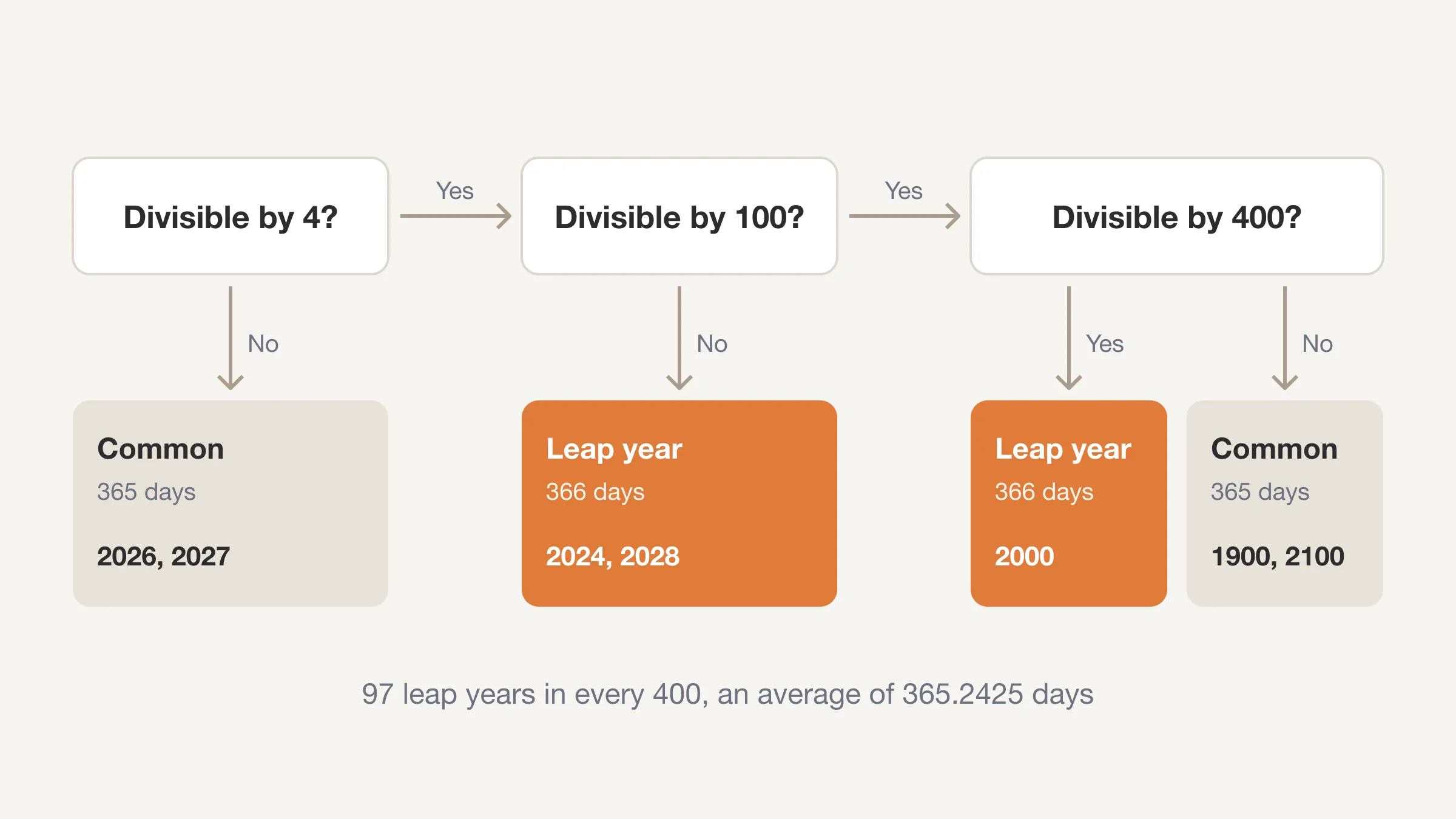
The rule is very close but not perfect. The Gregorian average of 365.2425 days is slightly longer than the tropical year, by about 0.0003 days. That adds up to a one-day error every 3,300 years or so.
How many days are in each month?
The months do not divide the year evenly, so here are the numbers for 2026, with the running total.
| Month | Days | Days through month end |
|---|---|---|
| January | 31 | 31 |
| February | 28 (29 in a leap year) | 59 |
| March | 31 | 90 |
| April | 30 | 120 |
| May | 31 | 151 |
| June | 30 | 181 |
| July | 31 | 212 |
| August | 31 | 243 |
| September | 30 | 273 |
| October | 31 | 304 |
| November | 30 | 334 |
| December | 31 | 365 |
By quarter, 2026 has 90, 91, 92 and 92 days. The first quarter is the shortest. In a leap year, it gets one more.
Today is 9 July. Add 181 days through the end of June and 9 more, and you get day 190.
See where each day goes
Log your day in 15-minute blocks. Two minutes in the morning, two at night.
Try Beyond Time freeHow many days are left in 2026?
Here is the count for Thursday, 9 July 2026.
| From 9 July 2026 | Amount |
|---|---|
| Days passed before today | 189 |
| Day of the year | 190 of 365 |
| Days left after today | 175 (exactly 25 weeks) |
| Days left including today | 176 |
| Waking hours left, including today (16 a day) | 2,816 |
| 15-minute waking blocks left | 11,264 |
| Share of the year gone, including today | 52% |
To count days left on any date, subtract its day number from 365, or 366 in a leap year. To find the day number, add the days in the earlier months to the day of the month.
If you also want the hours, how many hours are in a year gives 8,760 and breaks them into waking, working and free time.
How many working days and weekend days are in a year?
A common year has 365 days. In 2026, that splits into:
- 261 weekdays
- 104 weekend days (52 Saturdays and 52 Sundays)
The US federal government observes 11 holidays in 2026, all on weekdays, according to the US Office of Personnel Management. That leaves about 250 working days for a federal employee before any personal leave. Private employers differ.
Weekend days are more than a quarter of the year. We count them in detail in how many weekends are in a year.
What do 365 days really hold?
A day has 24 hours, but days do not feel equal. Two ordinary Tuesdays in different months can feel identical, and memory merges them. We explain why in why time goes by so fast.
A year of days also adds up faster than people expect. Take an 80-year life. At 365.2425 days a year, that is about 29,219 days. The idea of a limited number of weeks is the core of Four Thousand Weeks, and it is easier to feel when you look at a single day.
Each day is 96 fifteen-minute blocks. A year of days is 35,040 blocks. That is a lot, and it is also a number you can count. Knowing how many days are left is only half of the picture. The other half is how those days went.
How can you see where your days go?
Logging a day in 15-minute blocks takes about two minutes in the morning and two at night. In Beyond Time, Start your day lets you note how you slept and pick one to three goals. Log time shows the day as 96 blocks. You choose what each block was, and routines are grouped under Health, Life, Work and Sleep. Anything you skip shows as Not logged.
In the evening, End your day asks you to rate how health, life and work felt from 1 to 10 and add a line if you want. See your week then splits every hour by category and shows the trend and the share you logged. The AI reflection reads the logged day and says what went where you meant it to, where time leaked and one or two changes for tomorrow.
You can also start on paper with the daily time log template. Hourly structure helps too, and the hourly planner guide shows how to compare plan and day.
Make the next 176 days visible
Log time in 15-minute blocks and see where each day went. Two weeks free, everything unlocked.
Try Beyond Time freeFrequently Asked Questions
How many days are in a year?
A common year has 365 days and a leap year has 366. 2026 has 365 days, and the next leap year is 2028.
Why does a year have 365 days?
Earth takes about 365.2422 days to orbit the Sun, and the calendar rounds that down to 365 whole days. Leap years add back the leftover fraction.
How do you know if a year is a leap year?
A year is a leap year if it is divisible by 4, except century years, which must also be divisible by 400. That makes 2000 a leap year and 1900 and 2100 not.
How many days are left in 2026?
On 9 July 2026, 175 days are left after today, which is 25 weeks, and 176 including today. That is about 2,816 waking hours at 16 a day.
How many days are in a leap year?
A leap year has 366 days because February has 29 days instead of 28. It is 52 weeks and 2 days long.
How many days are in 2027?
2027 has 365 days, because it is not divisible by 4. The next leap year after 2026 is 2028, and then 2032.
The answer: 365 days, and 176 left in 2026
A year has 365 days, or 366 in a leap year, because Earth's orbit takes about 365.2422 days and leap days make up the difference. On 9 July 2026, 176 days remain including today.
Your time is limited, and a day is the smallest unit you can plan around. Pick one ordinary day this week and log it in 15-minute blocks to see where it went.
Put this into practice
Free tools that match this article.
Goal Setting Worksheet
Turn a vague goal into milestones, habits, blockers, and a weekly review plan.
Try Goal WorksheetTime ManagementWeekly Schedule Template
Plan your week with a free printable weekly schedule template for goals, routines, and focus blocks.
Try Schedule TemplateHabit BuildingHabit Tracker Template
Create a free printable habit tracker template — weekly or monthly. Customize your habits and download a clean PDF in seconds.
Try Habit TrackerTime ManagementTime Blocking Template
Map your day into focused time blocks with a free printable time blocking template.
Try Time BlockingRelated Articles

How Many Minutes in a Week? 10,080, and Where They Go
How many minutes in a week? 10,080, or 6,720 waking minutes at 8 hours of sleep. See the minutes in each activity for an average week and how many are left.

Bucket List Ideas: 100 Ideas Grouped by Theme and Lead Time
100 bucket list ideas grouped by theme and tagged by lead time: now, this year, or years ahead. Count the weeks you have, then pick ten. Start your list today.

How to Stop Doomscrolling: 9 Practical Fixes That Work
How to stop doomscrolling: add friction, swap in better habits and check your Screen Time against a real log of your day. Nine fixes, with sources. Try one.

Life Plan Template: A One-Page Plan With Weekly Costs
A free life plan template you can copy: eight areas of life, one outcome each, and a weekly time cost so your plan fits the 112 waking hours you really have.

How Many Work Weeks in a Year? 52 Minus Your Time Off
How many work weeks in a year? 52 on paper, usually 46 to 50 after holidays and leave. See the table by days off, 2026's count and the weeks left this year.

Second Brain Method Explained: CODE, PARA and Who It Suits
A second brain is a trusted place outside your head for notes and ideas. See how Tiago Forte's CODE and PARA work, who it suits, and what notes can't tell you.