
How Many Hours in a Work Week? 40, and What Is Left
How many hours in a work week? 40 is the standard: 8 hours, 5 days. See what it is out of 168, what the BLS says people work, and how many hours are left.
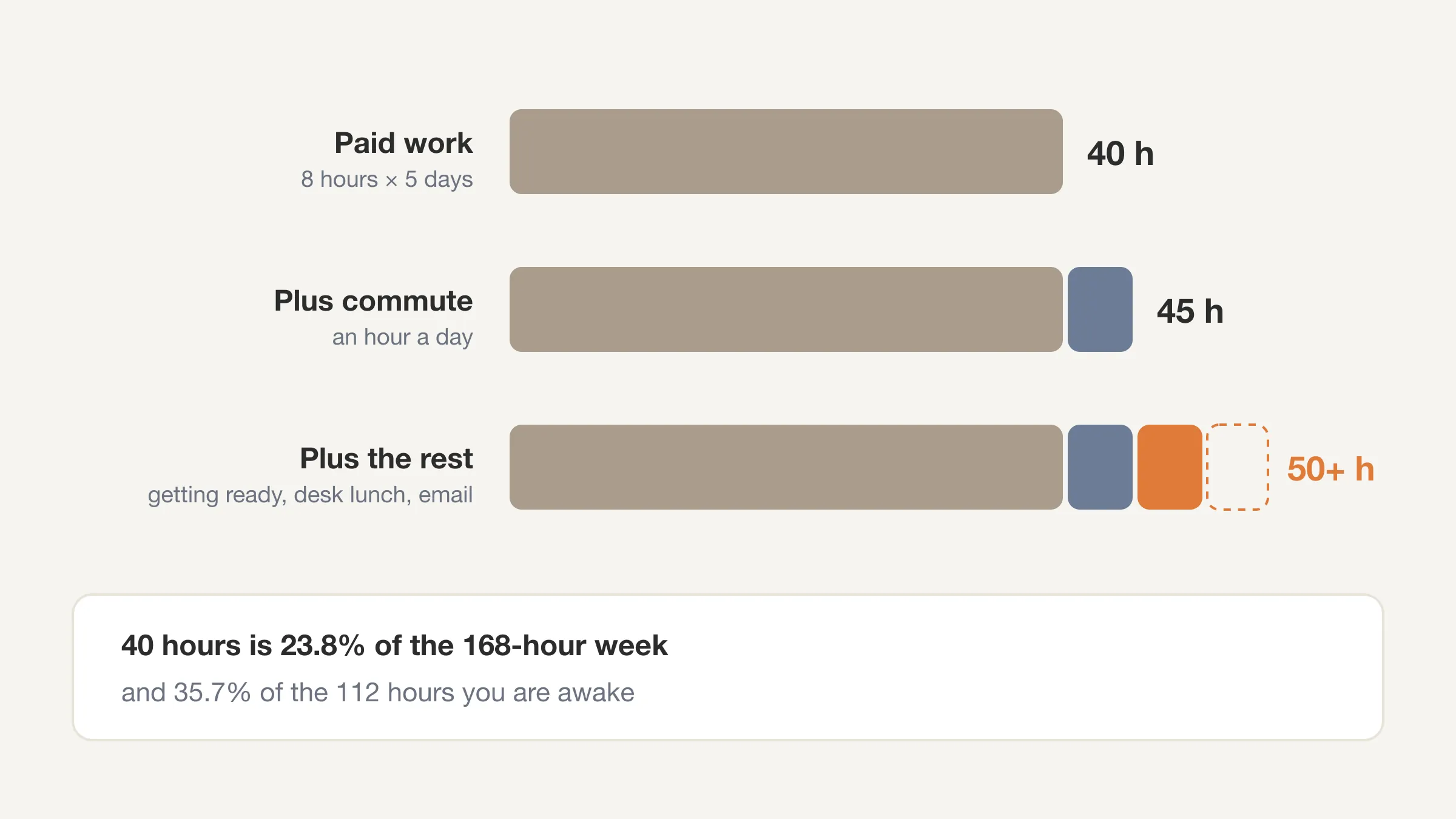
A standard work week is 40 hours: 8 hours a day, 5 days a week. In the United States that is also the line where overtime pay starts for most hourly workers. Out of the 168 hours in a week, 40 is 23.8%. Out of the 112 hours you are awake (at 8 hours of sleep a night), it is 35.7%.
That is the answer to "how many hours in a work week". It is the convention, not a measurement. Plenty of people work 35, some work 50, and the real number for you depends on your job, your commute and whether work follows you home.
This post gives you the standard number, a table of the other work weeks people search for, what US time-use data says people actually work, and what is left of the week once work is counted.
Key takeaways
- A standard full-time work week is 40 hours, or 160 fifteen-minute blocks.
- That is 23.8% of the week and 35.7% of your waking hours at 8 hours of sleep.
- US full-time workers averaged 8.4 hours on weekdays and 5.6 hours on weekend days and holidays in 2024 (BLS).
- A job is more than its hours. Add commuting and getting ready and the work week takes closer to 45 to 50 hours of your week.
How many hours are in a standard work week?
The standard is 40 hours. It comes from five days of eight hours. A week has 168 hours in total, so the work week is a bit less than a quarter of it. The same 40 hours in other units:
| Unit | In a 40-hour work week |
|---|---|
| Hours | 40 |
| Minutes | 2,400 |
| 15-minute blocks | 160 |
| Share of the 168-hour week | 23.8% |
| Share of 112 waking hours | 35.7% |
| Hours in a 52-week year | 2,080 |
If you want the full breakdown of the 168, read how many hours are in a week. The short version: about 56 hours go to sleep and 112 are waking hours, which is 448 blocks of 15 minutes.
Where does the 40 come from? In the United States, the Fair Labor Standards Act sets overtime at one and a half times the regular rate for covered, non-exempt employees for hours worked over 40 in a workweek, according to the US Department of Labor. That rule made 40 the reference point for pay. It is not a limit on how long anyone may work, and it does not apply the same way to every job.
How many hours is a work week for different schedules?
People search for this number because their own week is not 40. Here are the common versions, with what each one takes from the 168 hours.
| Schedule | Hours a week | Share of 168 | Share of 112 waking hours | 15-minute blocks |
|---|---|---|---|---|
| Part-time (4 hours, 5 days) | 20 | 11.9% | 17.9% | 80 |
| Short full-time | 30 | 17.9% | 26.8% | 120 |
| Four 8-hour days | 32 | 19.0% | 28.6% | 128 |
| 35-hour week | 35 | 20.8% | 31.3% | 140 |
| 37.5-hour week | 37.5 | 22.3% | 33.5% | 150 |
| Standard | 40 | 23.8% | 35.7% | 160 |
| Four 10-hour days | 40 | 23.8% | 35.7% | 160 |
| Long full-time | 45 | 26.8% | 40.2% | 180 |
| Heavy week | 50 | 29.8% | 44.6% | 200 |
| Very heavy week | 60 | 35.7% | 53.6% | 240 |
Two things stand out. A four-day week of 10-hour days is the same 40 hours as five 8-hour days, only packed into fewer days. And once you reach 60 hours, work takes more than half of your waking time.
Hours also differ by country and by contract. Your contract, or your employer's policy, is the number that applies to you. Treat 40 as a starting point.
See what your week is made of
Beyond Time splits every hour of your week into Health, Life, Work and Sleep, so you can see how much of it work really takes.
Try Beyond Time freeHow many hours do people actually work in a week?
The best public answer is the US Bureau of Labor Statistics' American Time Use Survey. It asks a national sample to describe their previous day, then reports averages. These are the 2024 results for full-time workers:
| Measure (2024, full-time workers) | Figure |
|---|---|
| Hours worked on days worked | 8.05 |
| Hours worked on an average weekday | 8.40 |
| Share who worked on an average weekday | 87.2% |
| Hours worked on an average weekend day or holiday | 5.55 |
| Share who worked on an average weekend day or holiday | 28.8% |
You can turn this into a rough weekly number. Five weekdays at 8.40 hours, with 87.2% of people working on each, comes to about 36.6 hours. Two weekend days at 5.55 hours, with 28.8% working on each, adds about 3.2. That is about 40 hours a week on average. This is our own arithmetic from the survey figures, not a number the BLS publishes, and it is only a rough guide.
What matters more is the pattern behind it:
- Work is not confined to weekdays. More than a quarter of full-time workers did some work on an average weekend day or holiday.
- People who work a weekday work more than 8 hours. The average of 8.4 is higher than the standard 8.
- It is self-reported. The survey is a diary interview about yesterday, so it relies on memory.
Averages hide a wide spread. Some people work 30 hours and some work 60. The only number that helps you is your own. For more averages like these, see 10 statistics on where time goes.
How much of the week is left after a 40-hour job?
Take a typical full-time week as an example. These are illustrative numbers, not a measurement of anyone:
| Block | Hours per week |
|---|---|
| Sleep (8 hours a night) | 56 |
| Work | 40 |
| Commute (an hour a day, round trip) | 5 |
| Meals | 9 |
| Getting ready and personal care | 5 |
| Chores, errands and household tasks | 19 |
| Left over | 34 |
That is 34 hours, or 136 blocks, for everything else. Spread over seven days, it is under 5 hours a day. It is also less than the 40 hours you give to your job.
The standard "40-hour week" understates what a job takes. Add the 5 hours of commute and the 40 becomes 45. Add the lunch you eat at your desk, the evening email and the time you spend getting ready for work, and the real cost passes 50 hours for many people. That is why a job feels bigger than 23.8% of the week.
Do breaks and lunch count as work hours?
It depends on your employer, your contract and your local rules, and the rules differ by country and state. A common arrangement is an unpaid meal break, so an 8-hour paid day at the office is often 9 hours from the time you arrive to the time you leave. Check your own contract or policy rather than assuming.
For your own planning, count the time that work takes from you, not just the time it pays for. If you leave at 7:30 a.m. and are back at 6 p.m., work took 10.5 hours of your day, whatever the payslip says. That number is the one to put next to your other priorities.
How do you see how many hours you really work?
Do not estimate it. Log one full week, including the commute and the evening work. Some people log the whole 168-hour week, Rob Dyrdek style, but one week of work hours is enough to start.
- Use 15-minute blocks. A day has 96 of them. A work block is simply a block spent on work. The 15-minute block method explains why this size catches what hours miss.
- Log at the end of each work block, or twice a day. Two minutes in the morning for yesterday's gaps and two at night for today is enough.
- Count work that happens outside work hours. The email at 10 p.m. is a Work block. So is the call on a Sunday.
- Add up the week. Compare the total with the 40 you assumed.
A printable log helps if you prefer paper. The daily time log template gives you a table to copy, and the guide to a time audit shows how to read the results.
Beyond Time does this in the app. You start your day by scoring your sleep, noting when you woke and picking one to three goals that matter. You log time as 96 blocks, grouped as Health, Life, Work and Sleep. You end your day by rating how health, life and work felt from 1 to 10. The week view shows every hour split by category and the share you logged, so your real work week is one number you can read. The AI reflection looks at the logged day and tells you what went where you meant it to, where time leaked and one or two changes for tomorrow.
What should you do with the number?
Once you know your real work week, you can ask better questions than "how do I fit everything in".
- Is it the week you chose? If you work 47 hours and you meant to work 40, the gap is a decision to make, not a flaw to fix.
- Which hours does it cost? Each extra hour of work comes out of the 34 that are left. Find out what it replaced.
- Does your day have slack? A full day with no gap is a day that breaks at the first delay. The planned vs. actual gap shows why days rarely go to plan.
- Does work leave room for the rest of your life? The work-life balance framework is a place to start if the answer is no.
None of this needs a new system. It needs a record you trust.
Find your real work week
Log your day in 15-minute blocks. Two minutes in the morning, two at night. Two weeks free, all features included.
Try Beyond Time freeFrequently Asked Questions
How many hours are in a work week?
A standard work week is 40 hours, which is 8 hours a day for 5 days. That is 23.8% of the 168 hours in a week. Many people work fewer or more than that, depending on their job.
How many hours is a full-time work week?
Full-time usually means about 35 to 40 hours a week, but there is no single legal definition in the United States. Employers set their own definition. The 40-hour mark matters for overtime pay under the Fair Labor Standards Act, not for deciding who counts as full-time.
How many hours is a 4-day work week?
A four-day week is 32 hours if each day is 8 hours, and 40 hours if each day is 10. Both are common. The first means working less in total, and the second means working the same hours in fewer days.
How many hours do Americans work per week on average?
The BLS American Time Use Survey found that full-time workers worked 8.05 hours on the days they worked in 2024, and 8.40 hours on an average weekday. Weekly totals vary by job, so use your own number.
How many hours is 40 hours a week in a year?
Forty hours a week for 52 weeks is 2,080 hours a year. Holidays and time off reduce the hours you actually work, usually to somewhere under 2,000.
How many 15-minute blocks are in a 40-hour work week?
There are 160 blocks in a 40-hour work week. A full week has 672 blocks, and 448 of them are waking blocks at 8 hours of sleep a night.
How many hours of the week are left after work?
If you sleep 8 hours a night and work 40 hours, 72 of the 168 hours are left for everything else. Commuting, meals and chores come out of that, which leaves roughly 34 hours in a typical week.
So, how many hours are in a work week?
The answer to how many hours in a work week is 40, which is 23.8% of the week and 35.7% of the hours you are awake. It is a standard, not a promise. Your real number may be lower or higher, and the commute and the evening email count even when the payslip doesn't.
Your time is limited, so see where it goes. Log one week in 15-minute blocks, add up the Work blocks, and compare the total with 40. Start with Beyond Time, or begin with how many hours are in a week if you want the whole 168 first.
Sources: US Bureau of Labor Statistics, American Time Use Survey 2024 results, published June 26, 2025. US Department of Labor, Wages and the Fair Labor Standards Act. The weekly estimate of about 40 hours is our own calculation from the survey's weekday and weekend figures.
Put this into practice
Free tools that match this article.
Weeks Left in the Year
How many weeks are left in the year? A live countdown of weeks, days, weekends and waking hours.
Try Weeks LeftTime ManagementTime Blocking Template
Map your day into focused time blocks with a free printable time blocking template.
Try Time BlockingPlanning90-Day Quarter Planner
Create a comprehensive 90-day plan with AI-powered goal setting and milestone tracking.
Try Quarter PlannerGoal SettingGoal Setting Worksheet
Turn a vague goal into milestones, habits, blockers, and a weekly review plan.
Try Goal WorksheetRelated Articles

How Many Minutes in a Week? 10,080, and Where They Go
How many minutes in a week? 10,080, or 6,720 waking minutes at 8 hours of sleep. See the minutes in each activity for an average week and how many are left.

Bucket List Ideas: 100 Ideas Grouped by Theme and Lead Time
100 bucket list ideas grouped by theme and tagged by lead time: now, this year, or years ahead. Count the weeks you have, then pick ten. Start your list today.

How to Stop Doomscrolling: 9 Practical Fixes That Work
How to stop doomscrolling: add friction, swap in better habits and check your Screen Time against a real log of your day. Nine fixes, with sources. Try one.

Life Plan Template: A One-Page Plan With Weekly Costs
A free life plan template you can copy: eight areas of life, one outcome each, and a weekly time cost so your plan fits the 112 waking hours you really have.

How Many Work Weeks in a Year? 52 Minus Your Time Off
How many work weeks in a year? 52 on paper, usually 46 to 50 after holidays and leave. See the table by days off, 2026's count and the weeks left this year.

Second Brain Method Explained: CODE, PARA and Who It Suits
A second brain is a trusted place outside your head for notes and ideas. See how Tiago Forte's CODE and PARA work, who it suits, and what notes can't tell you.