
Sunday Routine: A Calm Weekly Reset in 15-Minute Blocks
Build a Sunday routine that looks back at your week, plans the next one and still leaves room to rest. A sample schedule in 15-minute blocks, plus how to start.
A good Sunday routine does three things in one day: it looks back at the week that just ended, it sets up the week that is about to start, and it leaves real room to rest. Most people only do one of the three. Some spend the whole day on chores and planning and feel flat by evening. Others rest all day and meet Monday unprepared. The routine below fits all three into a single Sunday without turning it into a second work day.
A Sunday has about 16 waking hours, which is 64 blocks of 15 minutes. A full Sunday reset needs roughly 12 of those blocks, which is 3 hours, spread across the day. The other 52 are yours. That ratio is the point: the reset is small, and the rest of the day is deliberately left alone.
Key takeaways
- A Sunday routine has three jobs: look back, set up the week, and rest on purpose.
- The whole reset can fit in about 3 hours out of 16 waking hours. Keep it smaller than you think it needs to be.
- Do the look-back before the planning, so next week is built from what happened rather than from what you hoped.
- Schedule the rest. Unplanned rest tends to turn into drifting, and drifting makes the evening feel shorter.
What is a Sunday routine and why does it work?
A Sunday routine is a repeated sequence of activities that ends one week and starts the next. It is not a productivity ritual in the strict sense. It is closer to a handover: the week that is ending hands you what it learned, and you hand the next week a plan.
It works for three plain reasons.
- Sunday has distance. By Sunday, the week's frustrations have cooled, so you can look at a hard Wednesday without reliving it.
- It is a natural boundary. Weeks are the unit most of our lives are organized around, so a weekly checkpoint matches the rhythm you are already living.
- It removes the Monday scramble. If Monday morning starts with a plan already made, the first hour is not spent deciding what to do.
You may already have a short weekly review. If so, this guide is about the rest of the day. The review itself is covered in detail in the Sunday reset: a weekly time review and the complete guide to weekly reviews. Here we put it inside a whole Sunday.
What should a Sunday routine include?
Think of the day in five parts. You do not need all of them every week, and none of them has to be done at a fixed time.
- A slow start. Wake without an alarm if you can, eat properly, do something unhurried.
- Movement. Anything that gets you out of your head: a walk, a long run, a swim, a game with friends.
- The look-back. Fifteen to thirty minutes of seeing how the week went.
- The setup. Plan next week and take care of the few chores that make Monday easier.
- A deliberate wind-down. Close the day on purpose, not by running out of steam.
Everything else on Sunday is open. That is intentional. A routine that fills every hour is not a reset, it is another schedule.
How do you start a Sunday without feeling behind?
The first part of the day sets the tone. The aim is a slow start that is still a start.
Pick one thing that marks the morning as different from a weekday. It could be a breakfast you do not rush, a walk before you look at your phone, coffee in a place other than your desk, or a call with someone you like. The specific thing matters less than the fact that it is repeated, because repetition is what makes it a cue.
Then keep the first two hours free of anything with a deadline. Do not open work email. Do not start the planning yet. People often try to "get ahead" first thing on Sunday and then feel the day was spent on obligations before it began.
If your Sunday mornings are usually full with family or kids, shrink the slow start rather than cut it. Fifteen minutes with a hot drink before the day starts is still a start.
How should you look back on the week?
The look-back is the core of the routine, and the part most often skipped. It takes 15 to 30 minutes and answers three questions:
- What went where I meant it to? Name two or three things.
- Where did my time go that I did not plan? This is the useful one.
- What do I want to do differently? One concrete change, not a list.
You can answer these from memory, but memory is unreliable. By Sunday, Tuesday is a blur and Thursday has merged with Friday. A log fixes that. If you have kept even a rough daily time log, the answers are in front of you: you can add up the Health, Life, Work and Sleep hours and compare them with what you planned.
Without a log, use what you have. Scroll your calendar. Check your photos for what you did. Look at your messages. You will still see more than you expected.
Look back before you plan
Planning first and reviewing second is the most common mistake. If you plan from memory of how the week felt, you repeat the same assumptions. Review first, so that next week is built from what actually happened.
Make the look-back easy
Log your day in 15-minute blocks and your Sunday review is already done. See your week by category and where the time leaked.
Try Beyond Time freeHow do you plan next week without over-planning?
The setup takes 20 to 30 minutes. Keep it to four steps.
Step 1: Write down the fixed things
Open your calendar and list what is already set: work hours, appointments, events, deadlines. Do this first, because it tells you how much space is really left.
Step 2: Choose three outcomes
Pick three results you want by Friday or Sunday of next week. Not tasks, results. If you want a longer structure for this, the weekly planner template has a copyable page with a section for outcomes, fixed blocks and daily priorities.
Step 3: Place the one priority for each day
Give each day one main thing. Heavy days get only that. Lighter days can get a second. The goal is that on Wednesday night you can say whether the day worked, because you knew what it was for.
Step 4: Leave slack
Leave a third of your free hours unplanned. A plan with no gaps breaks the first time a meeting runs long. If you want the arithmetic: a typical week has about 112 waking hours, and after work, commuting and chores, the part that is yours is much smaller than you probably think.
What chores are worth doing on Sunday?
Some chores genuinely make the week lighter. Many do not. Use a simple test: does this remove a decision or a scramble on a weekday? If it does, do it. If it does not, leave it.
Chores that often pass the test:
- Laundry, so Monday does not start with a missing shirt.
- A grocery shop or a meal plan, so weekday evenings need fewer decisions.
- Packing a bag for the first day of the week.
- Clearing the one surface that annoys you every morning.
- A quick check of the week's schedule for conflicts.
Chores that often do not: a deep clean of the whole house, reorganizing a closet, a long email catch-up. These can be good Saturday or weekday tasks. On Sunday, they eat the rest you are trying to protect.
Cap the chore block. Ninety minutes is plenty. If you set a limit and stick to it, the chores stop expanding to fill the afternoon.
How do you rest on purpose?
This is the part that decides whether the routine works. Rest that is planned feels different from time that is left over. Time that is left over tends to turn into scrolling, which leaves you tired and slightly resentful at 9 pm.
To rest on purpose, choose it in advance. Put it in the plan like any other block. It could be an afternoon walk, a long meal with people, a book, a film, a nap, a hobby you do not monetize. The activity matters less than the decision.
A practical test is to look at how you feel at the end of a Sunday afternoon block. If you feel restored, repeat it. If you feel the same or worse, change it. After a few weeks of noting this, you will know which kinds of rest work for you.
If you are tempted to check work during your rest, set a boundary: one short look at a set time, or none. Both are better than checking at random.
What does a sample Sunday look like in 15-minute blocks?
Here is an example Sunday. It is an illustration, not a prescription: change the times to suit your life. A waking day from 7 am to 11 pm has 64 blocks. This sample uses them like this.
| Time | Blocks | What |
|---|---|---|
| 7:00 to 9:00 | 8 | Slow start: breakfast, coffee, no screens |
| 9:00 to 10:00 | 4 | Movement: a walk or a run |
| 10:00 to 10:30 | 2 | Look-back: how the week went |
| 10:30 to 11:00 | 2 | Plan next week: outcomes and daily priorities |
| 11:00 to 12:30 | 6 | Chores, capped at 90 minutes |
| 12:30 to 14:00 | 6 | Lunch and a break |
| 14:00 to 17:00 | 12 | Open, chosen rest: a hobby, friends, a book |
| 17:00 to 19:00 | 8 | Dinner and time with people |
| 19:00 to 21:30 | 10 | Easy evening: a film, reading, a bath |
| 21:30 to 22:00 | 2 | Wind-down: lay out tomorrow, set the week's first block |
| 22:00 to 23:00 | 4 | In bed, light on, or asleep |
That adds up to 64 blocks. The reset itself (look-back, plan, chores setup, wind-down) is 2 + 2 + 6 + 2 = 12 blocks, or 3 hours. Everything else is movement, meals and chosen rest.
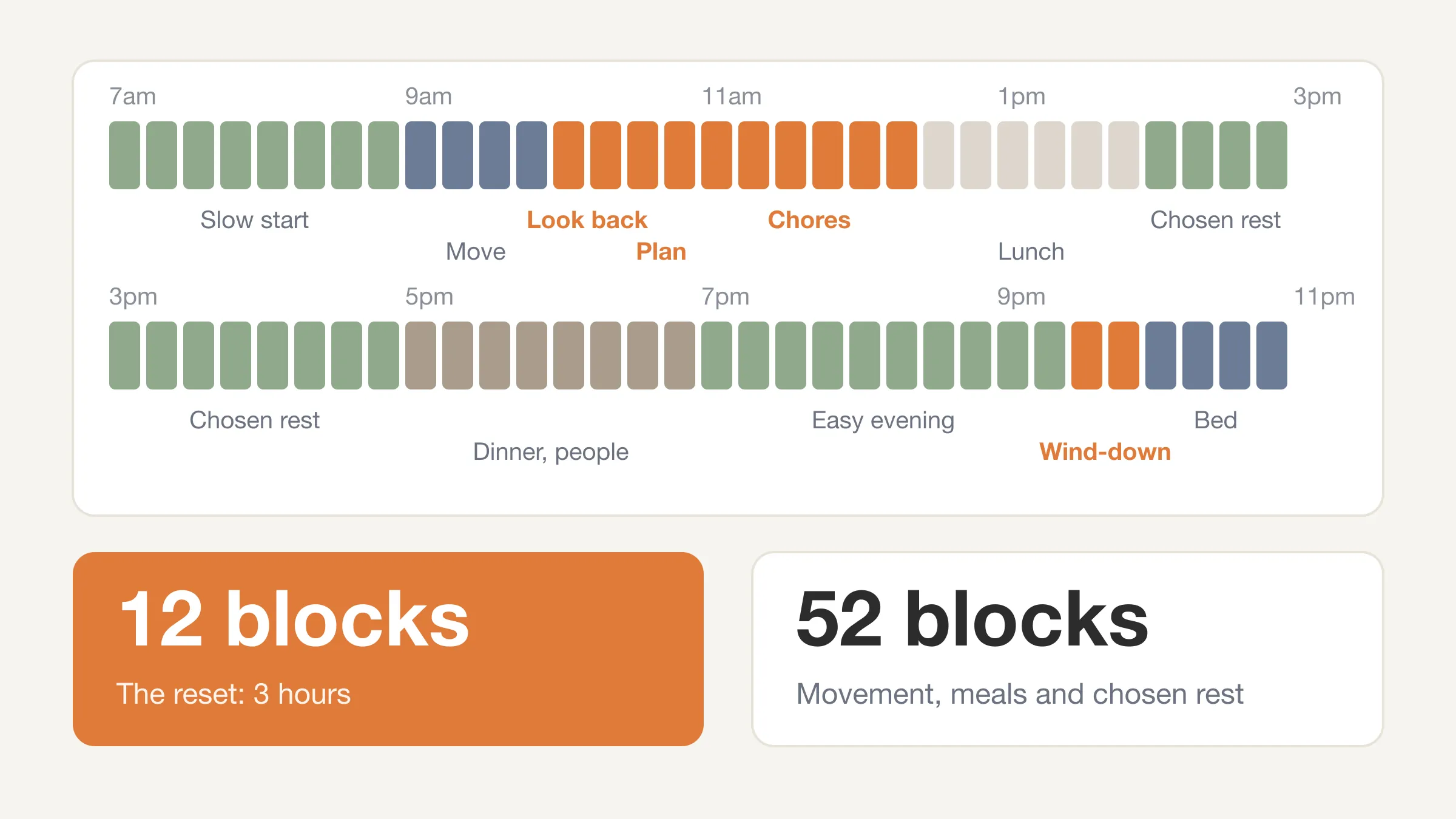
Notice what the sample does not include: no email, no deep work, no big household project. If you want any of these, you can add them, but know what you are trading for them. Every block has to come from somewhere.
How do you make the Sunday evening wind-down work?
The evening is where Sunday routines often fall apart. The week is about to restart, and a vague sense of dread can creep in. Two things help.
Close the loops. Take five minutes to write down anything on your mind that you are afraid you will forget. Put it in the plan or on a list. Once it is somewhere outside your head, it stops circling.
Make Monday's first block easy. Choose one small, clear first task for Monday morning and write it down. When the first block is already decided, the start of the week feels lighter.
If you are practicing a daily end-of-day habit already, for example rating your day or noting what worked, Sunday is a good day to look at the week of ratings together. In Beyond Time, End your day asks you to rate how health, life and work felt from 1 to 10, and the week view shows the trend across days. A week of those numbers tells you more about how the week felt than any single day.
What if you do not have a free Sunday?
Many people work on Sundays, care for family or have shifts that make Sunday a normal day. The routine still works, because it is not about the day of the week. It is about the three jobs: look back, set up, rest.
Move the routine to the day you do have. A Wednesday-night reset works exactly as well as a Sunday one if Wednesday is when your week turns over. If you have no full day, shrink it: a 20-minute version with the look-back, the three outcomes and one rest block is far better than nothing.
If time is tight, protect the look-back first. It is the one part that makes the rest better.
See where your week went
Two minutes in the morning and two at night. By Sunday, the whole week is in front of you, split by Health, Life, Work and Sleep.
Try Beyond Time freeHow does a Sunday routine fit with the rest of the week?
A Sunday reset is one end of a loop. The other end is the daily rhythm that gives it something to look at.
- Morning: two minutes to choose today's priorities.
- During the day: nothing special, just live it.
- Evening: two minutes to fill in what happened.
- Sunday: fifteen to thirty minutes to see the pattern and plan.
If you plan in hourly blocks, the Sunday routine is where you sketch the week's shape. If you use time blocking, it is where you place the blocks. Either way, the loop works because it is small enough to keep doing.
Frequently Asked Questions
What should be in a good Sunday routine?
A good Sunday routine includes a slow start, some movement, a look-back at the week, a short plan for the next one, a few useful chores, and chosen rest. Keep the planning to about three hours total, and leave the rest of the day open.
How long should a Sunday reset take?
A Sunday reset should take about two to three hours across the day, not all at once. The look-back takes 15 to 30 minutes, planning takes 20 to 30, and chores are capped at around 90. The remaining waking hours are for rest.
Should I plan my week on Sunday or Monday?
Either works. Sunday gives you a head start and lets you enter Monday with a plan. Monday morning planning suits people who find Sunday evening stressful. Pick the one you will repeat, and do the look-back before the planning in both cases.
How do I stop Sunday dread?
Close open loops by writing down what is on your mind, plan one easy first task for Monday, and keep the evening restful. If dread is severe, persistent or affects your sleep or daily life, talk to a doctor or a mental health professional. A planner cannot replace that.
What if I work on Sundays?
Move the routine to the day your week turns over. The three jobs are look back, set up and rest, and none depends on the calendar day. A 20-minute version is better than skipping it.
Is it okay to do nothing on Sunday?
Yes. Rest is part of the routine, and it works best when you choose it on purpose. If the whole day is rest, spend ten minutes at some point to look back and set up Monday's first block.
How many hours are there in a Sunday to plan?
A Sunday has 24 hours, of which about 16 are waking. That is 64 blocks of 15 minutes. A reset that uses 12 of those blocks leaves 52 for everything else.
A Sunday routine, in short
A Sunday routine is a small handover between weeks: look back first, set up next week second, rest on purpose in between. It needs about three of the day's 16 waking hours, and the other 13 are yours.
Your time is limited, and a week is made of Sundays you can plan or let drift. Start with the look-back, because it tells you where the last week went. If you want help seeing it, Beyond Time logs the day in 15-minute blocks and shows your week by category, so Sunday starts with the answer.
Put this into practice
Free tools that match this article.
Weekly Schedule Template
Plan your week with a free printable weekly schedule template for goals, routines, and focus blocks.
Try Schedule TemplateRoutine BuildingNight Routine Planner
Create a realistic night routine checklist for better sleep and a smoother tomorrow.
Try Night RoutineTime ManagementTime Blocking Template
Map your day into focused time blocks with a free printable time blocking template.
Try Time BlockingRoutine BuildingMorning Routine Generator
Design your ideal morning routine with AI-powered suggestions based on proven practices.
Try Morning RoutineKeep exploring this topic
Time blocking guide
Turn priorities into protected calendar blocks.
Morning routine template
Build a practical morning routine around energy and focus.
15-minute time blocks
Plan and review your day with more realistic precision.
Evening routine ideas
Wind down in a way that supports sleep and tomorrow’s goals.
Related Articles

How Many Minutes in a Week? 10,080, and Where They Go
How many minutes in a week? 10,080, or 6,720 waking minutes at 8 hours of sleep. See the minutes in each activity for an average week and how many are left.

Daily Goals: How to Set 1-3 That Get Done (With Examples)
Daily goals work when you set one to three and size them in 15-minute blocks. See examples, how to link them to weekly goals, and a two-minute check at night.

Bucket List Ideas: 100 Ideas Grouped by Theme and Lead Time
100 bucket list ideas grouped by theme and tagged by lead time: now, this year, or years ahead. Count the weeks you have, then pick ten. Start your list today.

How to Stop Doomscrolling: 9 Practical Fixes That Work
How to stop doomscrolling: add friction, swap in better habits and check your Screen Time against a real log of your day. Nine fixes, with sources. Try one.

Life Plan Template: A One-Page Plan With Weekly Costs
A free life plan template you can copy: eight areas of life, one outcome each, and a weekly time cost so your plan fits the 112 waking hours you really have.

How Many Work Weeks in a Year? 52 Minus Your Time Off
How many work weeks in a year? 52 on paper, usually 46 to 50 after holidays and leave. See the table by days off, 2026's count and the weeks left this year.