How to Plan Your Day in 5 Minutes (Then Check It at Night)
How to plan your day in five minutes: choose 1 to 3 goals, block the fixed things, leave slack, then check the plan at night. Includes a worked example.
To plan your day, spend five minutes doing five things: choose one to three goals, block the fixed things, place your goals in your best open slots, leave a third of the day empty, and decide what the day's floor is. Then, at night, take two minutes to check what happened. That is the whole method. It fits on an index card.
The check is the part most people skip, and it is what makes tomorrow's plan better. A plan is a guess about how the day will go. Without a look back, you keep making the same guess. A waking day holds about 64 fifteen-minute blocks, and this guide shows how to spend the first five minutes deciding what they are for.
Key takeaways
- Plan in five minutes, either the night before or at the start of the morning.
- Pick one to three goals. Three is the limit, one is fine.
- Block fixed things first, then goals, then the basics. Fill only about two-thirds of your day.
- Check the plan at night. The gap between plan and day is the most useful thing you will learn.
Why does planning your day help?
A day without a plan is decided by whatever asks for attention first: messages, a colleague, the feed. A plan lets you decide in advance, when you are calm, what matters. It does three things.
- It turns a vague intention into a slot. "Work on the report" is easy to postpone. "Report, 9:15 to 10:30" is a thing you either did or did not do.
- It shows you the limit. Writing the day down makes it obvious that 14 hours of tasks will not fit once meals, the commute and breaks come out of your 16 waking hours.
- It lowers the number of decisions you make mid-day. Once the plan exists, the question is "what is next?", not "what should I do?"
Planning also has a cost, and it is worth being honest about it. A plan that takes 30 minutes to make is a plan you will stop making. That is why this method is built to take five.
How do you plan your day step by step?
Here are the five steps. Do them on paper, in a notes app, in your calendar or in a planner. The medium matters less than the habit.
Step 1: Look at the day (1 minute)
Open your calendar and ask what is fixed. Meetings, appointments, school or work start, the commute, a standing call, pickups. Note how much of the day is already spoken for.
Count it in blocks if you like. A day with a 9 to 5 job has 32 blocks of work in the middle of its 64 waking blocks, before lunch and the commute. That is a number worth seeing.
Step 2: Choose one to three goals (1 minute)
Ask what would make today a good day. Write it as the thing you will do, not as a feeling. "Finish the first draft of the proposal," not "be productive."
- One goal is enough, and a good choice on a heavy day.
- Three goals is the maximum. A fourth is a wish.
- Include at least one thing that is not work if you can: a walk, a call with a friend, an hour for a hobby.
If you are choosing between many, our guide to how to prioritize when everything feels important helps. The Eisenhower matrix is another quick filter.
Step 3: Block the fixed things, then place your goals (1 minute)
Draw the day as a list of time slots. Put the fixed things in first. Then put each goal in the best open slot you have.
The best slot is usually where you have the most energy and the fewest interruptions. For many people that is the morning, but not for everyone. If you do not know yours, guess now and check at night.
Add the basics next: meals, movement, a break, a wind-down. These are the first things a busy plan forgets, and a plan that ignores lunch fails around 1 pm.
Step 4: Leave slack (1 minute)
Aim to fill about two-thirds of your waking blocks. Leave the rest open. An empty block is not wasted. It is where overruns, interruptions and the unplanned-but-necessary things live.
Why leave so much? People tend to estimate by imagining a task going smoothly. Psychologists Daniel Kahneman and Amos Tversky described this pattern in 1979, and it is now known as the planning fallacy: we underestimate how long a task will take, even when similar tasks have run over before. Slack is the cheapest fix. If your day is full of meetings, leave even more.
Step 5: Set the floor (1 minute)
Ask which one thing you would still be glad to have done if the day fell apart. Mark it. That is your floor. On a good day you do more. On a bad day you do that one thing and let the rest go. Our guide to the minimum viable day goes deeper on this.
Plan the day, then see what happened
Beyond Time's Start your day picks your goals for today. Log time shows the day in 15-minute blocks, so the gap between plan and day is easy to see.
Try Beyond Time freeWhat does a five-minute plan look like?
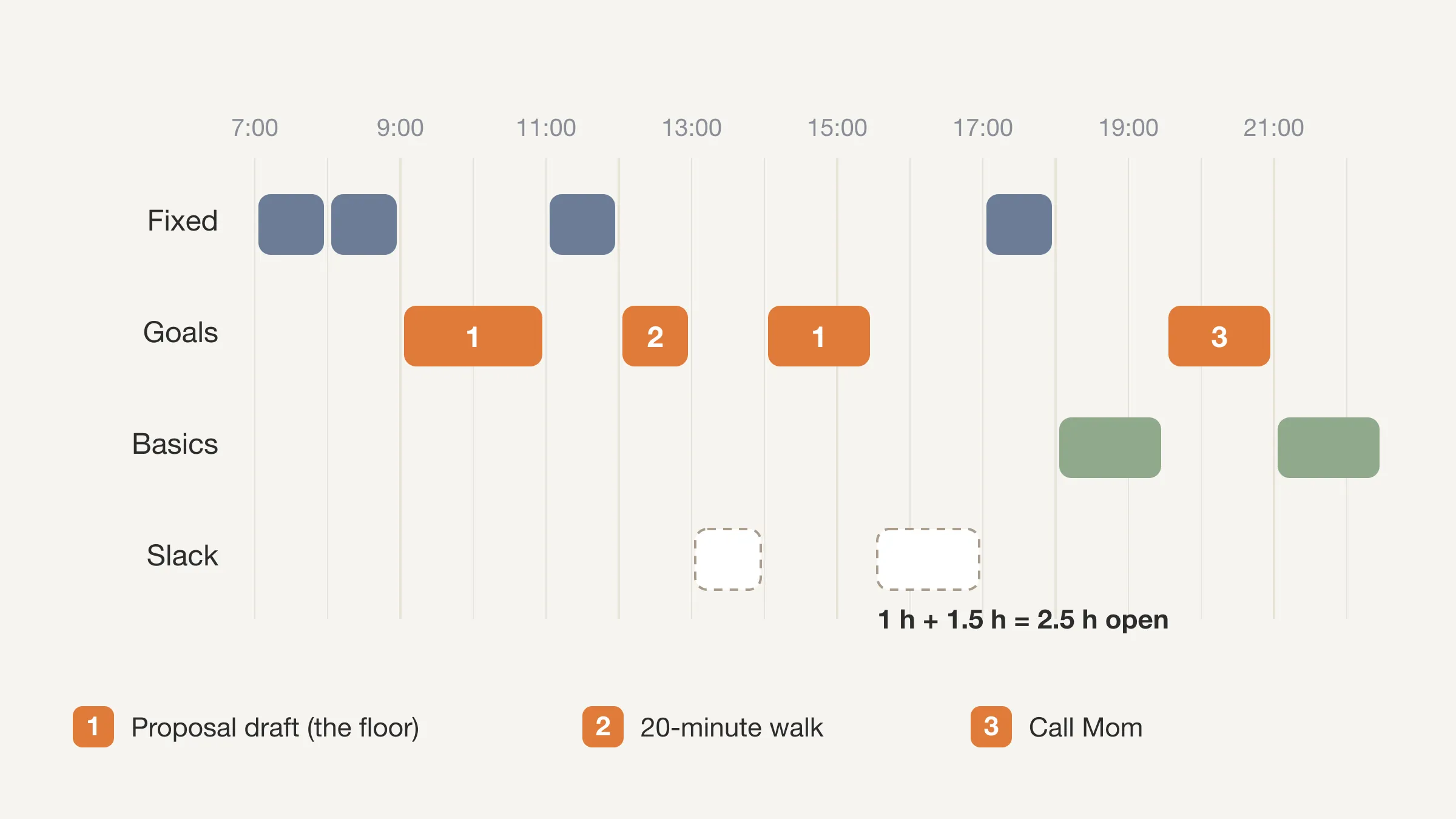
Here is an illustrative example for a weekday, not real data. The person works from 9 to 5, has a team meeting at 11 and wants to finish a proposal and go for a walk.
Goals for today
- Finish the proposal draft.
- 20-minute walk.
- Call Mom in the evening.
Floor: the proposal draft.
| Time | Plan | Type |
|---|---|---|
| 7:00 | Wake, water, breakfast | Fixed |
| 8:00 | Commute | Fixed |
| 9:00 | Messages (30 min), then proposal | Goal 1 |
| 11:00 | Team meeting | Fixed |
| 12:00 | Lunch and a 20-minute walk | Goal 2 |
| 1:00 | Open: slack | Slack |
| 2:00 | Proposal, second pass | Goal 1 |
| 3:30 | Open: slack | Slack |
| 5:00 | Commute | Fixed |
| 6:00 | Dinner | Basics |
| 7:30 | Call Mom | Goal 3 |
| 9:00 | Wind-down, sleep by 10:30 | Basics |
Count what is open. The two slack gaps add up to 2.5 hours, or 10 blocks, and the edges around lunch and the evening are loose too. The plan does not try to use every hour. Notice that the main goal appears twice: once in the morning, once in the afternoon. That is a hedge. If the morning goes wrong, the afternoon can still carry the floor.
How do you plan your day when it is already full?
Some days are mostly meetings. The method still works, but the steps shift.
- Plan the gaps, not the day. Find the 15 and 30-minute openings between commitments and decide what goes in each.
- Choose one goal and make it small. Draft the first paragraph, not the whole document.
- Defend one block. Even on a packed day, one 30-minute block with no meetings is enough to move a goal forward.
- Cut the basics last. If lunch goes, the rest of the plan suffers.
If you are consistently overbooked, the plan is not the problem. The week is. Our free weekly schedule template lays out the whole week so you can see where it is overbooked.
Should you plan the night before or in the morning?
Either works. Choose one and keep it. Each has trade-offs.
| When | Why it works | Watch out for |
|---|---|---|
| The night before | You are less rushed, and tomorrow starts with a decision already made | You may be tired when you plan |
| First five minutes of the morning | You know how you slept and what changed overnight | It can become rushed, or skipped |
Many people find the evening version saner, because the morning is already full. A plan made at 9 pm for the next day is usually more realistic than one made at 9 am in a hurry. If you plan in the morning, make it part of your morning routine and do it before you open email.
How do you check your plan at night?
This takes two minutes and is what turns a plan into learning. Ask three questions.
- Did I do my floor? Yes or no.
- Where did the biggest gap happen? One slot, one reason.
- What is one change for tomorrow? A single adjustment.
For example: "The proposal started at 9:40 because I opened messages. Tomorrow I start the proposal first and open messages at 10:30." That one line is worth more than a better planner. If you also track longer goals, a five-minute daily OKR review ties each day back to them.
Why logging helps more than remembering
By evening, your memory of the day is a rough summary. You remember the meeting, you forget the 25 minutes you lost between tasks. If you log the day in 15-minute blocks, you can see them. Our guide to the 15-minute time block method explains why that block size works, and planned vs actual: the most powerful metric nobody tracks explains why the gap matters.
If you want a simple log to start with, use our daily time log template. In Beyond Time, Log time shows your day as 96 fifteen-minute blocks. You pick a block, pick what you were doing, and the blocks you have not filled in show up as "Not logged". End your day takes about a minute: rate how health, life and work felt from 1 to 10 and add a line if you want. The AI reflection then reads the logged day and tells you what went where you meant it to, where time leaked and one or two changes for tomorrow.
What are the common mistakes when planning a day?
Most failed plans fail in the same few ways.
- Planning every block. A day with no slack breaks at the first overrun, and then every later item slides.
- Writing a to-do list instead of a plan. A list says what. A plan says when, and what you will do if the day goes wrong.
- Too many goals. Five goals usually means none get a protected slot.
- Ignoring energy. Putting the hardest task at 3 pm because that is where the space was, when you are slowest at 3 pm.
- Never looking back. Without the night check, you repeat the same plan and the same surprises.
Each one has a small fix. Leave a third of the day open, give each goal a time, cap goals at three, notice when you are sharpest, and spend two minutes at night on the gap.
What tools can help you plan your day?
The best tool is the one you will open. A few options:
- Paper or an index card. Fast, with no notifications. Good for the five-minute plan.
- An hourly planner. If you like hour-by-hour structure, our hourly planner guide has a copyable template with a Plan and an Actual column.
- A time-blocking template. For flexible block sizes, try our free time blocking template. It assigns tasks to blocks of any length.
- Your calendar. Put goals in as events. They are easier to defend when they sit next to meetings.
- An app. Beyond Time combines the day's goals, the 15-minute log and the AI reflection in one place.
Whichever you choose, keep it light. If planning takes longer than ten minutes, trim it.
Two minutes in the morning, two at night
Start your day, log it in 15-minute blocks, and let the AI reflection show where the plan and the day parted ways. Free for two weeks.
Try Beyond Time freeFrequently Asked Questions
How do I plan my day effectively?
Spend five minutes choosing one to three goals, blocking fixed commitments, placing goals in your best open slots, leaving about a third of the day empty and naming a floor. Then check the plan at night. The check is what improves tomorrow's plan.
How long should it take to plan your day?
Five minutes is enough for most days. Any longer and planning tends to become its own task that you stop doing. If you spend more than ten minutes, cut the plan down to the goals and the fixed commitments.
How many tasks should I plan for one day?
Plan one to three goals, plus the fixed commitments and basics. More than three goals is a wish list, and a plan that is too full fails by mid-afternoon. Leave about a third of your waking blocks empty for overruns and surprises.
Should I plan my day the night before?
It often works better, because you are less rushed and the next morning starts with a decision already made. The morning is fine too, as long as you plan before opening email. Pick one time and keep it for two weeks.
What is the best way to plan a busy day?
Plan the gaps between commitments, choose one small goal, and defend one 30-minute block with no meetings. Cut the basics last, because skipping meals and breaks usually costs more time later. If every day is busy, review your week.
How do I stick to my daily plan?
Keep the plan short, leave slack, and place your top goal in your best slot. Expect to drift, and treat it as information. A nightly check of the biggest gap shows which part of the plan to change, which is more useful than trying harder.
What should I do if my plan falls apart?
Go to your floor. Do the one thing you marked as the one you would still be glad to have done, and let the rest go. A plan that falls apart is not a failure. It tells you what to plan differently tomorrow.
The short version
To plan your day, take five minutes: look at what is fixed, choose one to three goals, place them in your best slots, leave a third of the day open and name your floor. Then check what happened. Your day has about 64 blocks, and the plan is only a guess until you compare it with the real thing.
Start tonight. Write tomorrow's goals on a card, plan the day in five minutes and look back at the end. To see where the blocks really go, try Beyond Time free.
Put this into practice
Free tools that match this article.
Goal Setting Worksheet
Turn a vague goal into milestones, habits, blockers, and a weekly review plan.
Try Goal WorksheetTime ManagementWeekly Schedule Template
Plan your week with a free printable weekly schedule template for goals, routines, and focus blocks.
Try Schedule TemplateRoutine BuildingNight Routine Planner
Create a realistic night routine checklist for better sleep and a smoother tomorrow.
Try Night RoutineTime ManagementTime Blocking Template
Map your day into focused time blocks with a free printable time blocking template.
Try Time BlockingKeep exploring this topic
Goal setting guide
Start with the fundamentals of setting goals that turn into action.
Time blocking guide
Turn priorities into protected calendar blocks.
Morning routine template
Build a practical morning routine around energy and focus.
Goal frameworks compared
Choose between SMART goals, OKRs, BHAGs, and 12-week goals.
Related Articles

Daily Goals: How to Set 1-3 That Get Done (With Examples)
Daily goals work when you set one to three and size them in 15-minute blocks. See examples, how to link them to weekly goals, and a two-minute check at night.

Daily Planner Template: Free One-Page and 15-Minute Versions
A free daily planner template to copy: a one-page version and a 15-minute schedule grid, with a plan-vs-actual column so you can see where your day really went.

Hourly Planner: How to Use One + Free Template to Copy
An hourly planner turns your day into 16 slots. Copy the free hour-by-hour template, learn how to fill it, and why logging the real day beside it makes it work.

The 15-Minute Time Block Method: Why Precision Beats Estimation
Stop guessing where your time goes. The 15-minute block method reveals exactly how you spend each day and helps you plan with surgical accuracy.

How Many Minutes in a Week? 10,080, and Where They Go
How many minutes in a week? 10,080, or 6,720 waking minutes at 8 hours of sleep. See the minutes in each activity for an average week and how many are left.

Bucket List Ideas: 100 Ideas Grouped by Theme and Lead Time
100 bucket list ideas grouped by theme and tagged by lead time: now, this year, or years ahead. Count the weeks you have, then pick ten. Start your list today.