Morning Routine Checklist: 10, 30 and 60-Minute Versions
A morning routine checklist you can copy in three sizes: 10, 30 or 60 minutes. Pick one, run it for a week, and log your first hour to see if it really happens.
A good morning routine checklist is short enough to finish and specific enough to tick off. Below you will find three copyable versions, one for 10 minutes, one for 30 and one for 60, so you can pick the size your mornings can actually hold. You will also find a simple way to check, after a week, whether the routine happens or only exists on paper.
That second part matters more than the list. Most morning routines fail quietly. The plan says 45 minutes of calm, and the real morning is 12 minutes of scrolling and a rush out the door. Your day has about 64 fifteen-minute blocks between waking and bed, and the first few are the ones you control most. Looking at them for a week tells you more than any list will.
Key takeaways
- Choose one size: 10, 30 or 60 minutes. A 60-minute routine is 4 of your roughly 64 waking blocks, about 6 percent of the day.
- Keep the list to 5 to 8 items. Every item beyond that is another way to fail.
- Write the minimum version (3 items) for rough mornings, so a bad start does not cancel the whole routine.
- After a week, log your first hour in 15-minute blocks and count how many mornings matched the list.
What should a morning routine checklist include?
A routine only needs to answer one question: what do I want to be true by the time I leave the house or sit down to work? Most good checklists cover five things, in roughly this order.
- Wake up on purpose. A fixed wake time, an alarm across the room or a plain "feet on the floor" rule.
- Light and water. Open the curtains, drink a glass of water. Small, easy, and a reliable first win.
- Move your body. Anything from two minutes of stretching to a full workout.
- Look at the day. Check the calendar and choose the one to three things that matter today.
- Delay the feed. Keep email and social media out of the first stretch of the morning, or set a time for them.
Those five are a skeleton. Every size below is that skeleton with more or less on it. For the reasoning behind each piece, see our science-backed morning routine template and our review of what research says about starting your day.
One useful anchor comes from public health guidance. The U.S. Centers for Disease Control and Prevention advises going to bed and waking up at the same time every day, and says adults aged 18 to 60 need seven or more hours of sleep (CDC, About Sleep). A checklist can only start on time if the night before did its part. If you regularly have trouble sleeping, talk to a healthcare provider. A checklist will not fix that.
How long should a morning routine be?
As long as your real mornings allow, and not a minute longer. The mistake is to copy a 90-minute routine from someone who has a different job, house and sleep schedule. Look at what the morning costs in blocks instead.
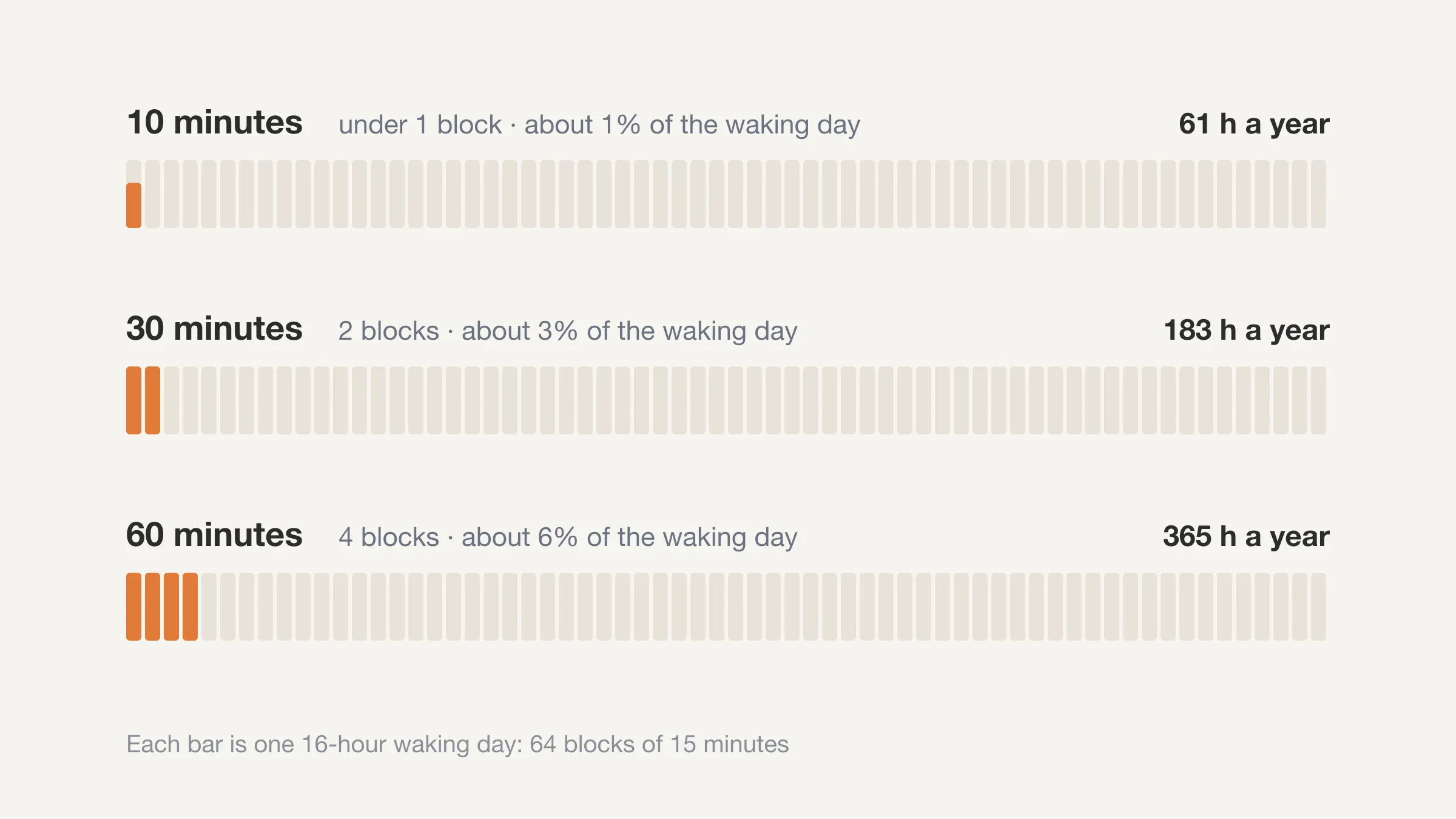
| Routine size | Minutes | Blocks (15 min) | Share of a 16-hour waking day | Hours a year, every day |
|---|---|---|---|---|
| Short | 10 | under 1 | about 1% | 61 |
| Medium | 30 | 2 | about 3% | 183 |
| Full | 60 | 4 | about 6% | 365 |
A 60-minute morning, kept every day, adds up to 365 hours a year, which is just over 15 full days. That is a fine use of time if the routine is doing its job. It is a poor use if half of it is spent looking for a sock and half is spent in your phone. The table is not an argument for a shorter routine. It is a reminder that the minutes are a budget, and a budget should be spent on purpose.
See where your morning goes
Log the first hour in 15-minute blocks. Two minutes in the morning, two at night. Beyond Time shows the gap between the routine you planned and the one you had.
Try Beyond Time freeThe 10-minute morning routine checklist
This is the version for school mornings, early shifts, babies, and any day you would otherwise skip the routine entirely. It is deliberately small. If you only ever do this one, you will still have started the day on purpose.
MORNING ROUTINE: 10 MINUTES
Date: ____________

[ ] Alarm goes off, feet on the floor (no snooze)
[ ] Glass of water
[ ] Open the curtains or step outside for a minute
[ ] 2 minutes of stretching or a short walk
[ ] Write today's ONE thing: ______________________
[ ] Phone stays on the charger until the list is done

Done by: ______ (time)
Notes on the 10-minute version:
- The one thing is a single sentence. Not a list. If you can only get one important thing done today, what is it?
- The phone rule is the item that tends to give the most back. Ten minutes without the feed is ten minutes that stay yours.
- You can do this entire routine in about one block.
The 30-minute morning routine checklist
The 30-minute version adds food, a proper bit of movement and a look at the day. It fits most working mornings and covers all five parts of the skeleton.
MORNING ROUTINE: 30 MINUTES
Date: ____________

WAKE
[ ] Alarm, feet on the floor, no snooze
[ ] Water, then the bathroom and teeth

BODY
[ ] 10 minutes of movement (walk, stretch, bodyweight, yoga)
[ ] Shower and get dressed for the day

FUEL
[ ] Breakfast or a drink, sitting down, no screen

DAY
[ ] Look at the calendar: what is fixed today?
[ ] Choose 1 to 3 goals for today:
    1. ______________________
    2. ______________________
    3. ______________________
[ ] Phone stays away from email and social until this is done

Minimum version if the morning goes wrong (do these 3):
[ ] Water  [ ] Choose today's one goal  [ ] 2 minutes of movement

Done by: ______ (time)
Notes on the 30-minute version:
- Breakfast without a screen is the item most people skip. It also tends to be the easiest place to find five calm minutes.
- Choose goals after you look at the calendar, not before. A goal that ignores a 2 pm meeting is a wish.
- The minimum version is part of the checklist on purpose. A routine with no fallback turns one bad morning into a broken streak.
If you want a routine built around your own wake time, goals and energy, try our free morning routine generator. It produces a schedule you can paste into this checklist.
The 60-minute morning routine checklist
The 60-minute version is for people who have the time and want the morning to be more than getting ready. It adds a longer workout, a short block of learning or reflection and a few minutes to set up the day. It is 4 blocks of your day, so make sure each one earns its place.
MORNING ROUTINE: 60 MINUTES
Date: ____________

WAKE (5 min)
[ ] Alarm, feet on the floor, no snooze
[ ] Water and open the curtains

BODY (25 min)
[ ] 15 to 20 minutes of exercise (run, lift, class, yoga)
[ ] Shower and get dressed

FUEL (10 min)
[ ] Breakfast, sitting down, no screen

MIND (10 min)
[ ] 5 minutes of reading, learning or quiet
[ ] 5 minutes of writing: how I feel, what is on my mind

PLAN (10 min)
[ ] Look at the calendar and note what is fixed
[ ] Choose 1 to 3 goals for today:
    1. ______________________
    2. ______________________
    3. ______________________
[ ] Put the most important goal in the best open slot
[ ] Phone stays away from email and social until this is done

Minimum version if the morning goes wrong (do these 3):
[ ] Water  [ ] Choose today's one goal  [ ] 2 minutes of movement

Done by: ______ (time)
Notes on the 60-minute version:
- The times in brackets add up to the full 60 minutes, so there is no slack in the list. On a slow morning, cut the exercise first and keep the plan step.
- If you cannot hold it for four mornings in a row, drop to the 30-minute version. That is not failure. It is data about what your mornings hold.
- Do not stack more than 8 groups. A routine you dread is a routine you will skip.
How do you build a morning routine that sticks?
Start from the end of the checklist and work backward. A morning routine is mostly a night-before routine in disguise.
Fix the wake time first
Pick a wake time you can keep on weekdays and, within an hour or so, on weekends. Consistency matters more than earliness. If you are thinking about waking much earlier, move bedtime first. Moving the wake time without moving bedtime is the most common way these plans fail.
Prepare the night before
Lay out clothes, fill a water glass, put the phone on a charger outside arm's reach, and write tomorrow's one thing on a note. Each of those removes a decision from the morning. Our guide to an evening routine for better sleep and productivity covers the other half.
Attach new items to old ones
A new habit is easier to keep when it follows something you already do. "After I pour my coffee, I write today's one thing." This idea, known as habit stacking, is covered in habit stacking: the simple technique to build new habits.
Start smaller than you think
If the 30-minute version feels heavy, do the 10-minute one for two weeks first. A short routine that happens every day is worth more than a long one that happens on Tuesdays.
How can you tell if your morning routine is actually happening?
You can find out in a week, and the method costs about two minutes a day. Log the first hour of your morning in 15-minute blocks, then compare it to the checklist.
Step 1: log the first four blocks
When you wake, note the time. Over the next hour, record what each 15-minute block held. Do it as you go, or in a quick review at the end of the morning. Use plain labels: "snooze," "bathroom," "workout," "phone," "breakfast," "calendar."
Here is an illustrative example of one morning, not real data.
| Block | Time | What happened | Counts toward the routine? |
|---|---|---|---|
| 1 | 6:30 | Snooze, then water | Half |
| 2 | 6:45 | Phone: news and messages | No |
| 3 | 7:00 | Shower, dressed | Yes |
| 4 | 7:15 | Breakfast, rushed, phone | Half |
On paper this was a 30-minute routine. In practice, one block went to the phone before anything else, and the movement and planning items never happened.
Step 2: score the week
At the end of the day, mark the morning with one of three results:
- Full: you did most of the list, in roughly the order you intended.
- Minimum: you did the three-item fallback.
- Missed: the morning went somewhere else.
After seven days you will have a simple count, such as 3 full, 2 minimum and 2 missed. That is a better picture than a feeling.
Step 3: find the leak
Look at the blocks that did not count. Most of the time one thing repeats: the snooze, the phone, a search for keys, a slow start. That is the item to fix, not the whole routine. Fix one leak, then log another week.
You can do this on paper or in a spreadsheet, and our 15-minute time block method explains why this block size works. In Beyond Time, the Start your day screen records when you woke and how you slept. Log time then lets you tap through the first blocks of the day, and the "Not logged" blocks show the gaps.
What should you do when the routine breaks?
It will break. Travel, illness, a late night or a child who did not sleep will all take a morning. Plan for it.
- Fall back to the minimum version. Three items, under five minutes. It keeps the habit alive.
- Never skip the day-start decision. Even on a chaotic morning, choose the one thing that matters.
- Do not catch up. Missing a morning does not create a debt. Start the next day fresh.
- Review after a bad week. If you missed four mornings out of seven, the list is probably too long for the season you are in. Cut it down.
A routine is a tool for the life you have now. When your life changes, the checklist can change with it.
Check your first hour, not just your plan
Beyond Time shows your day as 15-minute blocks, with the gaps marked. Try it free for two weeks, everything included.
Try Beyond Time freeFrequently Asked Questions
What is a good morning routine checklist?
A good morning routine checklist has 5 to 8 items covering waking, light and water, movement, a look at the day and a delay before screens. It also has a three-item minimum version for rough mornings. Pick the 10, 30 or 60-minute version above and cut anything you do not use.
How long should a morning routine take?
A morning routine should take as long as your real mornings can hold, usually 10 to 60 minutes. A 30-minute routine is two of your roughly 64 waking blocks, and a 60-minute routine is four. If you keep missing it, shorten it rather than trying harder.
What are the best things to put in a morning routine?
The best items are the ones you will do on a bad day: water, light, a few minutes of movement and choosing your one goal for the day. Add food, a longer workout, reading or journaling as time allows. Start with fewer items and build up.
Should I check my phone first thing in the morning?
It helps to wait. Keeping email and social media out of the first part of the morning protects a few blocks for yourself. The CDC also suggests turning off electronic devices at least 30 minutes before bed, so a phone charging out of reach overnight supports both ends of the day.
How do I know if my morning routine is working?
Log your first hour in 15-minute blocks for a week and count the mornings that matched your checklist. If you did most of the list on five or more mornings, it works. If not, find the one block that keeps leaking and fix that first.
How can I stick to a morning routine?
Keep it small, fix your wake time, prepare the night before and attach each new item to something you already do. Have a minimum version for bad days, and never make up a missed morning. A short routine kept for months beats a long one kept for a week.
Is a morning routine necessary?
No. A morning routine is a tool, not a rule, and some people do well without one. It helps most people who feel their mornings are rushed or who want to start the day with one deliberate choice. If a routine makes you anxious, drop it.
The short version
A morning routine checklist works when it is small, specific and checked. Copy the 10, 30 or 60-minute version, add a three-item minimum for rough days, and run it for a week. Your day has about 64 waking blocks, and you have just decided how to spend the first few of them.
Then see where they went. Log the first hour for seven mornings and count the ones that matched. If you want to build a routine from your own wake time and goals, the free morning routine generator will draft one. To see your whole day, not just your mornings, try Beyond Time free.
Put this into practice
Free tools that match this article.
Night Routine Planner
Create a realistic night routine checklist for better sleep and a smoother tomorrow.
Try Night RoutineRoutine BuildingMorning Routine Generator
Design your ideal morning routine with AI-powered suggestions based on proven practices.
Try Morning RoutineHabit BuildingHabit Tracker Template
Create a free printable habit tracker template — weekly or monthly. Customize your habits and download a clean PDF in seconds.
Try Habit TrackerGoal SettingGoal Setting Worksheet
Turn a vague goal into milestones, habits, blockers, and a weekly review plan.
Try Goal WorksheetKeep exploring this topic
Morning routine template
Build a practical morning routine around energy and focus.
Evening routine ideas
Wind down in a way that supports sleep and tomorrow’s goals.
Guide articles
Explore more guide articles from the Beyond Time blog.
morning routine checklist
Read more articles tagged morning routine checklist.
Related Articles
How Many Minutes in a Week? 10,080, and Where They Go
How many minutes in a week? 10,080, or 6,720 waking minutes at 8 hours of sleep. See the minutes in each activity for an average week and how many are left.

Bucket List Ideas: 100 Ideas Grouped by Theme and Lead Time
100 bucket list ideas grouped by theme and tagged by lead time: now, this year, or years ahead. Count the weeks you have, then pick ten. Start your list today.
How to Stop Doomscrolling: 9 Practical Fixes That Work
How to stop doomscrolling: add friction, swap in better habits and check your Screen Time against a real log of your day. Nine fixes, with sources. Try one.
Life Plan Template: A One-Page Plan With Weekly Costs
A free life plan template you can copy: eight areas of life, one outcome each, and a weekly time cost so your plan fits the 112 waking hours you really have.
How Many Work Weeks in a Year? 52 Minus Your Time Off
How many work weeks in a year? 52 on paper, usually 46 to 50 after holidays and leave. See the table by days off, 2026's count and the weeks left this year.

Second Brain Method Explained: CODE, PARA and Who It Suits
A second brain is a trusted place outside your head for notes and ideas. See how Tiago Forte's CODE and PARA work, who it suits, and what notes can't tell you.