
Daily Goals: How to Set 1-3 That Get Done (With Examples)
Daily goals work when you set one to three and size them in 15-minute blocks. See examples, how to link them to weekly goals, and a two-minute check at night.
Daily goals are the one to three things you want done by the end of today. Keep the list that short, give each goal a size in 15-minute blocks, and check it at night. A waking day has about 64 blocks, so three goals of a few blocks each fit comfortably, and ten do not.
Here is the context. On 3 November 2026, there are 58 days left in the year. That is 58 days, each with about 16 waking hours. A daily goal is the smallest unit of that time you can still steer. This guide shows how to set daily goals, gives 24 examples, explains how to connect them to weekly goals, and ends with a two-minute check you can do before bed.
Key takeaways
- Set one to three daily goals. One is the must-do, the other two are bonuses.
- Size each goal in 15-minute blocks. A waking day has about 64, and fixed things take most of them.
- A daily goal is an outcome you can check tonight, not a theme.
- Choose daily goals from your weekly goals, so the day moves something that matters.
- Check at night in two minutes: done, partly done or not done, and why.
What are daily goals?
Daily goals are the outcomes you decide on for one day. They are not your whole to-do list. A to-do list holds everything that could happen. Daily goals are the few things that would make today count if nothing else got done.
Compare the two:
| To-do list | Daily goals |
|---|---|
| 15 to 30 items | 1 to 3 items |
| Everything you might do | What you decided matters today |
| Grows during the day | Fixed in the morning |
| Done when you run out of energy | Done when the goals are checked |
The idea is simple, and the numbers explain why. After sleep, work and upkeep, most people have only a few free hours on a weekday. Three goals use that margin. Fifteen items spill over it, and you end the day with a feeling of failure even if you worked hard.
If you want a longer routine for the morning, how to plan your day covers a five-minute method. This guide focuses on the goals themselves.
How many hours does a day have for goals?
A day is 24 hours, or 96 blocks of 15 minutes. Sleep takes about 8 hours, or 32 blocks. That leaves about 16 waking hours, or 64 blocks. For the weekly version of the math, see how many hours are in a week.
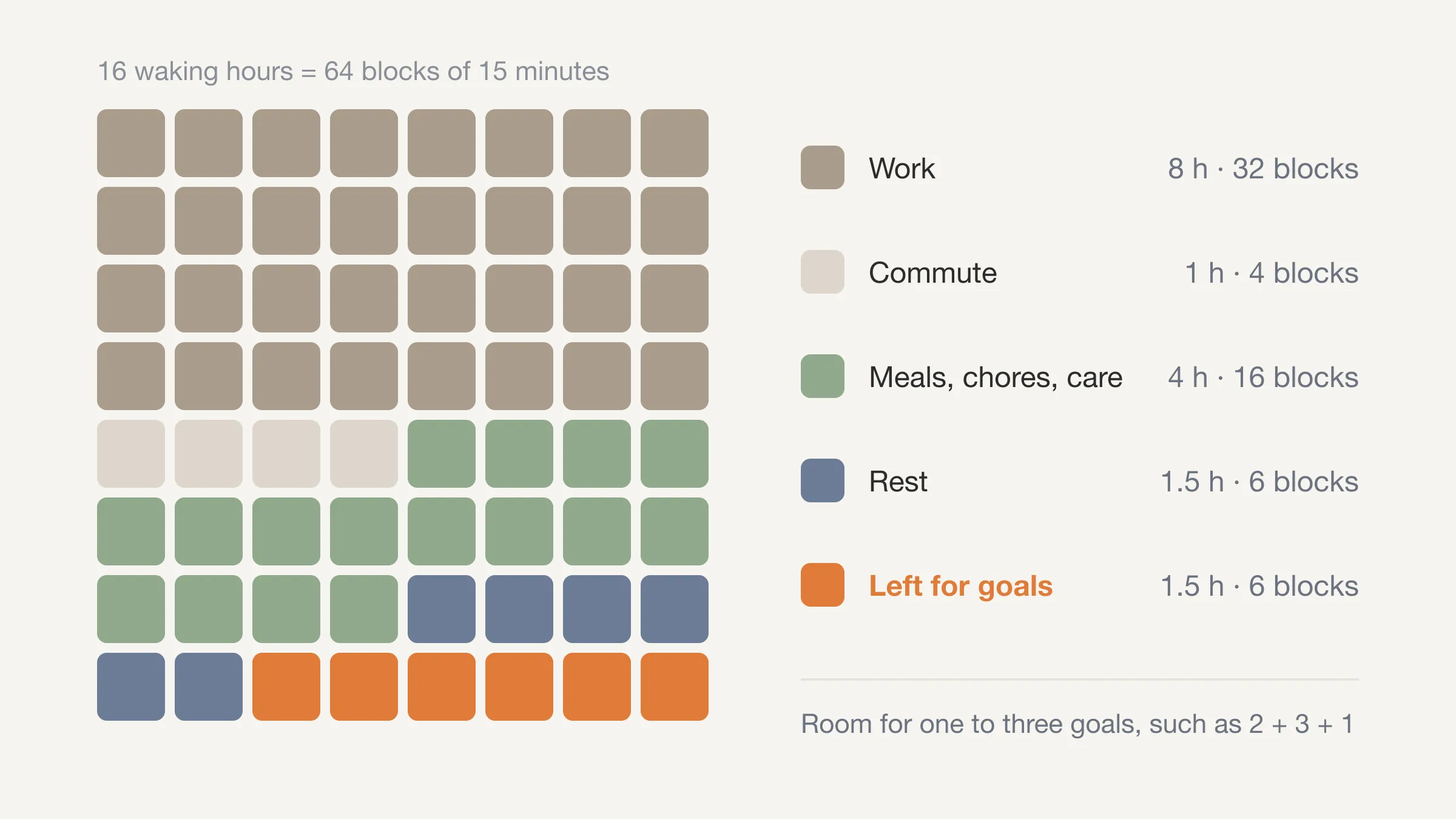
Here is an example weekday for someone with a full-time job. Your numbers will differ.
| Where the waking hours go | Hours | Blocks |
|---|---|---|
| Work | 8 | 32 |
| Commute | 1 | 4 |
| Meals, chores, personal care | 4 | 16 |
| Rest and downtime | 1.5 | 6 |
| Left for goals | 1.5 | 6 |
That fills the 16 waking hours and leaves about 6 blocks for goals. Look at it that way and the limit of three goals makes sense. One goal might take 2 blocks, another 3, a third 1. Add a fourth and you are borrowing from sleep or rest.
Weekends are different. With no work, a weekend day may have 8 to 10 free hours, so weekend goals can be larger. Plan them the same way: pick one must-do, add a bonus, and leave the rest open for people and rest.
The best way to see your own numbers is a time log. Three days in 15-minute blocks tell you more than any guess. Our daily time log template shows how to start.
See your real day in blocks
Log your day in 15-minute blocks. Two minutes in the morning, two at night. See how many blocks are truly free.
Try Beyond Time freeHow do you set daily goals?
Use five steps. The whole thing takes about five minutes, in the morning or the night before.
- Look at your fixed blocks. Meetings, school, pickups, appointments. Mark what is already taken.
- Look at your weekly goals. Which one can this day move forward?
- Pick one must-do. It is the one goal that makes today a success.
- Add up to two bonuses. Smaller or lower priority. If the day goes wrong, drop them without guilt.
- Size each in blocks and place it. "Draft section 2 of the report, 3 blocks, 9 to 9:45 am."
Placing the goal is the most important step. A goal with a time is much more likely to happen than a goal that floats. This is the idea behind what psychologists call implementation intentions: deciding when and where you will act. Studies of the idea have found a positive effect, though later work suggests early estimates may have been inflated by publication bias. Planning the time still costs nothing and probably helps.
If you prefer to see the whole day, a layout like our daily planner template or the free time blocking template works well. For a view with more detail than one-hour slots, see the 15-minute time block method.
What do good daily goals look like?
A good daily goal is specific, it has a finish line, and it fits a few blocks. Compare:
| Weak | Strong |
|---|---|
| Work on the report | Write the introduction of the report (3 blocks) |
| Be healthy | Walk for 30 minutes after lunch (2 blocks) |
| Deal with email | Reply to the five oldest emails (2 blocks) |
| Study | Finish 20 flashcards and one practice set (4 blocks) |
| Be nice to family | Call Mom for 15 minutes (1 block) |
To test a goal against the usual criteria, the free SMART goal validator is a quick check.
24 daily goals examples
These are planning estimates in blocks, not fixed rules. Pick one must-do and up to two bonuses from any list. You do not need one from every area. If the same goal shows up every day, it is really a habit, and these habit tracker ideas are sorted by area.
Work and study
| Goal | Blocks |
|---|---|
| Write the first 500 words of a draft | 3 |
| Send the one email you have been avoiding | 1 |
| Finish one section of a presentation | 4 |
| Complete one module of a course | 4 |
| Clear the five oldest tasks on the list | 3 |
| Prepare for tomorrow's most important meeting | 2 |
Health
| Goal | Blocks |
|---|---|
| Walk 30 minutes | 2 |
| Strength workout, 45 minutes | 3 |
| Cook dinner at home | 4 |
| In bed by 11 pm | 0 extra |
| Stretch for 10 minutes | 1 |
| Drink water with each meal and keep a bottle at the desk | 0 extra |
Home
| Goal | Blocks |
|---|---|
| One load of laundry, folded and put away | 2 |
| Clear one surface | 1 |
| Pay one bill or file one paper | 1 |
| Plan tomorrow's meals | 1 |
| Reset the kitchen after dinner | 1 |
| Fix one small thing that has been annoying you | 2 |
Mind and people
| Goal | Blocks |
|---|---|
| Journal for 10 minutes | 1 |
| Read 20 minutes before bed | 1 |
| Call a friend or family member | 2 |
| Spend 30 minutes outside without your phone | 2 |
| Write down three things that went well | 1 |
| Take a 15-minute break with nothing to do | 1 |
Notice that most goals take between 1 and 4 blocks. A daily goal bigger than 4 blocks (an hour) is usually a project in disguise. Split it across days.
How do daily goals connect to weekly goals?
A daily goal gets its meaning from a bigger one, such as one of your personal goals. Otherwise you finish today with a clean checklist and no progress.
The chain looks like this:
| Level | Example |
|---|---|
| Month | Finish the first draft of a 6,000-word guide |
| Week | Write 2,500 words of the draft |
| Day (Monday) | Write 800 words: 3 blocks, 7 to 7:45 am |
| Day (Tuesday) | Write 800 words: 3 blocks, 7 to 7:45 am |
Each level shrinks the one above into something you can schedule. The monthly goal names the result. The weekly goal says what to finish by Friday. The daily goal says what to do today.
You can read more about each layer in monthly goals and weekly goals. The short version: on Sunday you pick three weekly goals. Each morning you pick the day's one to three goals from those three. If a daily goal does not serve a weekly goal, ask whether it belongs.
How do you check your daily goals at night?
The check takes two minutes. It is where the learning happens.
- Mark each goal done, partly done or not done. No excuses yet.
- Look at the day. If the goal was 3 blocks and nothing happened, what took those blocks?
- Write one line. "Meetings ran over." "Phone after lunch." "Did it, and it felt easy."
- Decide about tomorrow. Carry over only what still matters. Shrink anything that keeps slipping.
In Beyond Time, this is the "Start your day" and "End your day" pair. In the morning you score your sleep, note when you woke and pick the one to three goals that matter today. At night you rate how health, life and work felt from 1 to 10 and add a line if you want. The AI reflection reads the logged day and shows what went where you meant it to, where time leaked and one or two changes for tomorrow. A paper notebook with the same three questions works too. For more night-time prompts, our guide to the minimum viable day is useful on days when almost nothing goes to plan.
The point of the check is not a score. It is to find the gap between the day you planned and the day you had. That gap is the most useful data you will have. Our article on the planned-vs-actual gap explains why it appears almost every day and what to do about it.
End the day with facts, not guesses
See where today went, in 15-minute blocks, and carry only what matters into tomorrow.
Try Beyond Time freeWhat if your day falls apart?
Some days lose half their hours before lunch. That is normal. The fix is to decide the minimum day in advance.
Next to your one must-do, write the smallest version of it that still counts. "Write 800 words" becomes "write the outline." "Strength workout" becomes "10 minutes of stretching." If the day collapses, you do the minimum and call it a good day.
Without that decision, a bad morning feels like failure, and the whole list goes. With it, you keep a thread. Over 58 days, a thread of small wins is worth more than a few perfect days followed by stalls.
What mistakes make daily goals fail?
- Too many goals. Seven goals are a to-do list. One to three are a plan.
- No size attached. If you do not know how many blocks a goal needs, you cannot tell whether it fits.
- No time. A goal floating in the day gets crowded out. Give it a start.
- Goals that are not connected. A day of unrelated goals moves nothing.
- Planning every block. A full plan breaks at the first delay. Leave space.
- Skipping the night check. Without it you repeat the same overplanned day.
Many of these trace back to planning without knowing your real blocks. If you keep finishing less than you plan, the execution gap explains why.
Frequently Asked Questions
What are daily goals?
Daily goals are the one to three outcomes you want to finish today. Each has a finish line, a size in 15-minute blocks and a time in the day. They are different from a to-do list, which holds everything you might do.
How many daily goals should I set?
Set one to three. A typical weekday leaves only about 6 free blocks after work and upkeep, which is enough for two or three small goals. Pick one must-do and up to two bonuses.
What is an example of a daily goal?
"Write the introduction of the report, 3 blocks, 9 to 9:45 am" is a daily goal. So is "walk 30 minutes after lunch." Each has a clear finish line and fits a few blocks.
How do I choose daily goals?
Choose them from your weekly goals. Look at the fixed blocks in your day, then pick the one thing that would move a weekly goal forward. Add up to two smaller bonuses if time allows.
What is the difference between daily goals and a to-do list?
A to-do list collects every task you might do. Daily goals are the few you decided matter today. The list can be 20 items long. The goals are three or fewer and are fixed in the morning.
What should I do if I miss my daily goals?
Look at what took the time, write one line about it and decide about tomorrow. Missing a goal is information, not failure. Carry over only what still matters and shrink anything that keeps slipping.
One to three goals, checked tonight
Daily goals work when there are one to three of them, each sized in 15-minute blocks, each placed at a time, and each linked to a weekly goal. Check them in two minutes before bed. With 58 days left in 2026, a short list you finish beats a long one you abandon.
Your time is limited. See where it goes, then choose what today is for.
See where today goes
Log your day in 15-minute blocks and see your week by category. Two weeks free, everything unlocked.
Try Beyond Time freePut this into practice
Free tools that match this article.
Goal Setting Worksheet
Turn a vague goal into milestones, habits, blockers, and a weekly review plan.
Try Goal WorksheetGoal SettingSMART Goal Validator
Instantly validate your goals against the SMART framework and get actionable improvement suggestions.
Try SMART ValidatorGoal SettingAI Milestone Generator
Turn your biggest goals into an actionable step-by-step plan in seconds with AI.
Try Milestone GeneratorGoal SettingOKR Generator
Transform any aspiration into a structured OKR with measurable key results in seconds.
Try OKR GeneratorKeep exploring this topic
Goal setting guide
Start with the fundamentals of setting goals that turn into action.
Goal frameworks compared
Choose between SMART goals, OKRs, BHAGs, and 12-week goals.
Time blocking guide
Turn priorities into protected calendar blocks.
Morning routine template
Build a practical morning routine around energy and focus.
Related Articles

Personal Goals Examples: 40+ Ideas With Weekly Time Cost
40+ personal goals examples for health, relationships, money, learning and mind, each with its weekly time cost, so you can pick goals that fit your hours.

How to Plan Your Day in 5 Minutes (Then Check It at Night)
How to plan your day in five minutes: choose 1 to 3 goals, block the fixed things, leave slack, then check the plan at night. Includes a worked example.

How Many Minutes in a Week? 10,080, and Where They Go
How many minutes in a week? 10,080, or 6,720 waking minutes at 8 hours of sleep. See the minutes in each activity for an average week and how many are left.

Bucket List Ideas: 100 Ideas Grouped by Theme and Lead Time
100 bucket list ideas grouped by theme and tagged by lead time: now, this year, or years ahead. Count the weeks you have, then pick ten. Start your list today.

How to Stop Doomscrolling: 9 Practical Fixes That Work
How to stop doomscrolling: add friction, swap in better habits and check your Screen Time against a real log of your day. Nine fixes, with sources. Try one.

Life Plan Template: A One-Page Plan With Weekly Costs
A free life plan template you can copy: eight areas of life, one outcome each, and a weekly time cost so your plan fits the 112 waking hours you really have.