
Personal Goals Examples: 40+ Ideas With Weekly Time Cost
40+ personal goals examples for health, relationships, money, learning and mind, each with its weekly time cost, so you can pick goals that fit your hours.
Personal goals examples are easy to find. A good list is the easy part. The hard part is that every goal costs hours, and your week has a fixed number of them. This guide gives you more than 40 examples across five areas of life, and each one comes with an honest weekly time cost, so you can choose goals your week can actually hold.
Here is the number that makes the choice concrete. On 14 July 2026, there are 170 days left in the year. That is about 24 weeks. If you want a different result by December, the plan has to start with how many of those hours are free, because goals only happen in free hours.
Key takeaways
- A personal goal is something you want for yourself, in your own life, with a way to tell whether it is happening.
- Every goal has a weekly time cost. Add them up before you commit. Most people can fund two or three goals at once, not ten.
- Pick one goal each from the areas that matter most right now, not one from every area.
- Check the plan against reality by logging a few ordinary days. The log tells you how many hours are really free.
What are personal goals?
Personal goals are outcomes or habits you choose for your own life, outside of any job requirement. Run a 10k. Call your parents every week. Save three months of expenses. Read twenty books. Nobody assigns them, so nobody checks on them. That is why they quietly fall off the list when work gets busy.
A useful personal goal has three parts: what you want, how often or how much, and how you will know. "Get fit" has none of the three. "Walk for 30 minutes, five days a week" has all of them. Researchers who study goal setting have found for decades that specific, difficult goals lead to better performance than vague "do your best" goals (Locke and Latham, 2002, American Psychologist, summarized here). Specific goals give you something to measure against.
If you want a refresher on the basic method, start with getting started with goal setting. The rest of this guide assumes you know the basics and want examples with numbers on them.
How many hours do you actually have for personal goals?
Start with the week. There are 168 hours in it. Eight hours of sleep a night takes 56 of them. The CDC's sleep guidance says adults should get at least 7 hours a night. That leaves about 112 waking hours, or 448 fifteen-minute blocks. For a deeper look at that math, see how many hours are in a week.
Now take out the fixed things. Here is an example week for someone with a full-time job (your numbers will differ):
| Where the waking hours go | Hours per week |
|---|---|
| Waking hours | 112 |
| Work (5 days at 8 hours) | 40 |
| Commute | 5 |
| Meals, chores, errands, personal care | 30 |
| Screens, social media, drifting | 12 |
| Left for deliberate goals | 25 |
Twenty-five hours is about 100 blocks of 15 minutes. That is the budget for every personal goal you have, including rest and time with people you love. A workable share to give to goals may be 5 to 10 hours a week, depending on your life. The rest is life.
Your own table will look different, and that is the point. If you do not know the "screens and drifting" line, you are guessing. Our daily time log template shows how to find out in three days.
How do you choose from these personal goals examples?
Use this order:
- Choose the area first. Health, relationships, money, learning, mind. Which one, if it improved, would make the next six months feel different?
- Choose one goal in that area, then a second area if you have the hours. Two or three active goals is a good ceiling.
- Price it. Write the weekly time cost beside it. Use the examples below as a guide.
- Subtract. Add up your goal costs. If the total is bigger than your free hours from the table above, drop one or shrink one.
- Schedule the first block. Not "sometime this week." A day and a start time.
That last step matters more than it looks. Psychologist Peter Gollwitzer's work on "implementation intentions" found that people who write down when and where they will act ("If it is Tuesday at 7 am, then I walk") follow through more than people who only state the goal. A 2006 meta-analysis by Gollwitzer and Sheeran reported a medium-to-large average effect. Later work has raised the question of publication bias, which can inflate early estimates. The honest summary is that planning the when helps, probably by less than the first number suggested.
See how many hours are really free
Log your day in 15-minute blocks. Two minutes in the morning, two at night. After a few days you will know your real free hours.
Try Beyond Time freeHealth goals: 9 examples
Health goals are the cheapest to start and the easiest to skip. Most cost under 3 hours a week.
| Goal | Weekly time cost | Blocks |
|---|---|---|
| Walk 30 minutes, 5 days a week | 2 h 30 min | 10 |
| Strength train twice a week, 45 minutes each | 1 h 30 min | 6 |
| Run a 5k three times a week, 30 minutes each | 1 h 30 min | 6 |
| Stretch 10 minutes every day | 1 h 10 min | 5 |
| Cook dinner at home 4 nights a week | 4 h | 16 |
| Keep a steady wake-up time within 30 minutes, 7 days | 0 extra | 0 |
| Be in bed by 11 pm on 5 nights | 0 extra, protects sleep | 0 |
| Book and attend a yearly checkup | 2 h, once a year | 8, once |
| Take a 15-minute walk after lunch on workdays | 1 h 15 min | 5 |
Two of these cost no extra time. They move time instead. A steady wake-up time and an earlier bedtime protect the 56 hours of sleep that everything else depends on. Our guide on how sleep affects your goals goes into why.
Relationship goals: 8 examples
Relationships rarely get a spot on a calendar, which is why they get the leftovers. A named block fixes that.
| Goal | Weekly time cost | Blocks |
|---|---|---|
| Call one friend each week for 45 minutes | 45 min | 3 |
| Have one proper family dinner a week | 2 h | 8 |
| Date night every other week, 3 hours | 1 h 30 min on average | 6 |
| Call a parent or grandparent each week for 30 minutes | 30 min | 2 |
| Send one handwritten note or thoughtful message a week | 15 min | 1 |
| Host friends for a meal once a month, 4 hours | 1 h on average | 4 |
| Join a club or regular group that meets weekly | 2 h | 8 |
| Reconnect with one old friend each month | 30 min a month | under 1 |
Notice the "on average" costs. A monthly dinner is 4 hours in one evening, which is about one hour a week spread across the month. Both views are useful. The weekly average is for budgeting. The calendar entry is for doing. Weekend plans work the same way: a summer bucket list sized to your weekends puts each one on a date.
Money goals: 8 examples
These are examples of goals and their time cost, not financial advice. For specifics, a licensed advisor can help. If you want a deeper look at setting money targets by life stage, read financial goals for your 20s, 30s and 40s.
| Goal | Weekly time cost | Blocks |
|---|---|---|
| Review spending for 20 minutes every week | 20 min | 2 |
| Write every expense down, 5 minutes a day | 35 min | 3 |
| Build a first budget | 2 h, once | 8, once |
| Cancel subscriptions you do not use | 1 h, once | 4, once |
| Set up an automatic monthly transfer to savings | 30 min, once | 2, once |
| Check progress toward a savings target monthly | 15 min a month | 1 a month |
| Pay down one debt: automate the payment, check monthly | 30 min once, then 15 min a month | 2, then 1 a month |
| Read a money book at 20 minutes a day | 2 h 20 min | 9 |
Money goals show a pattern. Many are one-time setup costs followed by tiny maintenance. A single focused hour can set up months of progress. That makes money one of the best areas to start in if your free hours are tight.
Learning goals: 9 examples
Learning goals are the easiest to over-promise. A course you can fit into three hours a week will not fit into ten.
| Goal | Weekly time cost | Blocks |
|---|---|---|
| Read 30 minutes a day | 3 h 30 min | 14 |
| Practice a language for 20 minutes a day | 2 h 20 min | 9 |
| Finish an online course at 3 hours a week | 3 h | 12 |
| Write 500 words, three sessions a week at 45 minutes | 2 h 15 min | 9 |
| Practice an instrument 15 minutes a day | 1 h 45 min | 7 |
| Practice coding four evenings a week, 1 hour each | 4 h | 16 |
| Study for a certification | 4 h | 16 |
| Build one small project a month | 3 h a week | 12 |
| Attend one talk, class or workshop a month, 2 hours | 30 min on average | 2 |
If a goal needs more than 4 hours a week, check whether it is really a project and not a habit. Projects need milestones. Our guide on breaking big goals into actionable steps shows how.
Check a goal before you commit
Paste any goal into the free SMART goal validator to see whether it is specific, measurable and time-bound.
Validate a goalMind and wellbeing goals: 8 examples
These goals are about how you feel on an ordinary Tuesday, not about achievements.
| Goal | Weekly time cost | Blocks |
|---|---|---|
| Journal for 10 minutes a day | 1 h 10 min | 5 |
| Meditate for 10 minutes a day | 1 h 10 min | 5 |
| Do a 30-minute weekly review every Sunday | 30 min | 2 |
| One phone-free hour each evening | 7 h, taken from screen time | 28, swapped |
| Spend 2 hours outdoors each weekend | 2 h | 8 |
| Keep a hobby with no output, 2 hours a week | 2 h | 8 |
| Write three lines of gratitude each night | 35 min | 3 |
| Talk with a counselor or therapist weekly | 1 h | 4 |
The last item belongs here with a note. If you feel persistently anxious, low or overwhelmed, a goal list is not the right tool by itself. Talk to a doctor or a licensed mental health professional.
The phone-free hour is listed as "swapped" because the hour does not come from your goal budget. It comes from the "screens and drifting" row. That is the cleanest kind of goal: it adds a good hour by subtracting a low-value one.
How do you turn a goal into a weekly time budget?
Pick your goals, two or three. Here is a worked example that stays inside the 25 free hours from earlier and uses well under half of them:
| Goal | Weekly time cost |
|---|---|
| Walk 30 minutes, 5 days a week | 2 h 30 min |
| Call one friend each week | 45 min |
| Read 30 minutes a day | 3 h 30 min |
| Total | 6 h 45 min (27 blocks) |
That is 27 blocks out of about 100 free ones. It leaves most of the free time free, which is the right design. Goals should not eat the whole margin of a week. Rest, friends, and a bad afternoon all need room.
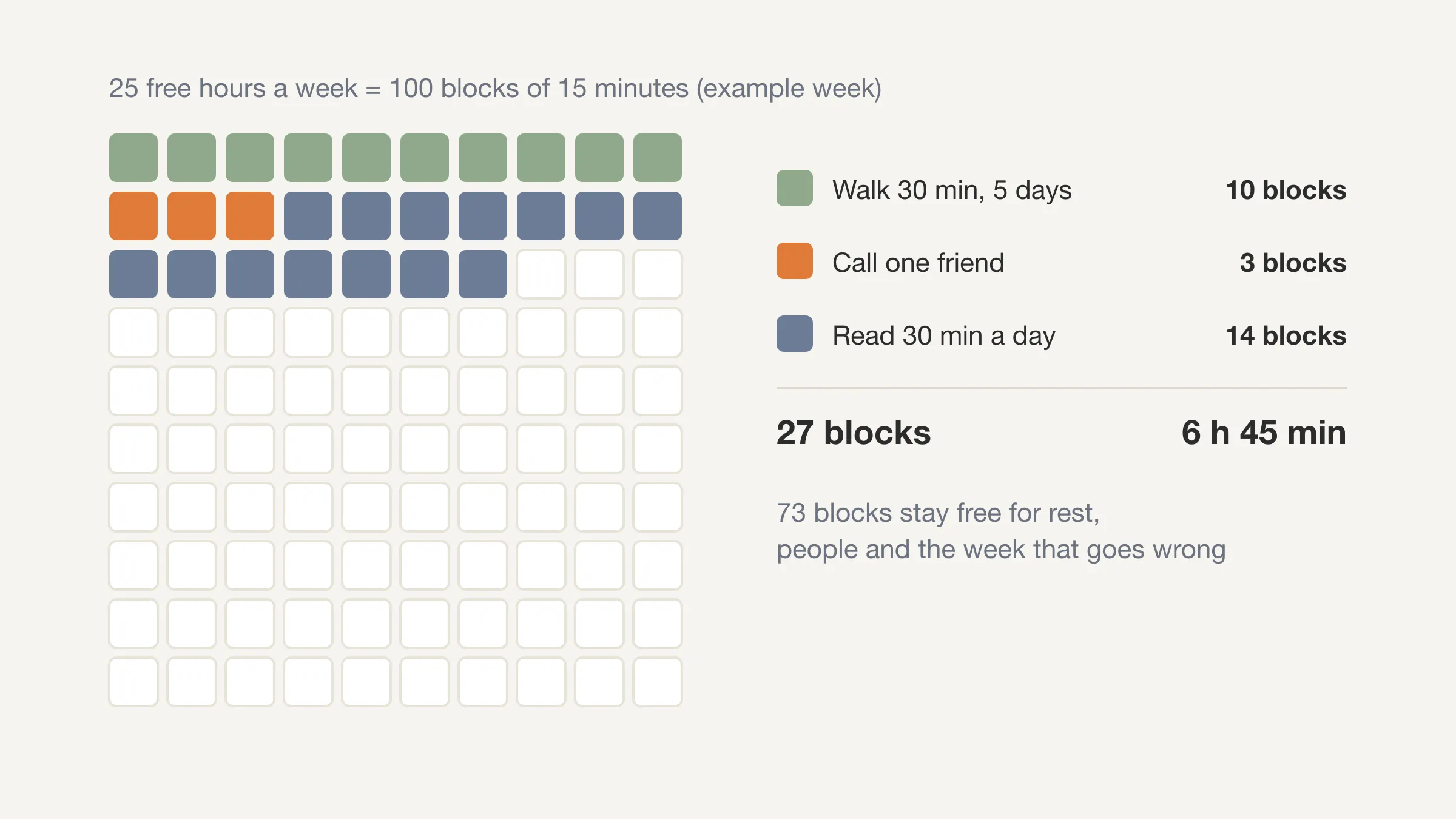
Now put each goal in a place. Walk after lunch. Read for 30 minutes before bed. Call on Sunday at 5 pm. If you want a ready layout, the free weekly schedule template is a good place to draw it.
For goals that come back every week, the next step is a smaller list of weekly targets. Our weekly review guide shows how to set them at the end of each week.
How do you know your goals are happening?
Most goal advice stops at the plan. The part that matters comes after: did the week match the plan?
The simplest check is a time log. For each day, mark what you did in 15-minute blocks, and look at the week. If the goal said "walk 2.5 hours" and the log shows 45 minutes, you do not have a motivation problem to debug. You have a scheduling problem. Maybe the walk always lands on the afternoon that meetings eat. Maybe it was never given a block.
The gap between the plan and the log is where the real information is. We cover why in the planned-vs-actual gap. A 20-minute review at the end of each week is enough to see it. Our weekly review guide walks through one.
If you track time in Beyond Time, the day is 96 blocks of 15 minutes, grouped into Health, Life, Work and Sleep. The "See your week" view shows every hour of the week by category, and the AI reflection points to where time leaked and one or two changes worth making. That is a way to do the check, not the only way. A paper notebook works too.
Frequently Asked Questions
What are some good personal goals examples?
Good personal goals are specific and fit your free hours. Examples include walking 30 minutes five days a week, calling a friend weekly, reviewing your spending every Saturday, reading 30 minutes a day, and writing three lines of gratitude each night. This guide lists more than 40, grouped by area.
How many personal goals should I have at once?
Two or three active goals is a practical limit for most people. Each goal needs weekly hours, and the free hours in a week are limited. A common example week has about 25 free waking hours, and the goals should use well under half of them.
What is the difference between personal goals and professional goals?
Personal goals are chosen for your own life, such as health, relationships, money, learning and wellbeing. Professional goals relate to your job or career, such as a promotion, a certification for work or a revenue target. The two compete for the same weekly hours, so budget them together.
How do I make a personal goal specific?
State what you will do, how often, and how you will check it. "Get fit" becomes "walk 30 minutes, five days a week." The SMART goal validator can test a goal against those criteria.
How much time should I spend on personal goals each week?
Five to 10 hours a week may be workable for someone with a full-time job, though your number depends on your fixed commitments. Log a typical week first. The log shows how many hours are free before you promise any of them.
Why do I keep dropping my personal goals?
Usually because the goals were never given a place in the week. A goal without a day and a start time competes with everything urgent and loses. Choose fewer goals, schedule the first block, and review the week against what actually happened.
Pick three, price them, start this week
Personal goals examples are useful when they carry a price tag. Choose one goal from the areas that matter most, write its weekly time cost next to it, and check the total against the free hours you really have. With 170 days left in 2026, a goal that fits your week will beat a bigger one that does not.
Your time is limited. See where it goes first, then choose where it should go.
Plan goals against the hours you have
Beyond Time shows your day in 15-minute blocks, so every goal gets a real place in the week. Two weeks free, everything unlocked.
Try Beyond Time freePut this into practice
Free tools that match this article.
Weekly Schedule Template
Plan your week with a free printable weekly schedule template for goals, routines, and focus blocks.
Try Schedule TemplateFocusFocus Session Planner
Create AI-optimized focus sessions with structured work blocks and refreshing breaks.
Try Focus PlannerGoal SettingGoal Setting Worksheet
Turn a vague goal into milestones, habits, blockers, and a weekly review plan.
Try Goal WorksheetAssessmentLife Audit Tool
Score your life in 6 key areas and get a personalized action plan to create balance and fulfillment.
Try Life AuditKeep exploring this topic
Goal setting guide
Start with the fundamentals of setting goals that turn into action.
Time blocking guide
Turn priorities into protected calendar blocks.
Goal frameworks compared
Choose between SMART goals, OKRs, BHAGs, and 12-week goals.
15-minute time blocks
Plan and review your day with more realistic precision.
Related Articles

How Many Minutes in a Week? 10,080, and Where They Go
How many minutes in a week? 10,080, or 6,720 waking minutes at 8 hours of sleep. See the minutes in each activity for an average week and how many are left.

Daily Goals: How to Set 1-3 That Get Done (With Examples)
Daily goals work when you set one to three and size them in 15-minute blocks. See examples, how to link them to weekly goals, and a two-minute check at night.

Bucket List Ideas: 100 Ideas Grouped by Theme and Lead Time
100 bucket list ideas grouped by theme and tagged by lead time: now, this year, or years ahead. Count the weeks you have, then pick ten. Start your list today.

How to Stop Doomscrolling: 9 Practical Fixes That Work
How to stop doomscrolling: add friction, swap in better habits and check your Screen Time against a real log of your day. Nine fixes, with sources. Try one.

Life Plan Template: A One-Page Plan With Weekly Costs
A free life plan template you can copy: eight areas of life, one outcome each, and a weekly time cost so your plan fits the 112 waking hours you really have.

How Many Work Weeks in a Year? 52 Minus Your Time Off
How many work weeks in a year? 52 on paper, usually 46 to 50 after holidays and leave. See the table by days off, 2026's count and the weeks left this year.