
Monthly Goals: How to Set Them + Examples and a Review
Monthly goals work when they fit your hours. See how to set three, with examples by area, a month-sized time budget and a 30-minute review to close each month.
Monthly goals are the one to three outcomes you want by the last day of the month, sized to the hours that month actually gives you. A month is long enough for a real result, like a finished draft or a new routine that holds, and short enough that you can still see the finish line from day one.
Here is the setting. On 22 September 2026, there are 100 days left in the year, about 14 weeks. September has 8 days left, and October is next with 31 days and 744 hours. Three months of the year remain after this one ends. This guide shows you how to turn a month into goals that fit, with examples, a way to break them into weeks, and a 30-minute review to close the month.
Key takeaways
- Set one to three monthly goals. One should be a result, the others a habit or a fix.
- Size the month in hours. A full-time worker may have about 108 free hours a month in an example week. Plan goals for about half of that.
- Break each goal into four weekly steps: start, build, build, finish.
- Close the month with a 30-minute review. Ask what happened, what leaked and what carries over.
What are monthly goals?
Monthly goals are results you aim to reach within a calendar month. They sit between your yearly or quarterly direction and your weekly plan. A yearly goal says where you are headed. A monthly goal says what needs to be true in 30 days. A weekly goal says what to do this week.
A good monthly goal has the same three parts as any goal: what you want, how much, and how you will know. "Get better at Spanish" has none. "Finish unit 4 of the Spanish course and hold a 10-minute conversation" has all three.
If you are still choosing what matters, our list of personal goals examples is a good starting point. Students can borrow from these academic goals examples, or plan a month of internship prep. If you prefer weekly steps, read weekly goals. This guide covers the middle layer.
Why choose a month as the unit?
Each period has a job.
| Period | Best for | Risk |
|---|---|---|
| Day | Next actions | Too small to survive a bad afternoon |
| Week | Scheduling and quick feedback | Too short for a finished result |
| Month | A visible result or a habit that sticks | Drift is hidden until week four |
| Quarter | Direction and bigger projects | Feels far away |
A month has about four weeks, which gives a natural shape: one week to start, two to build, one to finish and review. It is also long enough for a habit to take hold in a basic form, though research on habit formation shows the time varies widely between people and behaviors. Our 66-day rule guide covers that.
For the choice between monthly and quarterly planning, see quarterly vs monthly planning. Monthly is a good default when your life changes quickly. Quarterly suits bigger, slower goals, and it is the idea behind the 12-week year.
How many hours does a month really have?
A calendar month has between 672 and 744 hours (28 to 31 days). October 2026 has 31 days, so 744 hours. For a month-by-month table, see how many hours are in a month.
Most of those hours are spoken for. Here is an example for someone with a full-time job. Your numbers will differ, so use this as a shape, not a rule.
| Per week | Hours |
|---|---|
| Waking hours (8 hours of sleep a night) | 112 |
| Work | 40 |
| Commute | 5 |
| Meals, chores, errands, personal care | 30 |
| Screens, scrolling, drifting | 12 |
| Free for goals and rest | 25 |
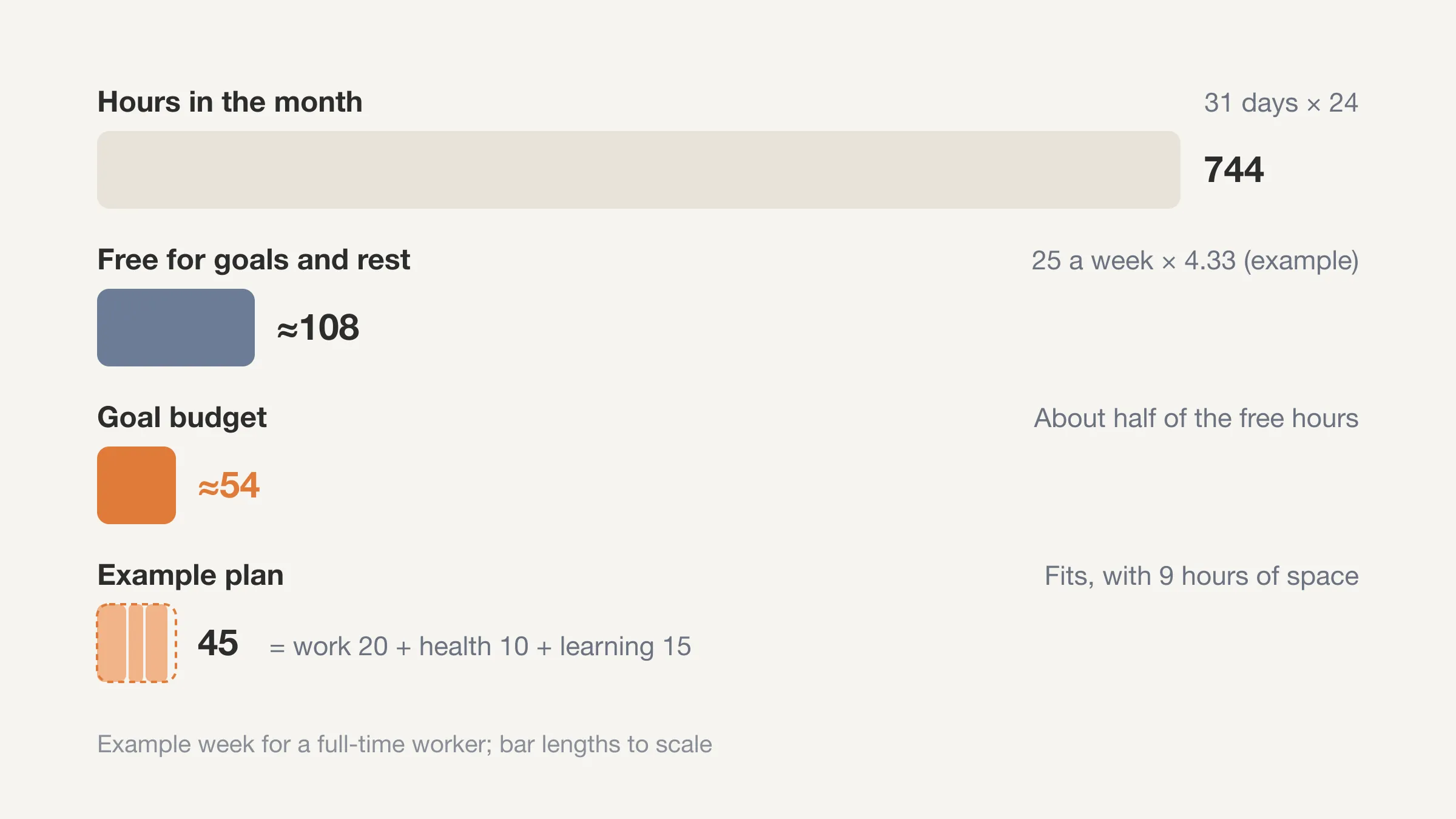
At 25 free hours a week, a month of about 4.33 weeks holds about 108 free hours. That is roughly 430 fifteen-minute blocks.
Do not fill all of them. Goals take about half your free hours at most, because the other half goes to rest, people and the weeks that go wrong. In this example that is about 54 hours across all your monthly goals.
That number is the most useful thing in this post. A goal that needs 80 hours does not fit, no matter how much you want it. Either shrink the goal or stretch it over two months.
Find your real free hours
Log your day in 15-minute blocks. Two minutes in the morning, two at night. After a week you will know what the month can hold.
Try Beyond Time freeHow do you set monthly goals?
Use six steps. Give it 30 minutes, ideally in the last days of the previous month.
- Review the last month. What got finished? What did you keep carrying over?
- Look at the calendar. Note trips, deadlines, birthdays and busy weeks. October 2026, for example, has 5 Saturdays and 4 Sundays, and Halloween falls on a Saturday. Each of those changes the hours.
- Choose the area that matters most. Work, health, money, learning, relationships, home.
- Write one to three goals as results. "Finish the first draft of the course" beats "work on the course."
- Price each in hours. Use the example table above to check that the total is under about half your free hours.
- Schedule the first week. Put the first two blocks in the calendar today.
If a goal feels fuzzy, test it with the free SMART goal validator. It checks whether a goal is specific, measurable and time-bound.
What do good monthly goals look like?
Here are 22 examples, grouped by area. The hours are planning estimates for the whole month, not fixed rules. Pick one or two, not one from each list.
Work and career
| Goal | Hours in the month |
|---|---|
| Finish the first draft of a report, course or proposal | 12 |
| Complete one certification module | 12 |
| Update your resume and portfolio and apply to three roles | 8 |
| Have a career conversation with your manager and write down the next step | 3 |
| Clear a backlog: reduce open tasks from 40 to 15 | 10 |
| Ship one small project end to end | 20 |
Health
| Goal | Hours in the month |
|---|---|
| Strength train twice a week for four weeks (45 minutes each) | 6 |
| Walk 30 minutes on 20 days | 10 |
| Cook at home four nights a week | 17 |
| Fix your sleep: same wake-up time within 30 minutes, all month | 0 extra |
| Do all overdue checkups: book and attend | 4 |
| Run a 5k at the end of the month (three runs a week) | 6 |
Money
| Goal | Hours in the month |
|---|---|
| Build a first budget and track every expense | 4 |
| Cancel subscriptions you do not use | 1 |
| Set up an automatic monthly transfer to savings | 1 |
| Gather all tax and insurance paperwork in one folder | 3 |
Learning, relationships and home
| Goal | Hours in the month |
|---|---|
| Read two books at 30 minutes a day | 15 |
| Finish one language unit and have one conversation | 9 |
| Host friends for one meal | 4 |
| Call a family member every week | 3 |
| Plan one weekend away | 4 |
| Declutter one room completely | 6 |
These are examples of goals and time cost, not financial advice. For money decisions, talk to a licensed advisor.
Check the total before you commit. If you pick the work goal at 20 hours, one health goal at 10 and one learning goal at 15, that is 45 hours. It fits inside the 54-hour example budget with 9 hours of space.
How do you break a monthly goal into weeks?
A goal too big for one sitting needs a weekly path. Here is the four-week shape.
| Week | Job | Example: finish a first draft of a 6,000-word guide |
|---|---|---|
| 1 | Start and scope | Outline, list sources, write 1,000 words |
| 2 | Build | Write 2,500 words |
| 3 | Build | Write 2,500 words |
| 4 | Finish and review | Edit, send, run the month review |
Each week becomes a weekly goal. This is where weekly goals and monthly goals connect. The month names the result. The weeks decide who does what and when.
Leave the last week partly empty. Projects almost always run longer than planned, and week four is where the extra time goes. Our weekly planner template shows a layout for each week, and the weekly review guide helps you check progress without losing time.
How do you run a monthly review?
The monthly review is what makes the next month better than this one. It takes about 30 minutes. Do it on the last day of the month or the first day of the next.
Ask five questions:
- What did I finish? List results, not effort.
- What did I plan and not do? Be specific. Which goal, which week?
- Where did the hours go instead? Look at your calendar or time log. This is the step most people skip, and it is the most useful one.
- What do I carry over, drop or shrink? Carry over only what still matters.
- What is the one change for next month? Move a block, remove a commitment, add slack.
Step 3 turns the review from a guess into a fact. Without a log, you rely on memory, and memory underestimates the hours spent on small things. Our daily time log template is a simple way to capture a week without special tools.
If you use Beyond Time, the "See your week" view shows every hour of the week split by category, with a trend across days and the share you logged. The AI reflection reads the logged day and points to where time leaked and one or two changes for tomorrow. It is one way to do step 3. A notebook works too.
Should every month have one big goal?
Not always. Some months are crowded: a move, a launch at work, a family event. In those months the right monthly goal is small, or it is a maintenance goal that protects what already works.
A maintenance month might have one line: "Keep walking 30 minutes on 15 days and keep the weekly review." You are not behind. You are choosing where the limited hours go. Then in a calmer month you can pick up a goal that costs 20 or 30 hours.
Seeing the whole year this way helps. With about three months left in 2026, you might give October to a work result, November to a lighter month and December to rest and review. You do not have to improve on every front at once.
What mistakes make monthly goals fail?
- Setting a yearly goal and calling it monthly. "Lose 30 pounds" is a long-term target. "Walk 30 minutes on 20 days" is a monthly goal.
- No hours attached. Without a cost, you cannot tell whether the goal fits.
- Too many goals. Three is a ceiling. One is often right.
- Ignoring the calendar. A month with a trip and a deadline has fewer free hours.
- Forgetting week one. Most monthly goals slip because nothing happened in the first week.
- Skipping the review. Without it, each month repeats the last.
Many of these come from the gap between what we plan and what happens. Our guide on the planned-vs-actual gap explains why that gap is normal and how to use it.
Close the month with facts
See where your hours went, by category, and carry only what matters into next month.
Try Beyond Time freeFrequently Asked Questions
What are monthly goals?
Monthly goals are one to three results you aim to reach by the end of the month. Each one has a clear finish line and a time cost in hours. They sit between yearly or quarterly goals and your weekly plan.
How many monthly goals should I set?
Set one to three. In an example full-time week, a month holds about 108 free hours, and goals should use about half of them. That rarely supports more than three real goals.
What is an example of a monthly goal?
"Finish the first draft of the report, about 12 hours" is a monthly goal. So is "walk 30 minutes on 20 days." Both have a finish line and an hours estimate.
How are monthly goals different from yearly goals?
Yearly goals describe direction and take twelve months. Monthly goals are the slices that produce visible progress in 30 days. A yearly goal like "run a half marathon" might become a monthly goal like "run three times a week for four weeks."
How do I choose between monthly and weekly goals?
Use both. A month names the result, and each week names the steps. If you only use one, weekly goals give faster feedback and monthly goals give a clearer finish line.
How often should I review monthly goals?
Review once at the end of each month for about 30 minutes, and check progress briefly each week. The monthly review is where you decide what to carry over, drop or change.
Set the month, then check where it went
Monthly goals work when you set one to three, price them in hours and check them against the free hours your month actually holds (about 108 in the example here). With 100 days left in 2026, you have time for three more months of good goals. Break each into four weekly steps and finish with a 30-minute review.
Your time is limited. See where it goes before you decide where next month's hours should go.
See where the month goes
Log your day in 15-minute blocks and see your week by category. Two weeks free, everything unlocked.
Try Beyond Time freePut this into practice
Free tools that match this article.
Goal Setting Worksheet
Turn a vague goal into milestones, habits, blockers, and a weekly review plan.
Try Goal WorksheetGoal SettingSMART Goal Validator
Instantly validate your goals against the SMART framework and get actionable improvement suggestions.
Try SMART ValidatorGoal SettingAI Milestone Generator
Turn your biggest goals into an actionable step-by-step plan in seconds with AI.
Try Milestone GeneratorGoal SettingOKR Generator
Transform any aspiration into a structured OKR with measurable key results in seconds.
Try OKR GeneratorKeep exploring this topic
Goal setting guide
Start with the fundamentals of setting goals that turn into action.
Goal frameworks compared
Choose between SMART goals, OKRs, BHAGs, and 12-week goals.
Time blocking guide
Turn priorities into protected calendar blocks.
15-minute time blocks
Plan and review your day with more realistic precision.
Related Articles
Weekly Goals: How to Set 3 That Fit Your Week + 30 Examples
Weekly goals work when they fit the hours you have. Set three that fit your week, see 30 examples with time costs, and use a Friday check that keeps you honest.

Personal Goals Examples: 40+ Ideas With Weekly Time Cost
40+ personal goals examples for health, relationships, money, learning and mind, each with its weekly time cost, so you can pick goals that fit your hours.

How Many Minutes in a Week? 10,080, and Where They Go
How many minutes in a week? 10,080, or 6,720 waking minutes at 8 hours of sleep. See the minutes in each activity for an average week and how many are left.

Daily Goals: How to Set 1-3 That Get Done (With Examples)
Daily goals work when you set one to three and size them in 15-minute blocks. See examples, how to link them to weekly goals, and a two-minute check at night.

Bucket List Ideas: 100 Ideas Grouped by Theme and Lead Time
100 bucket list ideas grouped by theme and tagged by lead time: now, this year, or years ahead. Count the weeks you have, then pick ten. Start your list today.

How to Stop Doomscrolling: 9 Practical Fixes That Work
How to stop doomscrolling: add friction, swap in better habits and check your Screen Time against a real log of your day. Nine fixes, with sources. Try one.