Academic Goals Examples: 32 Student Goals, Sized in Hours
Academic goals examples for students: 32 goals across grades, skills, habits and career, each sized in weekly hours so you can see if it fits your semester.
Good academic goals are specific, you can check them, and they fit in your week. This post gives you 32 academic goals examples for students, grouped by grades, skills, habits, career and wellbeing. Each one comes with a weekly time cost, so you can see before the semester starts whether it fits.
That time cost is the part most goal lists leave out. "Get better grades" costs nothing to write down and a lot to do. A goal with a number of hours next to it is a goal you can schedule, and one you can check in week six.
Key takeaways
- Specific goals beat vague ones. Locke and Latham's long research review found that specific, challenging goals lead to higher performance than "do your best".
- Writing goals down helps. In one randomized trial of 85 struggling students, a goal-setting exercise improved grades over four months (Morisano et al., 2010).
- Size every goal in hours a week. A 15-week semester has 15 chances to do it.
- Pick three to five goals, not thirty-two. Your waking week is 112 hours, and classes and study already take a large share.
What makes a good academic goal?
A good academic goal passes four tests:
- Specific. It names the course, the skill or the behavior. "Do well in chemistry" is vague. "Score 85 percent or higher on every chemistry quiz" is specific.
- Checkable. You can tell on a given date whether you did it.
- In your control. Goals about behavior, such as "test myself three times a week", are more in your control than goals about results, such as "get an A". The best goal sets pair one result with the behaviors that lead to it.
- Sized. You know the weekly hours it needs and where they come from.
Locke and Latham (2002) summarized 35 years of goal-setting research. Their review found that specific, difficult goals produced higher effort and performance than vague "do your best" goals, as long as people had the ability and stayed committed. For students, that means the commitment part matters: a goal you cannot fit into your week will not survive the first busy fortnight.
If you want to test a goal you already have, try the SMART goal validator or read how to tell if your goal is SMART enough.
How many hours do you actually have for goals?
Start from the week, not the wish. A week has 168 hours. Sleep takes about 56 if you sleep 8 hours a night, leaving 112 waking hours, or 448 fifteen-minute blocks.
A common college rule of thumb is about two hours of out-of-class work for every hour in class each week. North Carolina State University's credit-hour regulation words it as one hour of instruction plus a minimum of two hours of out-of-class work, over about 15 weeks for a semester credit. For 15 credits, that is 15 hours in class and 30 out of class, or 45 hours, which is 40 percent of 112.
| Credits | Class + study hours a week | Share of 112 waking hours | Left over |
|---|---|---|---|
| 12 | 36 | 32% | 76 hours |
| 15 | 45 | 40% | 67 hours |
| 18 | 54 | 48% | 58 hours |
The "left over" hours also cover meals, travel, work, exercise, friends and rest. So the realistic room for new goals is a handful of hours, not dozens. That is why sizing matters.
The costs below assume a 15-week semester. If yours is shorter, multiply by your own number of weeks. If you want the weeks for your own school, see how many weeks are in a semester. Summer has no semester clock, so summer break goals need their own sizing.
Check goals against your real week
Log your day in 15-minute blocks and see how many hours are free before you add a goal.
Try Beyond Time freeWhat are good academic goals for grades?
Grade goals work best when you pair the outcome with a behavior you control.
| Goal | Weekly time | Over 15 weeks |
|---|---|---|
| Raise one course grade by one letter by finals | 3 hrs of extra practice | 45 hrs |
| Score 85 percent or higher on every quiz in one course | 2 hrs of self-testing | 30 hrs |
| Hand in every assignment on time | 1 hr planning check | 15 hrs |
| Finish the semester at a target GPA you choose | 30 hrs of study at 15 credits | 450 hrs |
| Review lecture notes within a day of every class | 1.5 hrs (3 classes, 30 min each) | 22.5 hrs |
| Go to office hours every two weeks | 30 min averaged | 7.5 hrs |
| Join or start a weekly study group | 1.5 hrs | 22.5 hrs |
| Get a B or better in your hardest course | 4 hrs | 60 hrs |
The "3 hours of extra practice" and the "4 hours" for a hard course are planning estimates, not research findings. Use them as a first guess and adjust after two weeks of logging.
If a grade goal is more ambitious than your time allows, trim the goal or free up hours. Do not do both silently. The goal that quietly steals from sleep tends to fail later in the term.
What are good academic goals for skills?
Skill goals are about what you can do by the end of the term.
| Goal | Weekly time | Over 15 weeks |
|---|---|---|
| Finish a first draft of a long paper by week 12 | 3 hrs of writing | 45 hrs |
| Learn the basics of Python | 3 hrs | 45 hrs |
| Read one research paper a week in your field | 2 hrs | 30 hrs |
| Practice a language 20 minutes a day | 2.3 hrs (20 min x 7) | 35 hrs |
| Learn touch typing | 1.25 hrs (15 min x 5) | 18.75 hrs |
| Practice giving a presentation before each one | 1 hr | 15 hrs |
| Learn a statistics or spreadsheet tool you will need next year | 2 hrs | 30 hrs |
Pick skills that connect to a deadline. "Learn Python" is easier to keep when a project needs it in week eight. If your long paper is a thesis that spans several terms, plan it from proposal to defense rather than one semester at a time.
What are good academic goals for study habits?
Habit goals are the cheapest to fit and often the highest-payoff. They change how existing hours are used.
| Goal | Weekly time | Over 15 weeks |
|---|---|---|
| Test yourself three times a week | 1.5 hrs (30 min x 3) | 22.5 hrs |
| Review each of four courses for 30 minutes weekly | 2 hrs | 30 hrs |
| Plan the week every Sunday | 15 min | 3.75 hrs |
| Log study blocks every day | about 30 min total | 7.5 hrs |
| Start every weekday study session at a set time | 0 extra hrs | 0 hrs |
| Keep your phone out of reach during study blocks | 0 extra hrs | 0 hrs |
| Finish assignments two days before the deadline | 2 hrs of work pulled forward | 30 hrs |
The first two come straight from the research. Dunlosky and colleagues (2013) rated practice testing and distributed practice as the two highest-utility study techniques in a review of ten, and rated highlighting, rereading and summarizing low. A goal to test yourself three times a week is a goal built on that finding. For the full list of methods, see our guide on how to study effectively, and for review schedules, spaced repetition and active recall. For one student's switch from all-nighters to steady self-testing, see this pre-med study system.
The two "0 extra hours" goals cost nothing to schedule. They only change how the hours you already planned are spent.
What are good academic goals for career and projects?
Academic years have a clock that runs past graduation. These goals build the next step, and internship prep is often the first one.
| Goal | Weekly time | Over 15 weeks |
|---|---|---|
| Send one internship application a week | 3 hrs | 45 hrs |
| Build one portfolio project this semester | 2 hrs | 30 hrs |
| Email one professor about research each month | 15 min averaged | 3.75 hrs |
| Update your resume and one work sample | 30 min | 7.5 hrs |
| Attend one career event a month | 1 hr averaged | 15 hrs |
If you are earlier in your degree, swap "internship application" for "talk to one person who does a job you are curious about every two weeks". For more on translating academic work into later goals, see goal setting after college.
What are good academic goals for wellbeing and time?
Academic goals that ignore sleep and rest are borrowing against next month.
| Goal | Weekly time | Over 15 weeks |
|---|---|---|
| Exercise 150 minutes a week | 2.5 hrs | 37.5 hrs |
| Sleep at least 7 hours a night | 49 hrs a week, already in your week | not extra |
| Keep one evening a week completely free | 3 hrs | 45 hrs |
| Eat lunch away from your desk three days a week | 1.5 hrs | 22.5 hrs |
| Call or see a friend or family member weekly | 1 hr | 15 hrs |
The 150-minute figure is the baseline in the Physical Activity Guidelines for Americans for adults (the guidelines give a range of 150 to 300 minutes of moderate activity a week). The CDC recommends 7 or more hours of sleep for adults and 8 to 10 hours for ages 13 to 17. These are general guidelines. If you have health concerns or trouble sleeping, talk to a doctor or your school's health service.
How do you choose which goals to pick?
Use a simple three-step filter.
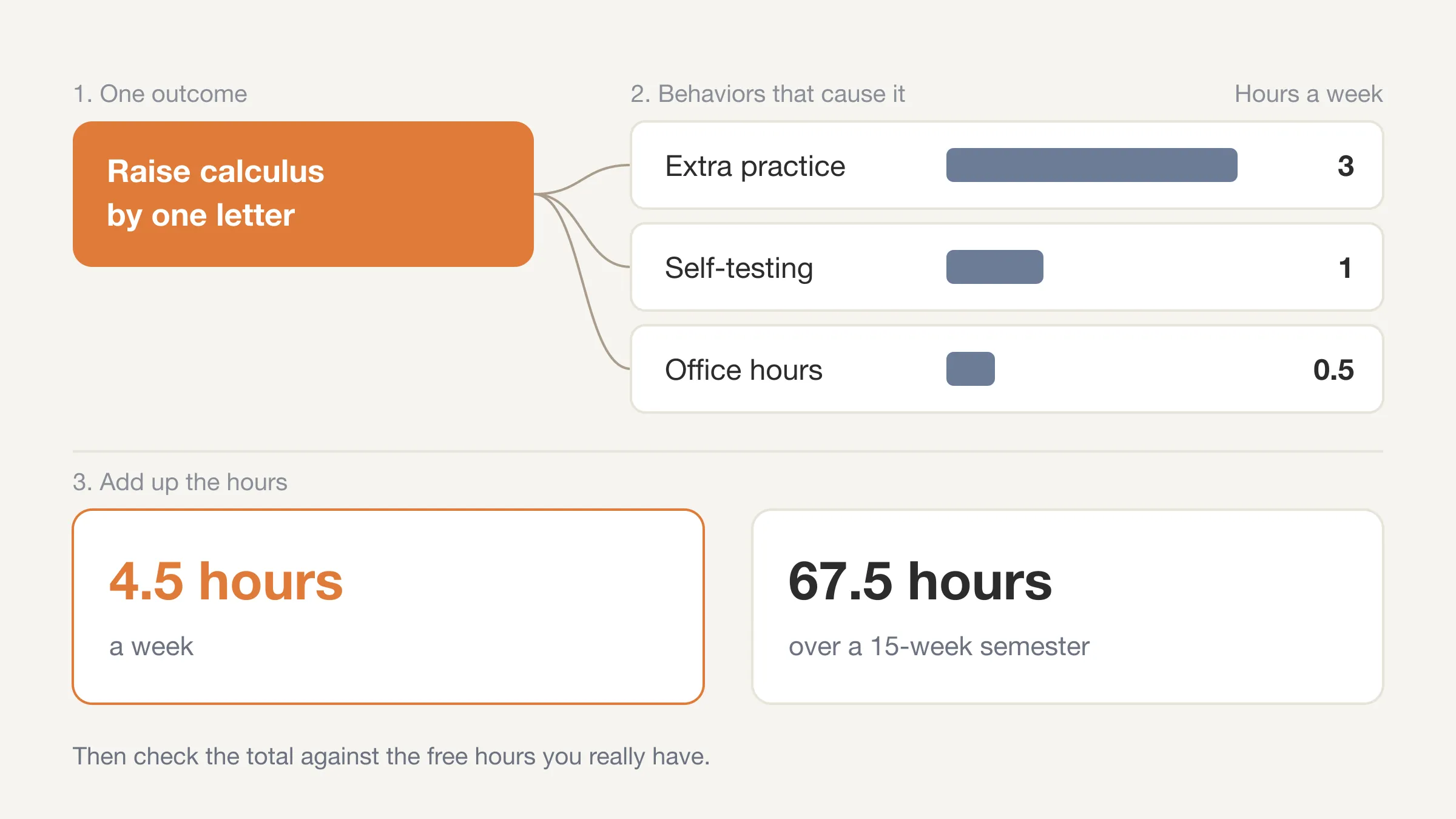
- Pick one outcome. For example, "raise calculus by one letter".
- Pick two or three behaviors that cause it. For example, "self-test twice a week" and "go to office hours every two weeks".
- Add up the hours. Here: 3 hours of extra practice, plus 1 hour of self-testing, plus 30 minutes for office hours, about 4.5 hours a week or 67.5 hours over 15 weeks.
Then check the total against the hours you have. A realistic set for most students is one outcome goal, two or three habit goals, and one non-academic goal such as sleep or exercise. If the sum is more than a few hours a week above your free time, remove something. Do not squeeze it into the night.
For turning semester goals into weekly and daily tasks, see the semester goals framework for students. If you want a worksheet, the goal setting worksheet walks you through it.
How do you check academic goals during the semester?
Goals fail quietly. Checking is what makes them work. Morisano and colleagues (2010) gave 85 students with academic difficulty either an online goal-setting program or a control task. After four months, the goal-setting group's academic performance had improved more than the control group's. The program involved setting, elaborating and reflecting on personal goals, not only writing them down. The reflecting part is the checking.
A simple rhythm:
- Every day, two minutes: log your study blocks in 15-minute units.
- Every Sunday, five minutes: count planned versus logged blocks for each goal.
- At weeks 4 and 8: ask whether each goal still deserves its hours. Drop one if not.
The gap between planned and logged hours is the useful number. If you planned 4.5 hours and logged 2, you have learned something about your week. See study schedule template for a plan-and-log layout, or start with a daily time log.
If a semester has already gone wrong, a reset is possible. Read how to recover from a bad semester.
Frequently Asked Questions
What are examples of academic goals?
Examples include raising one course grade by a letter, scoring 85 percent or higher on every quiz in one course, testing yourself three times a week, finishing a paper draft by week 12, and sleeping at least 7 hours a night. Each one is specific and checkable, and the examples above show a weekly time cost for 32 of them.
How many academic goals should a student have?
Three to five is a workable number. One outcome goal, two or three habit goals that cause it, and one wellbeing goal is a balanced set. More than that dilutes your time.
What are good SMART goals for students?
A SMART goal for students names the task, a number, a deadline and the time it needs. For example: "Complete 30 practice problems a week in calculus until finals, 3 hours a week." You can check it, schedule it and drop it if it does not fit.
How do I set academic goals for the semester?
Pick one outcome, add two or three behaviors that lead to it, and size each in weekly hours. Compare the total with your free hours, then check progress every Sunday. Revisit the goals at mid-semester.
Are specific goals really better than "do my best"?
Yes, in the research on goal setting. Locke and Latham's 2002 review found that specific, difficult goals led to higher performance than vague "do your best" goals, provided people had the ability and stayed committed.
How many hours a week should a student plan for study?
A common rule of thumb is two hours outside class for every hour in class, so a 15-credit load is about 30 hours of study. Treat it as a start and adjust to your courses. Logging a week shows what you actually do.
What if my goals do not fit in my week?
Reduce the goals or free up hours elsewhere on purpose. Cutting sleep is the most common mistake. Shrink the goal's weekly cost first, for example from 3 hours to 2, then check again after two weeks.
The short version
The best academic goals examples are specific, checkable and sized in hours. Choose one outcome and two or three habits that cause it, add up the weekly cost, and check the total against the hours you really have.
Your time is limited. A student's week has 112 waking hours, and each goal spends some of them. Write the hours next to the goal, log the week, and see where it goes.
See where your semester goes
Start your day, log your time, end your day. Beyond Time shows your week and where your hours went.
Try Beyond Time freeIf you are a student, our page for students shows how this works on a typical week.
Sources
- Locke, E. A., & Latham, G. P. (2002). Building a practically useful theory of goal setting and task motivation: A 35-year odyssey. American Psychologist, 57(9), 705 to 717. doi.org/10.1037/0003-066X.57.9.705
- Morisano, D., Hirsh, J. B., Peterson, J. B., Pihl, R. O., & Shore, B. M. (2010). Setting, elaborating, and reflecting on personal goals improves academic performance. Journal of Applied Psychology, 95(2), 255 to 264. doi.org/10.1037/a0018478
- Dunlosky, J., Rawson, K. A., Marsh, E. J., Nathan, M. J., & Willingham, D. T. (2013). Improving students' learning with effective learning techniques. Psychological Science in the Public Interest, 14(1), 4 to 58. doi.org/10.1177/1529100612453266
- North Carolina State University. REG 02.20.17, Definition of credit hour. policies.ncsu.edu/regulation/reg-02-20-17-definition-of-credit-hour
- U.S. Department of Health and Human Services. Physical Activity Guidelines for Americans, 2nd edition, executive summary. health.gov/sites/default/files/2019-10/PAG_ExecutiveSummary.pdf
- Centers for Disease Control and Prevention. How much sleep do I need? cdc.gov/sleep/about/index.html
Put this into practice
Free tools that match this article.
Weekly Schedule Template
Plan your week with a free printable weekly schedule template for goals, routines, and focus blocks.
Try Schedule TemplateFocusFocus Session Planner
Create AI-optimized focus sessions with structured work blocks and refreshing breaks.
Try Focus PlannerLearningAI Study Plan Generator
Generate a personalized study plan with proven learning techniques for exam success.
Try Study PlannerGoal SettingGoal Setting Worksheet
Turn a vague goal into milestones, habits, blockers, and a weekly review plan.
Try Goal WorksheetKeep exploring this topic
Beyond Time for students
See how students connect semester goals, study blocks, and routines.
Student success guide
Use Beyond Time to plan study sessions, habits, and academic goals.
Goal setting guide
Start with the fundamentals of setting goals that turn into action.
Goal frameworks compared
Choose between SMART goals, OKRs, BHAGs, and 12-week goals.
Related Articles

How Many Minutes in a Week? 10,080, and Where They Go
How many minutes in a week? 10,080, or 6,720 waking minutes at 8 hours of sleep. See the minutes in each activity for an average week and how many are left.
Daily Goals: How to Set 1-3 That Get Done (With Examples)
Daily goals work when you set one to three and size them in 15-minute blocks. See examples, how to link them to weekly goals, and a two-minute check at night.

Bucket List Ideas: 100 Ideas Grouped by Theme and Lead Time
100 bucket list ideas grouped by theme and tagged by lead time: now, this year, or years ahead. Count the weeks you have, then pick ten. Start your list today.

How to Stop Doomscrolling: 9 Practical Fixes That Work
How to stop doomscrolling: add friction, swap in better habits and check your Screen Time against a real log of your day. Nine fixes, with sources. Try one.

Life Plan Template: A One-Page Plan With Weekly Costs
A free life plan template you can copy: eight areas of life, one outcome each, and a weekly time cost so your plan fits the 112 waking hours you really have.

How Many Work Weeks in a Year? 52 Minus Your Time Off
How many work weeks in a year? 52 on paper, usually 46 to 50 after holidays and leave. See the table by days off, 2026's count and the weeks left this year.