How to Study Effectively: 7 Methods That Work, With Sources
How to study effectively, based on the research: test yourself, space it out, mix problems, sleep, and log your hours. Every claim sourced. Start tonight.
The most effective way to study is to test yourself instead of rereading, spread your sessions over days instead of cramming, mix problem types, and sleep enough to let it stick. Those four habits have the strongest research behind them. Most students do the opposite, and most never check how many hours of "studying" are really studying.
This guide covers what the evidence says, in plain language, with a source for every claim. It ends with the part most study advice skips: a simple log that shows where your study time goes. Learning methods decide how much you get from an hour. A log tells you how many real hours you have.
Key takeaways
- Practice testing and spacing were the two techniques rated highest in a widely cited review of study methods (Dunlosky et al., 2013). Rereading and highlighting were rated low.
- Cramming works for tomorrow, not for next month. Spread the same hours over several days.
- Sleep is part of studying. The CDC recommends 8 to 10 hours for ages 13 to 17 and 7 or more for adults.
- A 15-minute log shows how many of your study hours are focused ones. Most people overestimate.
What does the research say about how to study effectively?
In 2013, Dunlosky and four colleagues reviewed ten popular study techniques in the journal Psychological Science in the Public Interest. They rated each one for how well it works and how widely it applies, across materials, learners and tests. The full citation is at the end of this post.
| Rating | Technique | What it means in practice |
|---|---|---|
| High | Practice testing | Quiz yourself, use flashcards, do practice problems |
| High | Distributed practice | Spread study over several sessions |
| Moderate | Interleaved practice | Mix problem types in one session |
| Moderate | Elaborative interrogation | Ask yourself why a fact is true |
| Moderate | Self-explanation | Explain how you solved a step |
| Low | Highlighting, rereading, summarizing | Passive review of the same page |
The review also covered two other techniques, keyword mnemonics and imagery for text learning, and rated them low. The pattern is clear. Techniques that make you pull information out of memory beat techniques that put it in front of you again.
That does not mean highlighting is useless in every case. It means it is a weak default, and it is the default for many students. The next section explains why.
Why do most students study the wrong way?
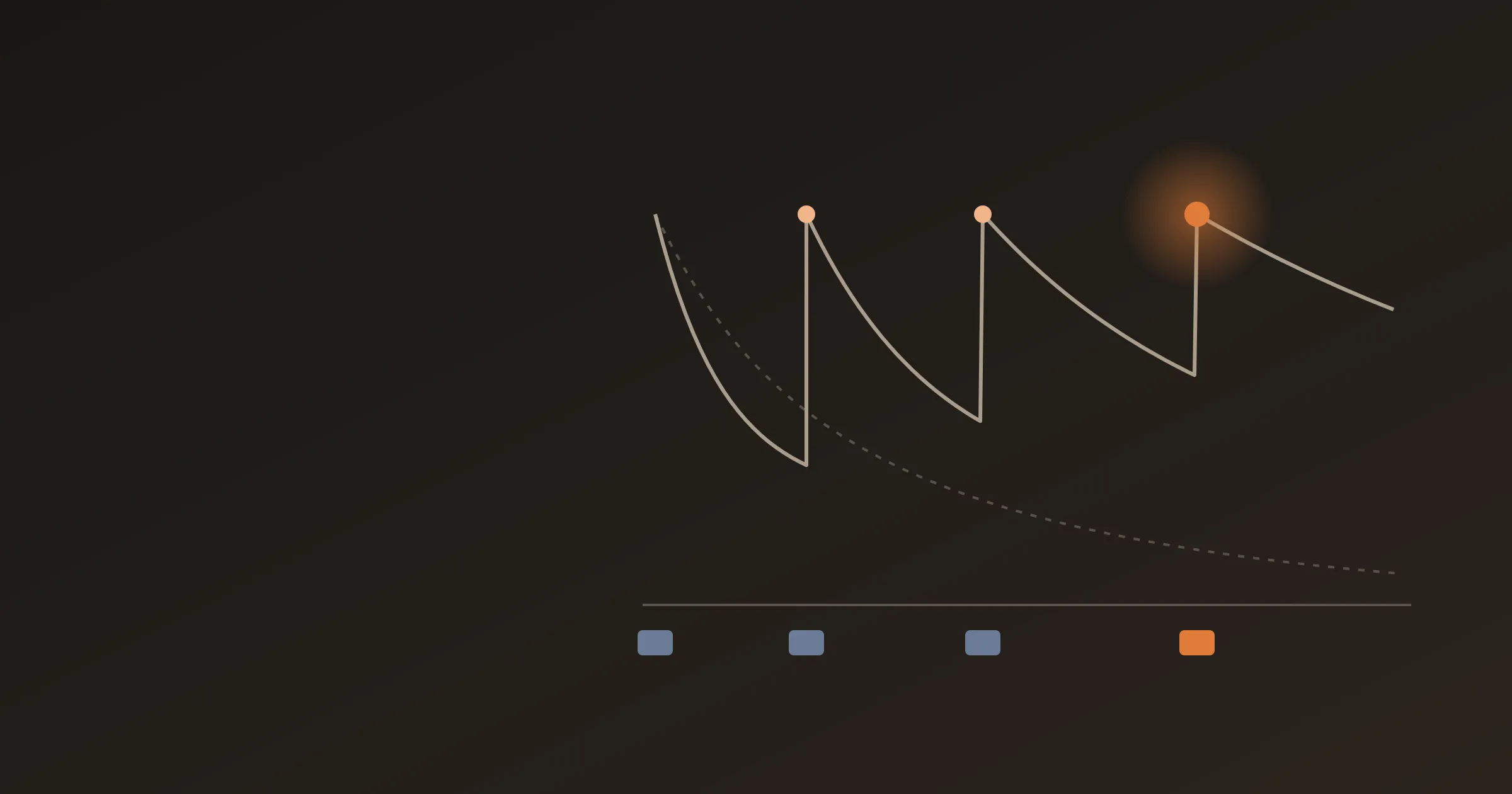
Rereading feels productive. The page looks familiar, so you feel like you know it. That feeling is called fluency, and it is easy to mistake for learning.
In a 2009 survey of 177 undergraduates, Karpicke, Butler and Roediger asked what strategies students use when studying on their own. Students most often named rereading notes or textbooks, and few named testing themselves. The authors argued that students rely on strategies that feel effective but are not.
There is a second reason. Strong techniques feel harder. Practice testing exposes what you do not know, and that is uncomfortable. The discomfort is the signal that the memory is being strengthened, not a sign that the method is failing. The psychologist Robert Bjork calls these desirable difficulties.
See where your study hours go
Log your day in 15-minute blocks. Two minutes in the morning, two at night.
Try Beyond Time freeHow do you use practice testing?
Practice testing means trying to recall or apply what you studied, without looking. It can be low-stakes and ugly. The point is the retrieval, not the score.
The classic result comes from Roediger and Karpicke (2006). Students read short prose passages. One group studied the passage four times in a row. Another group read it once and then took repeated recall tests, writing down what they remembered. Five minutes later, the rereading group did better. After one week, the tested group recalled about 61 percent of the passage and the study-only group about 40 percent. The students who were tested had read the passage less often.
Here is how to put that to work:
- Close the book and write. After reading a section, write everything you remember on a blank page, then check what you missed.
- Use flashcards that ask a question. Write the front as a question, not a topic. "Why does inflation reduce the value of savings?" beats "Inflation."
- Do problems before you feel ready. For math, physics, chemistry and similar subjects, practice problems are the retrieval.
- Use past papers and end-of-chapter questions early, not only in the last week.
- Check your answers. Feedback matters. Retrieval followed by a quick check of the correct answer is the full loop.
For a deeper walk-through of recall and review schedules, see our guide to spaced repetition and active recall.
How does spaced practice beat cramming?
Distributed practice means splitting study into several shorter sessions with gaps between them. It is one of the most replicated findings in memory research. Cepeda and colleagues (2006) combined 839 assessments from 317 experiments in a meta-analysis. They found that the best gap between sessions depends on how long you need to remember the material: the longer the retention interval, the longer the best spacing.
You do not need to calculate the ideal gap. A simple rule works well enough for coursework:
- Study the new material the day you hear it, even briefly.
- Review it two or three days later, by testing yourself.
- Review it again a week later.
- Before an exam, run one more round of mixed practice.
Cramming is not worthless. It can get you through tomorrow's quiz. The problem is that it fails when you need the material again, for a cumulative final, the next course, or work.
What does spacing look like in a real week?
Take a student with a 90-minute block of study time for one course. Cramming puts all 90 minutes in one evening before the quiz. Spacing puts 30 minutes on Monday, 30 on Wednesday and 30 on Friday. It is the same 6 fifteen-minute blocks. The second schedule gives memory two forgetting-and-recalling cycles. The first gives it none.
Spacing also makes the plan easier to follow. Thirty minutes is easy to start. Ninety is a negotiation.
What is interleaving and when should you use it?
Interleaved practice means mixing different types of problems or topics in one session instead of finishing one type before starting the next. A blocked math assignment might be ten problems on one formula. An interleaved one mixes in problems from earlier lessons, so you have to work out which method each problem needs.
Interleaving is rated moderate in the Dunlosky review. A large classroom trial by Rohrer, Dedrick, Hartwig and Cheung (2020) gave a sense of the size of the effect. They randomly assigned 54 seventh-grade math classes, 787 students in all, to blocked or interleaved assignments. The students saw the same problems, in a different order. On an unannounced test a month later, the interleaved group scored 61 percent and the blocked group 38 percent.
Two cautions. The trial was one grade, one subject and one state, so do not expect that exact gap everywhere. And interleaving feels slower while you do it. The teachers in the study reported that interleaved assignments took more time. If your practice session feels messier than usual, that is normal.
When to use it: any subject where you must choose a method, such as math, science problem sets, grammar, case analysis, or coding exercises. For memorizing a list of facts, spacing and testing matter more.
How much does sleep matter for studying?
Sleep is part of the study plan, not a reward for finishing it. Diekelmann and Born (2010) reviewed the evidence in Nature Reviews Neuroscience and concluded that sleep helps consolidate new memories, with the benefit depending on how and when you learned. Sleep and self-testing both make the short list of habits with real evidence behind them.
The CDC recommends 8 to 10 hours of sleep a day for ages 13 to 17 and 7 or more hours for adults. Those are general guidelines, not a personal prescription. If you consistently struggle to sleep or feel exhausted despite enough hours, talk to a doctor or your school's health service.
Practically, this changes how you plan:
- Protect the hours before bed for review, not new material. A short test of what you studied today is a good use of the last study block.
- Cut the late-night block first when time runs short. An hour of sleep usually helps more than an hour of tired rereading.
- Keep your wake time steady so your waking day stays predictable.
For more on this, read how sleep affects your goals.
How do you stay focused while you study?
Focus is where plans meet reality. Rosen, Carrier and Cheever (2013) quietly observed middle school, high school and university students studying at home for 15 minutes. The students averaged under 6 minutes on a task before switching to something else, most often technology such as texting or social media. Students who used study strategies more often stayed on task more, and the authors suggested teaching students when interruptions hurt most.
That is a small, observed sample, not a law of nature. But it matches what many students notice. A few things help:
- Move your phone out of reach, not just face down. Distance removes the decision.
- Work in short, named blocks. Fifteen to forty-five minutes with one defined task ("do 8 practice problems on limits") beats "study calculus".
- Take planned breaks. The study above suggested short technology breaks as a workable trade. Decide when the break is before you start.
- Write down the distracting thought and return to it after the block.
If you like timers, our post on focus sessions beating the Pomodoro timer covers variations, and tips 8 to 14 in our list of productivity tips that hold up are about protecting focus.
How do you know where your study hours actually go?
You can use every method above correctly and still fall short, because the hours were never there. The most common gap is the difference between time planned for studying and time actually spent studying. The only way to see it is to log it.
A study log is simple. For one week, record study sessions in 15-minute blocks. For each block write what you did and how: tested myself, solved problems, reread, or drifted. The 15-minute unit is small enough to catch a lost half hour and large enough to keep logging quick. For why, see the 15-minute time block method.
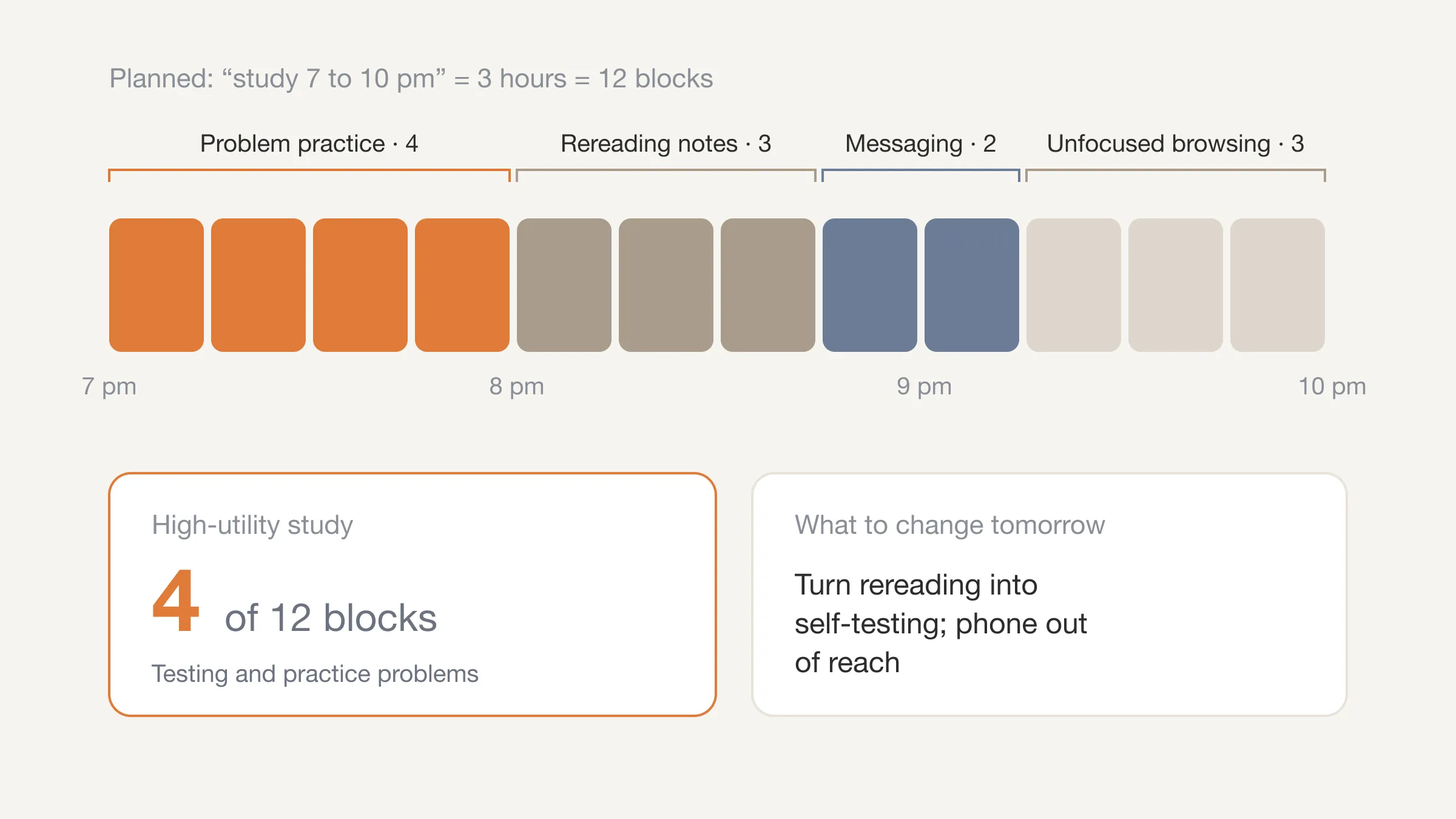
Here is an illustrative example. A student blocks "study 7 to 10 pm". That is 3 hours, or 12 blocks. The log shows 4 blocks of problem practice, 3 of rereading notes, 2 of messaging, and 3 of unfocused browsing. Only 4 of the 12 blocks were the high-utility kind. That is not a failure. It is the first useful number, and it tells you exactly what to change tomorrow.
After a week, look for three things:
- Planned versus logged study blocks. Did you do what you meant to?
- Method mix. How many blocks were testing and practice, and how many were rereading?
- Where the leaks are. Which time of day or place loses the most blocks?
If you want a ready-made layout, a daily time log template gives you a page to copy. A broader version is in our complete time audit guide.
Log a study day in two minutes
Start your day, log the blocks, end your day. Beyond Time shows the week and the gap between plan and reality.
Try Beyond Time freeHow do you build a study plan that uses these methods?
Put the methods into a weekly structure. A simple plan for each course:
- Set the weekly budget. A common rule of thumb in colleges is about two hours of work outside class for every hour in class. A student taking 15 credit hours would budget roughly 30 hours a week out of class. Your school's guidance and your own course load matter more than the rule of thumb.
- Place sessions on specific days and times. Implementation matters: "Tuesday 4:00 to 4:45, calculus problems, library" beats "study calculus this week".
- Assign a method to each session. Session one is new material plus a quick recall test. Session two is mixed problems. Session three is a self-test on everything so far.
- Review the log on Sunday. Move missed blocks, not wishes.
A free study plan generator can draft a schedule from your exam dates. If you prefer drawing it yourself, use the weekly schedule template or the time blocking template. For exam season specifically, see how to build an exam study schedule that works, or how one pre-med student replaced cramming with a weekly system.
What does a study day look like?
This is an example of one weekday for a student with classes until early afternoon. It is not a prescription.
| Time | Block | Method |
|---|---|---|
| 4:00 to 4:45 pm | Course A problem set | Interleaved practice, closed notes first |
| 4:45 to 5:00 pm | Break | Away from the phone |
| 5:00 to 5:30 pm | Course B reading | Read, then write what you remember |
| 7:30 to 8:00 pm | Course A flashcards | Practice testing, spaced from last week |
| 9:15 to 9:30 pm | Quick review | Test yourself on today's topics |
| 10:30 pm | Lights out | Aim for your 8 to 10 hours |
That is about 2 hours of focused study, or 8 fifteen-minute blocks of the day's 64 waking blocks, if your waking day runs 7 am to 11 pm. It is not a heroic schedule. The point is that every block has a method, and each one can be checked.
What study mistakes should you avoid?
- Studying only what feels comfortable. Reviewing the topics you already know feels good. Start with the ones that scored worst on your last test.
- Making notes the whole session. Rewriting is a form of rereading. Make notes, then use them as test questions. Some note-taking systems, such as Cornell notes, build a question column in from the start.
- Skipping feedback. Retrieval without checking answers can cement errors.
- Planning a perfect week. A plan that assumes no bad days fails on the first bad day. Leave a block or two of slack.
- Counting hours instead of blocks that worked. Two focused hours beat four distracted ones.
- Treating sleep as optional during exam weeks.
Frequently Asked Questions
What is the most effective way to study?
The most effective methods in the research are practice testing and spaced practice. Dunlosky and colleagues (2013) rated both as high utility in a review of ten techniques. In practice, that means quizzing yourself on a schedule that spreads sessions over days or weeks.
Is rereading notes a bad way to study?
Rereading is a weak default, not a banned technique. The 2013 review rated rereading low utility because it does not consistently improve performance. If you reread, follow it with a closed-book recall test.
How many hours a day should you study?
There is no single right number, because it depends on your courses and goals. A common college guideline is about two hours outside class per hour in class each week, so a 15-credit load comes to roughly 30 hours a week. Check your school's guidance, then log a week to see what you actually do.
Does cramming work?
Cramming can help short-term performance, such as a test the next day. Research on distributed practice shows that spreading the same time over several sessions improves retention over longer periods. If you must cram, test yourself during the session and sleep afterward.
How long should a study session be?
There is no proven perfect length. Short, named sessions of 15 to 45 minutes with one clear task are easy to start and easy to measure. Take a planned break between sessions.
How much sleep do students need?
The CDC recommends 8 to 10 hours of sleep a day for ages 13 to 17 and 7 or more hours for adults. If you often struggle to sleep, talk to a doctor or school health service.
How do I track my study time?
Log it in 15-minute blocks for a week: what you did, which method you used, and whether it was focused. Add up planned versus logged blocks. A daily time log template or an app makes this a two-minute habit.
The short version
To study effectively, test yourself, space sessions out, mix problem types, protect your sleep, and keep the phone out of reach. Then check the one thing no technique can fix: whether the study hours you planned actually happened.
Your time is limited. A week has 112 waking hours, and a study plan only works if it fits inside them. Log a few days, see where the blocks went, and change one thing. That is how you see where it goes.
See where your time goes
Log your day in 15-minute blocks and let the AI reflection point out the gaps. Free for two weeks.
Try Beyond Time freeSources
- Dunlosky, J., Rawson, K. A., Marsh, E. J., Nathan, M. J., & Willingham, D. T. (2013). Improving students' learning with effective learning techniques. Psychological Science in the Public Interest, 14(1), 4 to 58. doi.org/10.1177/1529100612453266
- Roediger, H. L., & Karpicke, J. D. (2006). Test-enhanced learning: Taking memory tests improves long-term retention. Psychological Science, 17(3), 249 to 255. doi.org/10.1111/j.1467-9280.2006.01693.x
- Karpicke, J. D., Butler, A. C., & Roediger, H. L. (2009). Metacognitive strategies in student learning: Do students practise retrieval when they study on their own? Memory, 17(4), 471 to 479. pubmed.ncbi.nlm.nih.gov/19358016
- Cepeda, N. J., Pashler, H., Vul, E., Wixted, J. T., & Rohrer, D. (2006). Distributed practice in verbal recall tasks: A review and quantitative synthesis. Psychological Bulletin, 132(3), 354 to 380. pubmed.ncbi.nlm.nih.gov/16719566
- Rohrer, D., Dedrick, R. F., Hartwig, M. K., & Cheung, C. N. (2020). A randomized controlled trial of interleaved mathematics practice. Journal of Educational Psychology, 112(1), 40 to 52. doi.org/10.1037/edu0000367
- Diekelmann, S., & Born, J. (2010). The memory function of sleep. Nature Reviews Neuroscience, 11, 114 to 126. doi.org/10.1038/nrn2762
- Rosen, L. D., Carrier, L. M., & Cheever, N. A. (2013). Facebook and texting made me do it: Media-induced task-switching while studying. Computers in Human Behavior, 29(3), 948 to 958. doi.org/10.1016/j.chb.2012.12.001
- Centers for Disease Control and Prevention. How much sleep do I need? cdc.gov/sleep/about/index.html
Put this into practice
Free tools that match this article.
AI Study Plan Generator
Generate a personalized study plan with proven learning techniques for exam success.
Try Study PlannerTime ManagementWeekly Schedule Template
Plan your week with a free printable weekly schedule template for goals, routines, and focus blocks.
Try Schedule TemplateFocusFocus Session Planner
Create AI-optimized focus sessions with structured work blocks and refreshing breaks.
Try Focus PlannerRoutine BuildingNight Routine Planner
Create a realistic night routine checklist for better sleep and a smoother tomorrow.
Try Night RoutineKeep exploring this topic
Morning routine template
Build a practical morning routine around energy and focus.
Beyond Time for students
See how students connect semester goals, study blocks, and routines.
Evening routine ideas
Wind down in a way that supports sleep and tomorrow’s goals.
Student success guide
Use Beyond Time to plan study sessions, habits, and academic goals.
Related Articles
How Many Minutes in a Week? 10,080, and Where They Go
How many minutes in a week? 10,080, or 6,720 waking minutes at 8 hours of sleep. See the minutes in each activity for an average week and how many are left.
Daily Goals: How to Set 1-3 That Get Done (With Examples)
Daily goals work when you set one to three and size them in 15-minute blocks. See examples, how to link them to weekly goals, and a two-minute check at night.
Bucket List Ideas: 100 Ideas Grouped by Theme and Lead Time
100 bucket list ideas grouped by theme and tagged by lead time: now, this year, or years ahead. Count the weeks you have, then pick ten. Start your list today.
How to Stop Doomscrolling: 9 Practical Fixes That Work
How to stop doomscrolling: add friction, swap in better habits and check your Screen Time against a real log of your day. Nine fixes, with sources. Try one.
Life Plan Template: A One-Page Plan With Weekly Costs
A free life plan template you can copy: eight areas of life, one outcome each, and a weekly time cost so your plan fits the 112 waking hours you really have.
How Many Work Weeks in a Year? 52 Minus Your Time Off
How many work weeks in a year? 52 on paper, usually 46 to 50 after holidays and leave. See the table by days off, 2026's count and the weeks left this year.