
Habits of Successful People: 6 That Have Real Evidence
The habits of successful people that research actually supports: sleep, movement, if-then plans, tracking, focus and self-testing. Sources included. Test one.
The habits of successful people that hold up under research are not secret morning rituals. They are ordinary: enough sleep, regular movement, specific if-then plans, tracking progress, protecting focus, and testing yourself when you learn. Each has real studies behind it. None needs a billionaire's schedule.
This post skips the celebrity routines. Stories like "he wakes at 4 am" are easy to repeat and hard to verify, and they only show habits shared by people we already know about. Instead, here are six habits with named sources, what each one asks of your week in hours, and a simple way to test one for a month.
Key takeaways
- Six habits with evidence: sleep, movement, if-then plans, tracking progress, protecting focus, and self-testing.
- Each has a cost in hours. Seven hours of sleep is 49 hours a week. The movement guideline is about 21 minutes a day.
- Habits take longer than a slogan suggests. In one study the median time to automatic behavior was 66 days, with a range from 18 to 254.
- Pick one, test it for a month, and log it so you can see whether it happened.
Why should you be careful with "habits of successful people" lists?
Most lists copy routines from famous people. There are three problems with that.
First, survivorship. We hear about the routines of people who succeeded, not about the many people with the same routine who did not. A habit that appears in a famous person's day may have nothing to do with their results.
Second, verification. Many routines are retold from interviews, books or social posts, then embellished. A claim with no named source is a story, not evidence.
Third, fit. A founder with no commute and a team is not living your week.
A better question is: which habits have been studied, in more than one group of people, with results that don't depend on being famous? The six below are an honest shortlist, not a complete one. They are strongest where the sources are strongest, and the post says where the evidence is thinner.
Habit 1: Do you sleep enough?
Sleep is the habit most often traded away and most reliably regretted. Diekelmann and Born (2010) reviewed the research in Nature Reviews Neuroscience and concluded that sleep helps consolidate newly acquired memories, with the benefit depending on the conditions of learning and the timing of sleep.
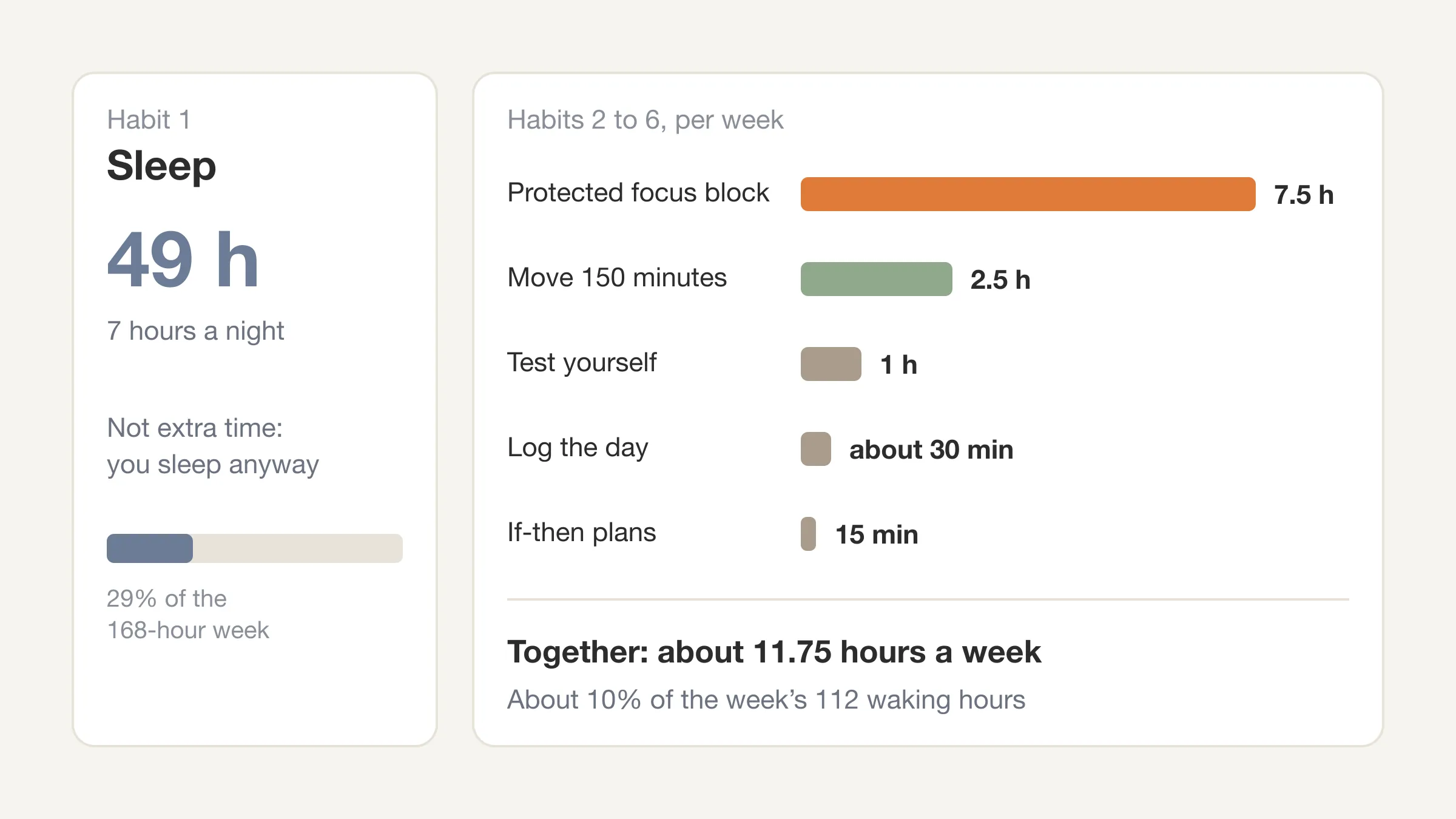
The CDC recommends 7 or more hours a day for adults aged 18 to 60 and 8 to 10 hours for ages 13 to 17. Seven hours a night is 49 hours a week, about 29 percent of the 168 hours in a week, and it leaves 119 hours awake.
What to try: fix a wake-up time first, because it is easier to keep than a bedtime, then count back seven hours or more. This is general information, not medical advice. If you often have trouble sleeping, talk to a doctor.
For more, see how sleep affects your goals.
Habit 2: Do you move regularly?
The U.S. Physical Activity Guidelines for Americans (2nd edition) recommend that adults get 150 to 300 minutes a week of moderate-intensity aerobic activity, plus muscle-strengthening activities on two or more days a week. The guidelines also say that benefits continue beyond 300 minutes, and that short bouts count toward the total.
The cost is small. 150 minutes a week is about 21 minutes a day, or 2.5 hours in a week. That is under 3 percent of 112 waking hours.
What to try: pick a regular slot, such as a 20-minute walk after lunch or a gym visit on three set days, and write it on the calendar like a meeting. If you have a health condition, ask a doctor what is right for you.
Habit 3: Do you make if-then plans?
An implementation intention is a plan in the form "if situation X comes up, then I will do Y". For example: "If it is 7:30 am and I have made coffee, then I write for 25 minutes."
Gollwitzer and Sheeran (2006) combined 94 independent tests in a meta-analysis and found a medium-to-large effect of these plans on goal attainment (d = .65). A 2024 synthesis by Sheeran, Listrom and Gollwitzer of 642 tests found a range of effects, from d = .27 to d = .66 depending on the outcome. So the effect is real but not magic, and its size varies with the outcome and the kind of plan.
What to try: take one goal you keep postponing and write one if-then plan with a specific time, place and action. Compare "I will exercise more" with "If it is Monday, Wednesday or Friday at 6:30 am, then I will walk for 20 minutes". A morning routine template is a natural place to anchor plans like these.
This is why a time-blocked day beats a to-do list. A block names the "when". If you want a layout, see our hourly planner guide and how to plan your day.
See whether the plan happened
Log your day in 15-minute blocks. Two minutes in the morning, two at night.
Try Beyond Time freeHabit 4: Do you track your progress?
Harkin and colleagues (2016) reviewed 138 randomized studies, with 19,951 participants in all, that tested interventions to get people to monitor progress toward a goal. Their conclusion in Psychological Bulletin: monitoring goal progress promotes goal attainment. The effect was larger when progress was physically recorded, such as written down, and when it was reported to others.
This is the same idea behind a time log. Writing down what you did, in the unit you planned it in, turns a vague sense of the week into a number. It also makes the gap between plan and reality visible, which is the useful piece. See planned versus actual for more on that gap.
What to try: log your day in 15-minute blocks for one week. A waking day of 16 hours is 64 blocks. At the end of each day, count how many blocks went where you meant them to. Our daily time log template is a copyable page, and the time audit guide shows what to look for.
A note on scope: the studies in that review mostly concern health and personal goals, and they tested interventions that prompted monitoring. They show that tracking progress helps people reach goals. They do not show that every kind of tracking helps everyone, and tracking that becomes a source of guilt can backfire. Keep it short and kind.
Habit 5: Do you protect your focus?
Focused work is easy to praise and hard to measure. One observational study is useful, if limited. Rosen, Carrier and Cheever (2013) watched 263 middle school, high school and university students study at home for 15 minutes. Students averaged less than 6 minutes on task before switching, most often to technology such as texting or social media. Students who used more study strategies were more likely to stay on task.
That study is about students, was observational, and measured short periods. It does not prove that adults at work lose focus at the same rate. It does show how often attention breaks when a phone is within reach.
What to try:
- Pick one block a day for the most important task and give it a name, such as "write intro, 8 to 9:30 am".
- Put the phone out of reach for that block.
- Write down interruptions and deal with them after.
If you want a method, deep work and focus sessions are two ways to structure it.
Habit 6: Do you test yourself when you learn?
If you learn new things for work or study, one habit is clearly better supported than others. Dunlosky and colleagues (2013) rated ten study techniques in Psychological Science in the Public Interest. Practice testing and distributed practice (spacing study over time) were rated high utility. Rereading, highlighting and summarizing were rated low.
In a well-known experiment, Roediger and Karpicke (2006) had students read a passage and then either restudy it or take recall tests. After one week, the tested students recalled about 61 percent of the passage and the restudy students about 40 percent.
What to try: after learning something, close the book and write down what you remember. Do it again a few days later. See spaced repetition and active recall.
What does this add up to in a week?
Here is the hour cost of the six habits, as an example for an adult:
| Habit | Weekly time | In 15-minute blocks |
|---|---|---|
| Sleep 7 hours a night | 49 hours | 196 |
| Move 150 minutes | 2.5 hours | 10 |
| Write if-then plans (Sunday) | 15 minutes | 1 |
| Log the day, 4 minutes a day | about 30 minutes | 2 |
| One protected focus block, 5 days at 90 minutes | 7.5 hours | 30 |
| Test yourself, 3 sessions at 20 minutes | 1 hour | 4 |
| Total | about 60.75 hours | about 243 |
Sleep dominates, and it is not extra time, because you sleep anyway. Without sleep, the other five add up to about 11.75 hours, or 47 blocks, out of the week's 112 waking hours. That is about 10 percent of your waking week.
These are planning numbers worked out for this example, not findings. Your own week will differ.
How do you test one habit for a month?
The research on how long habits take to form is more modest than the slogans. Lally and colleagues (2010) followed 96 volunteers for 84 days as they tried to repeat a chosen behavior daily. The median time to reach automatic behavior was 66 days, with a huge range from 18 to 254 days. Missing a single day did not materially affect the process. Even after 84 days, many people had not reached a plateau.
So do not promise yourself you will have a new habit in 21 days. Run an experiment instead.
- Pick one habit from the list. Not three.
- Write the if-then plan. Time, place, action.
- Set the minimum version. Ten minutes of walking, not an hour at the gym.
- Log it for 30 days. Mark each day done or not. A missed day is data.
- Review at day 30. How many days did it happen? What got in the way? Keep, shrink or swap it.
The 66-day rule post covers the Lally study in more depth, and the neuroscience of habit formation explains what is going on in the brain.
Log the habit, not just the intention
Beyond Time shows the week in hours, split into Health, Life, Work and Sleep, so you can see whether a habit really happened.
Try Beyond Time freeWhat about habits with thinner evidence?
Several popular habits are not in the six, on purpose.
- Waking up at 5 am. There is no good study showing that early rising on its own improves results. What matters is whether your total sleep and your best hours fit your schedule. If you want to try it anyway, here is how to wake up at 5am without losing sleep.
- Cold showers, journaling, meditation. Some have research behind them for specific outcomes such as stress or mood, but the findings are mixed or specific to certain groups. They may suit you, but they are not on this list.
- Reading a set number of books a year. Reading is valuable, but a book count is a number, not a habit with a documented effect on success.
Leaving something off is not saying it does not work. It is saying the sources I checked do not support a confident claim for a general reader.
Frequently Asked Questions
What are the habits of successful people?
The habits with the most research support are getting enough sleep, regular physical activity, making specific if-then plans, tracking progress toward goals, protecting focus, and testing yourself when you learn. Each has named studies or official guidelines behind it. Popular morning routines of famous people have much weaker evidence.
Do successful people wake up early?
Some do, but there is no good evidence that waking early causes success. Sleep guidance from the CDC is about the number of hours, 7 or more for adults, not the clock time. Choose a schedule you can keep.
How long does it take to form a habit?
It varies a lot. In a study of 96 volunteers by Lally and colleagues (2010), the median time to automatic behavior was 66 days, and the range was 18 to 254 days. Missing one day did not materially affect progress.
How many habits should I work on at once?
One is a good number to start with. Test a single habit for about 30 days, with a minimum version you can do on bad days, then decide whether to keep it before adding another.
Is tracking habits actually useful?
Yes, for many goals. A meta-analysis by Harkin and colleagues (2016) of 138 randomized studies found that monitoring goal progress promoted goal attainment, with larger effects when progress was recorded physically or reported to others.
Are morning routines worth copying?
Copy the principles, not the clock. Sleep enough, move, plan the day with specific times, and protect one focus block. The exact hour you do them matters far less than doing them. Our guide to the science of morning routines goes into more detail.
The short version
The habits of successful people that research supports are plain: sleep 7 or more hours, move about 21 minutes a day, write if-then plans, track your progress, protect a focus block, and test yourself as you learn. Together they cost about 12 waking hours a week, plus the sleep you need anyway.
Your time is limited. Choose one habit, test it for 30 days, and log it. A week of 15-minute blocks will show you whether it happened, and where the rest of the time went. That is how you see where it goes.
See where your week goes
Log your day in 15-minute blocks, then let the AI reflection show where time went where you meant it to.
Try Beyond Time freeSources
- Centers for Disease Control and Prevention. How much sleep do I need? cdc.gov/sleep/about/index.html
- Diekelmann, S., & Born, J. (2010). The memory function of sleep. Nature Reviews Neuroscience, 11, 114 to 126. doi.org/10.1038/nrn2762
- U.S. Department of Health and Human Services. Physical Activity Guidelines for Americans, 2nd edition, executive summary. health.gov/sites/default/files/2019-10/PAG_ExecutiveSummary.pdf
- Gollwitzer, P. M., & Sheeran, P. (2006). Implementation intentions and goal achievement: A meta-analysis of effects and processes. Advances in Experimental Social Psychology, 38, 69 to 119. doi.org/10.1016/S0065-2601(06)38002-1
- Sheeran, P., Listrom, O., & Gollwitzer, P. M. (2024). The when and how of planning: Meta-analysis of the scope and components of implementation intentions in 642 tests. European Review of Social Psychology. doi.org/10.1080/10463283.2024.2334563
- Harkin, B., Webb, T. L., Chang, B. P. I., et al. (2016). Does monitoring goal progress promote goal attainment? A meta-analysis of the experimental evidence. Psychological Bulletin, 142(2), 198 to 229. doi.org/10.1037/bul0000025
- Rosen, L. D., Carrier, L. M., & Cheever, N. A. (2013). Facebook and texting made me do it: Media-induced task-switching while studying. Computers in Human Behavior, 29(3), 948 to 958. doi.org/10.1016/j.chb.2012.12.001
- Dunlosky, J., Rawson, K. A., Marsh, E. J., Nathan, M. J., & Willingham, D. T. (2013). Improving students' learning with effective learning techniques. Psychological Science in the Public Interest, 14(1), 4 to 58. doi.org/10.1177/1529100612453266
- Roediger, H. L., & Karpicke, J. D. (2006). Test-enhanced learning: Taking memory tests improves long-term retention. Psychological Science, 17(3), 249 to 255. doi.org/10.1111/j.1467-9280.2006.01693.x
- Lally, P., van Jaarsveld, C. H. M., Potts, H. W. W., & Wardle, J. (2010). How are habits formed: Modelling habit formation in the real world. European Journal of Social Psychology, 40(6), 998 to 1009. doi.org/10.1002/ejsp.674
Put this into practice
Free tools that match this article.
Habit Tracker Template
Create a free printable habit tracker template — weekly or monthly. Customize your habits and download a clean PDF in seconds.
Try Habit TrackerHabit BuildingHabit Stack Builder
Use habit stacking to build new habits by attaching them to your existing routines.
Try Habit Stack BuilderHabit Building30-Day Challenge Generator
Build any habit with a personalized 30-day challenge featuring daily tasks and weekly milestones.
Try 30-Day ChallengeTime ManagementTime Blocking Template
Map your day into focused time blocks with a free printable time blocking template.
Try Time BlockingKeep exploring this topic
Atomic Habits summary
Apply the core behavior-change principles behind lasting habits.
Habit stacking guide
Attach new behaviors to routines you already do every day.
Time blocking guide
Turn priorities into protected calendar blocks.
Morning routine template
Build a practical morning routine around energy and focus.
Related Articles

Goal Accountability: The Complete System for Staying on Track
Learn how to stay accountable to goals with a proven system combining habits, external partners, and smart tools. Build your accountability framework now.

Why Motivation Fails and Systems Win — Complete Guide
Motivation is unreliable. Systems aren't. Learn why the most productive people don't rely on willpower and what they use instead. Templates and examples inside.

The Execution Gap: Why Your Plans Fail and How to Close It
Most goals fail in the gap between planning and doing. Learn the execution funnel framework and weekly rituals that turn quarterly goals into daily wins.

The Planned vs. Actual Gap: Why Your Days Never Go as Expected
Your planned schedule rarely matches reality. Learn why the gap exists, how to measure it, and how closing it transforms your productivity. Templates and.

The Habit-Goal Connection: Why Disconnected Habits Fail
Building habits without connecting them to goals is like running without a finish line. Learn why linking habits to goals transforms your consistency.
Quality Time: What It Means and How to Make More of It
Quality time is undivided attention shared with someone. See what counts, 25 ideas by relationship, and how to check how much quality time you really had.