
How to Wake Up at 5am Without Wrecking Your Sleep Habits
How to wake up at 5am: move your bedtime first, shift your alarm 15 minutes at a time, then run a two-week test and log it to see if 5am is worth it for you.
To wake up at 5am, go to bed earlier first. The alarm is the easy part. If you want seven to eight hours of sleep and a 5 am wake-up, you need to be asleep by about 9 to 10 pm, and no trick at 5 am makes up for a bedtime that did not move. The way to get there is to shift your wake time by 15 minutes at a time, and to test the result for two weeks before you decide it is for you.
This guide is honest about what waking at 5 does and does not buy. It does not add hours to your life. A waking day is still about 64 blocks of 15 minutes if you sleep eight hours. What it can do is move some of those blocks to a quieter part of the day. Whether that is worth the cost depends on you, and you can measure it.
Key takeaways
- Waking at 5 only works if bedtime moves too. For 7 hours of sleep, be asleep by 10 pm. For 8 hours, by 9 pm.
- Shift by one 15-minute block every two or three days. Going from 7:00 to 5:00 is 8 blocks.
- Waking early does not create time. It moves your waking blocks to the start of the day.
- Run a two-week test, log your sleep and your first hour, and keep it only if the numbers say it helps.
Should you wake up at 5am?
Maybe. The honest answer is that nothing in public health guidance says 5 am is better than 7 or 8 am. What the guidance does say is that you need enough sleep, at regular times.
The U.S. Centers for Disease Control and Prevention says adults aged 18 to 60 need seven or more hours of sleep a day, and advises going to bed and waking up at the same time every day (CDC, About Sleep). The National Heart, Lung, and Blood Institute, part of the NIH, gives similar advice: keep the same sleep schedule on weeknights and weekends (NHLBI, Healthy Sleep Habits).
So the question is not "is 5 am a better time?" It is "can I wake at 5 and still sleep enough, regularly, without it costing me elsewhere?" For some people the answer is yes. For others, such as people whose natural sleep comes later, shift workers and parents of young children, a 5 am alarm means cutting sleep, and that is a bad trade.
A reason to try it is practical. If your evenings are full or your mornings are chaotic, an earlier start may be the only quiet stretch you can get. A reason not to is that it sounds impressive. Impressive is not a plan.
How much sleep do you need to wake up at 5am?
Start from the wake-up time and count back. You need your sleep hours, plus the time it takes to fall asleep, which for many people is 10 to 20 minutes. Here is the bedtime for a 5:00 am alarm.
| Sleep you want | Lights out if you fall asleep in 15 min | Asleep by |
|---|---|---|
| 7 hours | 9:45 pm | 10:00 pm |
| 7.5 hours | 9:15 pm | 9:30 pm |
| 8 hours | 8:45 pm | 9:00 pm |
| 9 hours | 7:45 pm | 8:00 pm |
If you are used to going to bed at midnight, that table is the real news. Waking at 5 means a bedtime two to three hours earlier, and evenings that end at 9 pm. Many people try 5 am for a week, keep the old bedtime, sleep five hours, and conclude that early rising does not work. It was the sleep that did not work.
What does 5am cost your evenings?
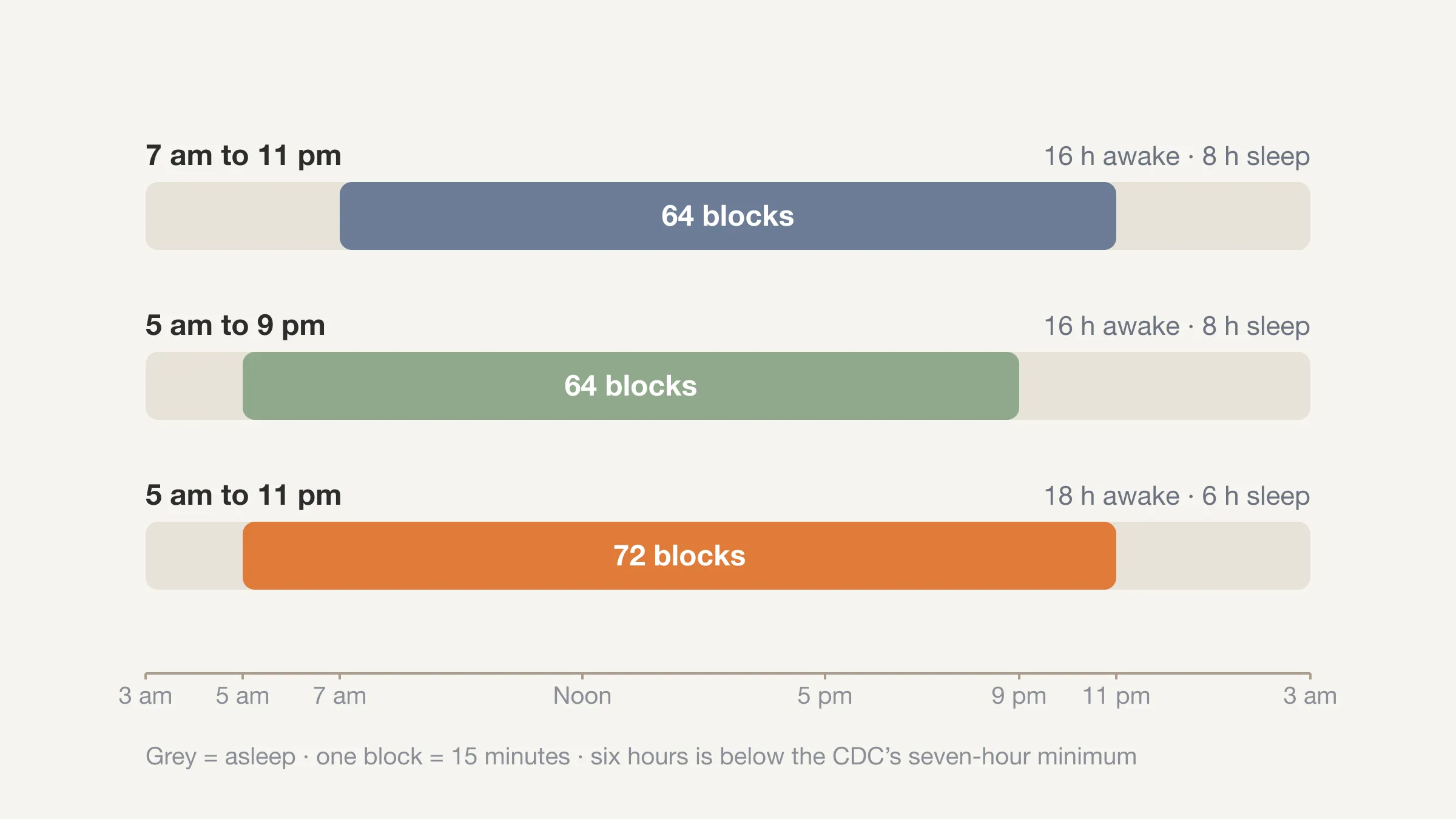
Look at it as a trade of blocks, not a loss of time. If you wake at 5 and sleep until 9 pm bedtime, your waking day runs 5 am to 9 pm: 16 hours, or 64 blocks. If you currently wake at 7 and go to bed at 11, your waking day is also 16 hours and 64 blocks. The total is the same. The blocks sit in different places.
| Schedule | Waking day | Blocks |
|---|---|---|
| 7 am to 11 pm | 16 hours | 64 |
| 5 am to 9 pm | 16 hours | 64 |
| 5 am to 11 pm (sleeping 6 hours) | 18 hours | 72 |
The third row is the trap. It looks like eight extra blocks a day, and it is, but they come out of sleep. A six-hour night is below the CDC's seven-hour minimum for adults, and the blocks you gain are often the least useful ones of the day.
What does waking up at 5am actually buy you?
It buys a different arrangement of the same day. Three things are worth having, and one is not.
- A quieter start. Fewer messages, fewer people, fewer demands. For some people the first two hours are the only part of the day nobody else has a claim on.
- Space for something you keep skipping. Exercise, writing, study. If that thing never happens at 7 pm, it may happen at 5:30 am.
- A calmer morning. An unhurried start can make the rest of the day feel less like a scramble.
- Not a free hour. It is not extra time. If your day still ends at 11 pm, you are tired by 3 pm.
One more honest point. An earlier start only helps if what you do with it is clear. If you wake at 5 and spend the first hour on your phone, you have moved the same habit earlier. Decide what the first blocks are for before you set the alarm. A short morning routine checklist is the easiest way to do that.
See the blocks you already have
Beyond Time shows your day as 15-minute blocks, so you can see which part of the day is really yours before you move your alarm.
Try Beyond Time freeHow do you shift to a 5am wake-up step by step?
Do it slowly. A sudden two-hour jump produces a week of bad sleep and a lot of snoozing. A gradual shift lets your body adjust.
Step 1: find your starting point
Look at when you actually wake on a normal weekday, not when you intend to. Say it is 7:00. The gap to 5:00 is two hours, which is 8 blocks of 15 minutes.
Step 2: move one block at a time
Shift your wake time and your bedtime 15 minutes earlier. Hold that for two or three days, then shift again. This is the schedule for a 7:00 start.
| Step | Wake time | Bedtime (8 hours + 15 min) |
|---|---|---|
| Start | 7:00 | 10:45 pm |
| 1 | 6:45 | 10:30 pm |
| 2 | 6:30 | 10:15 pm |
| 3 | 6:15 | 10:00 pm |
| 4 | 6:00 | 9:45 pm |
| 5 | 5:45 | 9:30 pm |
| 6 | 5:30 | 9:15 pm |
| 7 | 5:15 | 9:00 pm |
| 8 | 5:00 | 8:45 pm |
Eight steps at two days each is 16 days. At three days each it is 24. That is a reasonable price for a change you plan to keep.
Step 3: protect the bedtime, not just the alarm
The bedtime is the part that fails. Treat it as the appointment. Set a reminder for wind-down 30 to 60 minutes earlier, and have a short evening routine ready. Our guide to the night routine for better sleep and goal progress and the evening routine ideas post give you something to follow.
Step 4: keep the same wake time on weekends
The CDC and the NHLBI both advise keeping a consistent schedule, including on weekends. A 5 am alarm on weekdays and a 10 am lie-in on Saturday undoes much of the shift. The NHLBI suggests limiting the difference to about an hour, which is also easier to live with than a full reset every Monday.
What habits make waking at 5am easier?
None of these is a trick. They all make it a little easier to fall asleep earlier and to get up when the alarm goes.
- Get light early. Open the curtains or step outside soon after you get up. Morning light helps signal that the day has started.
- Keep caffeine for the morning. The CDC advises avoiding caffeine in the afternoon or evening.
- Turn off screens early. The CDC suggests switching off electronic devices at least 30 minutes before bed.
- Keep the bedroom quiet, cool and dark. The CDC lists a quiet, relaxing, cool bedroom, and the NHLBI adds dark.
- Put the alarm out of reach. Standing up to turn it off is the first small win.
- Have a reason to get up. A specific thing you are looking forward to beats a general intention.
Avoid large meals and alcohol close to bedtime. Both are also on the CDC's list, and both make sleep worse.
What should you do at 5am?
Something small, clear and a bit enjoyable. A plan for the first hour should be easy to start while you are still waking up.
A simple structure for the first four blocks:
- Block 1 (5:00): water, light, a bathroom stop.
- Block 2 (5:15): movement. A walk, stretching, a short workout.
- Block 3 (5:30): the thing you are protecting: writing, study, a project.
- Block 4 (5:45): look at the day, choose your one to three goals, then get ready.
That is one hour, or 4 blocks, and it uses the structure from our morning checklist. If you want to build a longer routine around it, our science-backed morning routine template goes into more detail.
How do you test waking at 5am for two weeks?
Treat it as an experiment with a start and an end, not a new identity. Two weeks is long enough to get past the first rough days and see a pattern.
What to record
Each day, write down four things. Each takes seconds.
- Wake time and bedtime (actual, not planned).
- Sleep quality on a 1 to 5 scale, or the sleep score in an app.
- The first four blocks: did they go to what you intended?
- Energy at 3 pm: low, medium or high.
Here is a template you can copy.
5 AM TEST: 14 DAYS
Goal: ______________________  (what the early hours are for)
Plan: wake 5:00, asleep by ______ (so I get ____ hours)

| Day | Bed (actual) | Wake (actual) | Sleep hrs | Sleep 1-5 | First 4 blocks used for goal (0-4) | 3 pm energy |
|-----|--------------|---------------|-----------|-----------|------------------------------------|-------------|
| 1   |              |               |           |           |                                    |             |
| 2   |              |               |           |           |                                    |             |
| 3   |              |               |           |           |                                    |             |
| 4   |              |               |           |           |                                    |             |
| 5   |              |               |           |           |                                    |             |
| 6   |              |               |           |           |                                    |             |
| 7   |              |               |           |           |                                    |             |
| 8   |              |               |           |           |                                    |             |
| 9   |              |               |           |           |                                    |             |
| 10  |              |               |           |           |                                    |             |
| 11  |              |               |           |           |                                    |             |
| 12  |              |               |           |           |                                    |             |
| 13  |              |               |           |           |                                    |             |
| 14  |              |               |           |           |                                    |             |

End of week 2:
Average sleep hours: ____    Days with 7+ hours: ____ of 14
Average blocks used for goal: ____ of 4
What I did with the early hours: ______________________
Keep / adjust / drop: ______
How to decide at the end
Be strict about two numbers and loose about the rest.
- Sleep hours. If you slept 7 hours or more on most nights, the schedule is sustainable. If you averaged under 7, the plan is costing you sleep and you should move the wake time later or the bedtime earlier.
- Blocks used for your goal. If the early blocks went to what you wanted on most days, the effort is paying off. If they went to your phone, change the plan, not the alarm.
If both numbers look good and your energy holds, keep going. If not, try 5:30 or 6:00. A wake time you can keep beats the one that sounds best.
In Beyond Time, Start your day records how you slept and when you woke, and Log time shows the first blocks of the day. After two weeks, See your week shows the shape of the change. You can run the same test with a notebook.
Who should not try waking up at 5am?
Some people should not force it.
- If you would have to cut your sleep. Under seven hours a night is below guidance for most adults.
- If you work late or irregular shifts. A fixed 5 am alarm may conflict with the hours you actually work.
- If you have young children and your nights are broken. Sleep is the thing to protect. Take the early blocks when you can.
- If you feel unwell or very tired during the day. Persistent daytime sleepiness, trouble sleeping or insomnia deserve a conversation with a doctor or other health professional. This article is general information, not medical advice.
If you are a natural night owl, a later schedule you can keep is better than an early one you cannot. The goal is rested and regular, not early.
Test it with a log, not a hunch
Two minutes in the morning and two at night. Beyond Time shows how you slept, how the first blocks went and where the day leaked.
Try Beyond Time freeFrequently Asked Questions
How do I wake up at 5am if I am not a morning person?
Shift gradually and move your bedtime first. Go 15 minutes earlier every two or three days, keep the same wake time on weekends and get light soon after you rise. If you have to cut your sleep below seven hours to do it, a later wake time is the better choice.
What time should I go to bed to wake up at 5am?
To wake at 5 am with 7 hours of sleep, be asleep by 10 pm. For 8 hours, be asleep by 9 pm. Add the 10 to 20 minutes it usually takes you to fall asleep to find your lights-out time. The CDC says adults need at least 7 hours.
How long does it take to get used to waking up at 5am?
Plan on a few weeks if you shift gradually. Moving from 7:00 to 5:00 in 15-minute steps, two days per step, takes 16 days. Some people adjust faster and some slower. If you are still exhausted after a month, the schedule may not suit you, and persistent trouble sleeping is worth raising with a doctor.
Is waking up at 5am healthy?
It can be healthy if you still get enough sleep at regular times. The CDC recommends seven or more hours for adults aged 18 to 60. Waking at 5 on six hours of sleep is not healthy. The time on the clock matters less than the hours and the regularity.
Does waking up at 5am make you more productive?
Not by itself. It moves your waking blocks earlier but does not add any. It helps if it gives you a quiet, protected stretch for something that matters, and if you still sleep enough. Log two weeks of your first hour and see what it produced.
What should I do at 5am?
Do something small and clear: water, light, a few minutes of movement, then one protected task and a look at the day. Four 15-minute blocks is plenty. Decide the plan the night before so you are not choosing while half asleep.
The short version
To wake up at 5am, move your bedtime first, shift in 15-minute steps and keep the schedule the same on weekends. Waking at 5 does not give you more time. A sleep-sufficient day is still about 64 blocks, and the only question is whether starting them earlier suits your life.
So test it. Run the two-week log, look at your sleep hours and your first four blocks, and keep the change only if the numbers back it up. To see where all your blocks go, not only the early ones, try Beyond Time free.
Put this into practice
Free tools that match this article.
Habit Tracker Template
Create a free printable habit tracker template — weekly or monthly. Customize your habits and download a clean PDF in seconds.
Try Habit TrackerTime ManagementWeekly Schedule Template
Plan your week with a free printable weekly schedule template for goals, routines, and focus blocks.
Try Schedule TemplateRoutine BuildingNight Routine Planner
Create a realistic night routine checklist for better sleep and a smoother tomorrow.
Try Night RoutineTime ManagementTime Blocking Template
Map your day into focused time blocks with a free printable time blocking template.
Try Time BlockingKeep exploring this topic
Atomic Habits summary
Apply the core behavior-change principles behind lasting habits.
Time blocking guide
Turn priorities into protected calendar blocks.
Morning routine template
Build a practical morning routine around energy and focus.
Habit stacking guide
Attach new behaviors to routines you already do every day.
Related Articles

Morning Routine Checklist: 10, 30 and 60-Minute Versions
A morning routine checklist you can copy in three sizes: 10, 30 or 60 minutes. Pick one, run it for a week, and log your first hour to see if it really happens.

How Many Minutes in a Week? 10,080, and Where They Go
How many minutes in a week? 10,080, or 6,720 waking minutes at 8 hours of sleep. See the minutes in each activity for an average week and how many are left.

Daily Goals: How to Set 1-3 That Get Done (With Examples)
Daily goals work when you set one to three and size them in 15-minute blocks. See examples, how to link them to weekly goals, and a two-minute check at night.

Bucket List Ideas: 100 Ideas Grouped by Theme and Lead Time
100 bucket list ideas grouped by theme and tagged by lead time: now, this year, or years ahead. Count the weeks you have, then pick ten. Start your list today.

How to Stop Doomscrolling: 9 Practical Fixes That Work
How to stop doomscrolling: add friction, swap in better habits and check your Screen Time against a real log of your day. Nine fixes, with sources. Try one.

Life Plan Template: A One-Page Plan With Weekly Costs
A free life plan template you can copy: eight areas of life, one outcome each, and a weekly time cost so your plan fits the 112 waking hours you really have.