
Weekly Goals: How to Set 3 That Fit Your Week + 30 Examples
Weekly goals work when they fit the hours you have. Set three that fit your week, see 30 examples with time costs, and use a Friday check that keeps you honest.
Weekly goals are the two or three things you want to have finished or moved forward by the end of the week. The best set is small: three goals, each sized to the hours you really have. A week is the shortest period that still has room for real progress, and the longest one you can plan without guessing.
Count what is left. On 25 August 2026, there are 128 days left in the year, or about 18 weeks. That is not many weeks, and each one has 168 hours. This guide shows you how to turn a week into three goals that fit, with 30 examples, a Sunday planning routine and a Friday check.
Key takeaways
- Set three weekly goals, not ten. One carries the week, two are supporting.
- Size each goal in hours. A week has about 112 waking hours, and after work and upkeep an example full-time week leaves about 25 free ones.
- A weekly goal names an outcome you can check on Friday. "Work on the report" is not one. "Send the first draft of the report" is.
- Plan on Sunday in 20 minutes. Check on Friday in 10.
What are weekly goals?
Weekly goals sit between your long-range goals and your daily to-do list. A yearly goal says where you want to be. A daily task says what to do now. A weekly goal says what must be true by Friday for the yearly goal to move.
Two features separate a weekly goal from a task:
- It has a finish line. You can look at it on Friday and answer yes or no.
- It carries a time cost. You know roughly how many hours it needs and where they will come from.
If your goals live in a longer plan, such as a 12-week year or a monthly or quarterly plan, the weekly goal is the unit that actually gets scheduled. If you have not chosen goals at all yet, start with personal goals examples and come back.
Why set goals weekly instead of daily or monthly?
Daily goals are too small to survive one bad afternoon. Monthly goals are too big, and a month hides drift until the last week. A week is the right size for three reasons.
- It matches how life repeats. Work rhythms, school, childcare and weekends all run on a seven-day cycle. A weekly goal can use the shape of your actual week.
- It gives you quick feedback. If you miss a goal, you find out in days, not weeks.
- It is easy to budget. There are 168 hours in a week. After sleep, that is 112 waking hours, or 448 fifteen-minute blocks. For the full math, see how many hours are in a week.
Our guide to weekly reviews covers the review side. This post covers the goal side.
How many hours do you really have for weekly goals?
This is the step most goal advice skips. Before you choose goals, find the hours.
Take an example week for someone working full time:
| Where the waking hours go | Hours |
|---|---|
| Waking hours | 112 |
| Work | 40 |
| Commute | 5 |
| Meals, chores, errands, personal care | 30 |
| Rest, screens, slack | 12 |
| Free for goals | 25 |
That is 25 hours, or 100 blocks. Many people have more or fewer. A parent of young children might have 10. A student on a light week might have 40. If you run your own business, the solopreneur's weekly system shows how to fit it into 40 hours.
The best way to know your own number is to look at past weeks, not guess. Log three or four ordinary days in 15-minute blocks, using something like our daily time log template. The log shows what is fixed and what is real slack.
Then apply a rule: plan goals for about half your free hours. If you have 25 free hours, your three goals should cost about 12 hours in total. The other half absorbs what the week throws at you.
Find out your real free hours
Log your day in 15-minute blocks. Two minutes in the morning, two at night. See the week split by category.
Try Beyond Time freeHow do you set three weekly goals?
Use five steps. It takes about 20 minutes on a Sunday.
- Review last week. Look at what got done and what slid. One minute per day is enough.
- List what matters. Write the five things you would like to move forward. Include work, home and yourself.
- Cut to three. One main goal and two supporting. If everything feels main, cut again.
- Write each as an outcome with a cost. "Send draft of the Q3 report (3 hours)." "Run three times (1 h 30 min)." "Book the dentist and the car service (30 min)."
- Put each in the calendar. Give every goal a day and a start time. A goal without a block is a wish.
On step 4, write the verb and the object. "Finish," "send," "book," "run," "write," "call." If you cannot name the verb, the goal is still a theme.
Step 5 is where goals meet reality. Blocks on the calendar compete with meetings and errands, so place them first, before the week fills. The free weekly schedule template and the copyable layout in our weekly planner template both work for this.
What does a good weekly goal look like?
Compare the weak and strong versions.
| Weak | Strong |
|---|---|
| Work on the presentation | Finish slides 1 to 8 of the presentation by Thursday |
| Exercise more | Strength train Monday and Thursday, 45 minutes each |
| Be more organized | Clear the inbox to zero on Wednesday and Friday, 30 minutes each |
| Save money | Review spending Saturday morning (20 minutes) |
| Call family | Call Mom on Sunday at 5 pm |
The strong versions share three traits. They are specific, they have a finish line, and most have a day and duration. If you want to test a goal against the usual criteria, the free SMART goal validator will check it.
30 weekly goals examples
Each example below has a rough time cost. Treat the costs as planning estimates for a typical week, not fixed rules. Adjust them to your own pace.
Work and study (7)
| Goal | Time cost |
|---|---|
| Send the first draft of a report | 3 h |
| Clear the inbox to zero twice | 1 h |
| Finish one chapter or module of a course | 3 h |
| Prepare for and run one important meeting | 2 h |
| Write the next week's plan and priorities (Friday) | 30 min |
| Complete one application, proposal or pitch | 4 h |
| Do two deep-work blocks of 90 minutes on one project | 3 h |
Health (6)
| Goal | Time cost |
|---|---|
| Strength train twice | 1 h 30 min |
| Walk 30 minutes on five days | 2 h 30 min |
| Cook dinner at home on four nights | 4 h |
| In bed by 11 pm on five nights | 0 extra |
| Prepare lunches for the week on Sunday | 1 h |
| Book one overdue appointment | 20 min |
Home and errands (6)
| Goal | Time cost |
|---|---|
| Clear one drawer, closet or shelf | 1 h |
| Do the laundry and put it away | 2 h |
| Pay the bills and file the paper | 30 min |
| Fix or replace one broken item | 1 h |
| Plan next week's meals and shop once | 1 h 30 min |
| Reset the home on Sunday evening | 45 min |
Learning (4)
| Goal | Time cost |
|---|---|
| Read 30 minutes on five days | 2 h 30 min |
| Practice a language 20 minutes on five days | 1 h 40 min |
| Write 500 words, three times | 2 h 15 min |
| Practice an instrument 15 minutes on five days | 1 h 15 min |
Relationships (4)
| Goal | Time cost |
|---|---|
| Call one friend | 45 min |
| One unhurried family meal | 2 h |
| Plan a weekend outing | 3 h |
| Send three thoughtful messages | 15 min |
Money and mind (3)
| Goal | Time cost |
|---|---|
| Review spending | 20 min |
| Journal on five days for 10 minutes | 50 min |
| Spend 90 minutes outdoors with no phone | 1 h 30 min |
Pick from these, but do not pick one from every list. A good week has three goals total. Students can find more in these academic goals sized in hours.
Worked example: one week, three goals
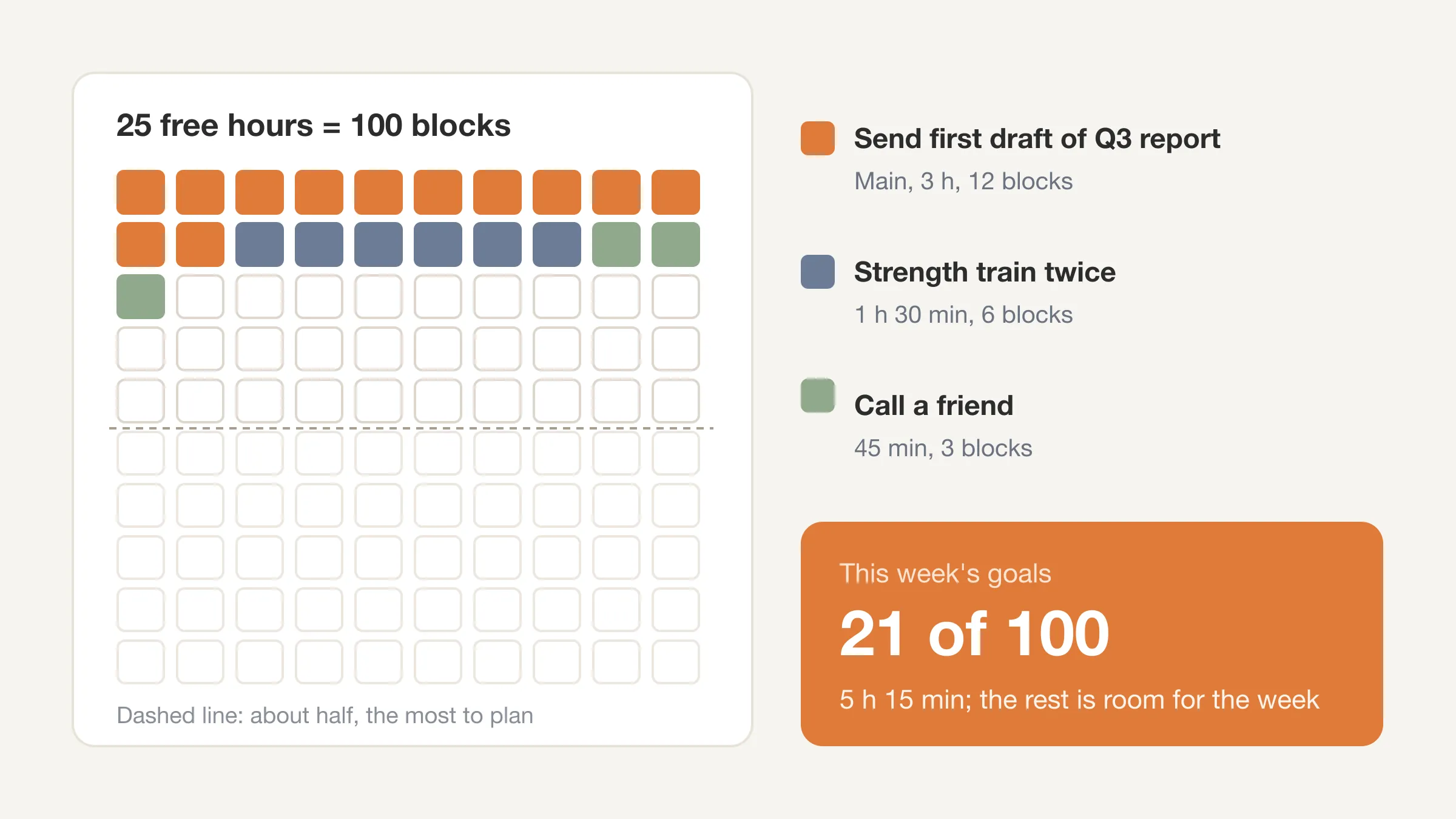
Here is an example for a full-time employee with 25 free hours. Planning about half of them would be 12 hours. This week uses less.
| Goal | Type | Cost | Where it goes |
|---|---|---|---|
| Send first draft of Q3 report | Main | 3 h | Tue and Wed, 7 to 8:30 am |
| Strength train twice | Supporting | 1 h 30 min | Mon and Thu, 6 pm |
| Call a friend | Supporting | 45 min | Sunday, 5 pm |
| Total | 5 h 15 min | about 21 blocks |
That is 21 blocks out of 100 free ones, well under the half you could plan. The rest of the free time is deliberately empty. Delays, a sick child, an unplanned dinner and a bad night of sleep all land there instead of on top of your goals. The leftover room is what makes the plan survive contact with the week.
How do you check your weekly goals on Friday?
Ten minutes on Friday afternoon turns a plan into a loop.
- Mark each goal done, partly done or not done. No explanations yet.
- Look at the log. How many of the planned hours really happened? If the goal cost 3 hours and the log shows 45 minutes, the problem is in the schedule.
- Find the leak. Which blocks did the time go to instead? Meetings, messages, a long lunch?
- Choose one change. Move a block earlier. Shrink a goal. Drop one.
- Carry over only what still matters. An unfinished goal is not automatically next week's goal.
Sharing the Friday check with an accountability partner makes it harder to skip. This gap between the plan and the day is the most useful number in the exercise. See the planned-vs-actual gap for why it shows up in almost every week. If you use Beyond Time, the AI reflection reads the logged day and shows what went where you meant it to, where time leaked, and one or two changes for tomorrow. A notebook can do the same job with a little more effort.
Plan the week, then see how it went
Beyond Time shows every hour of your week split by category, and compares it with what you planned.
Try Beyond Time freeWhat if your week keeps getting taken over?
Some weeks you will lose half your hours to a sick child, a deadline or a trip. That is normal, and the plan should have a smaller version ready.
Write a minimum week on Sunday next to your three goals. It is the version you would still be fine with if only a third of your free hours survive. Usually it is the main goal alone, in its smallest useful form: "send an outline of the report instead of the draft." Supporting goals pause without guilt.
Deciding the minimum in advance matters. In the moment, a squeezed week feels like failure and you drop everything. With a minimum written down, you keep the one thing that mattered and move on. Our guide to the minimum viable day uses the same idea at the scale of a single day.
What mistakes make weekly goals fail?
- Too many goals. Seven goals are a to-do list. Three are a plan.
- No hours attached. A goal without a cost cannot be compared with the hours you have.
- Planning every free hour. A week at 100% fills up the moment anything goes wrong.
- Goals that are really themes. "Health" is a theme. "Strength train Monday and Thursday" is a goal.
- Never checking. Without a Friday check you repeat the same overplanned week.
- Ignoring the calendar. Place goal blocks before the meetings take the good hours.
Most of these come back to one problem: planning without knowing the real hours. If you keep planning more than you finish, our guide on the execution gap explains why that happens and how to close it.
Frequently Asked Questions
What are weekly goals?
Weekly goals are the two or three outcomes you want to finish or move forward by the end of the week. Each has a clear finish line, a time cost in hours and a place in the calendar. They sit between long-term goals and the daily to-do list.
How many weekly goals should I set?
Set three: one main goal and two supporting ones. Three is enough to make progress and few enough to protect. More than three usually means some are tasks, which belong on a list.
What is an example of a weekly goal?
"Send the first draft of the Q3 report by Wednesday (3 hours)" is a weekly goal. So is "strength train Monday and Thursday for 45 minutes each." Both have a finish line and a time cost.
How long should weekly goal planning take?
About 20 minutes on a Sunday or Monday morning, and 10 minutes for a check on Friday. Using last week's log makes planning faster, because you already know what happened.
What is the difference between weekly goals and weekly priorities?
Priorities rank what matters. Goals name what must be done by Friday. A priority list can be long. A weekly goal list should be three items, each with a finish line.
Should weekly goals connect to bigger goals?
Yes. A weekly goal should move a monthly, quarterly or yearly goal forward, otherwise it is busywork. Ask what bigger goal each of your three serves. If you cannot name one, it may not belong on the list.
Three goals, sized to your hours
Weekly goals work when there are few of them and each one is priced in hours. Choose three on Sunday, put each in the calendar, plan for about half your free hours, and check the week on Friday. With 128 days left in 2026, that is about 18 more chances to get the week right.
Your time is limited. See where it goes, then decide where this week's hours should go.
See where this week goes
Log each day in 15-minute blocks and see your week by category. Two weeks free, everything unlocked.
Try Beyond Time freePut this into practice
Free tools that match this article.
Goal Setting Worksheet
Turn a vague goal into milestones, habits, blockers, and a weekly review plan.
Try Goal WorksheetTime ManagementWeekly Schedule Template
Plan your week with a free printable weekly schedule template for goals, routines, and focus blocks.
Try Schedule TemplateTime ManagementTime Blocking Template
Map your day into focused time blocks with a free printable time blocking template.
Try Time BlockingGoal SettingSMART Goal Validator
Instantly validate your goals against the SMART framework and get actionable improvement suggestions.
Try SMART ValidatorKeep exploring this topic
Goal setting guide
Start with the fundamentals of setting goals that turn into action.
Time blocking guide
Turn priorities into protected calendar blocks.
Goal frameworks compared
Choose between SMART goals, OKRs, BHAGs, and 12-week goals.
15-minute time blocks
Plan and review your day with more realistic precision.
Related Articles

Monthly Goals: How to Set Them + Examples and a Review
Monthly goals work when they fit your hours. See how to set three, with examples by area, a month-sized time budget and a 30-minute review to close each month.

Personal Goals Examples: 40+ Ideas With Weekly Time Cost
40+ personal goals examples for health, relationships, money, learning and mind, each with its weekly time cost, so you can pick goals that fit your hours.

How Many Minutes in a Week? 10,080, and Where They Go
How many minutes in a week? 10,080, or 6,720 waking minutes at 8 hours of sleep. See the minutes in each activity for an average week and how many are left.

Daily Goals: How to Set 1-3 That Get Done (With Examples)
Daily goals work when you set one to three and size them in 15-minute blocks. See examples, how to link them to weekly goals, and a two-minute check at night.

Bucket List Ideas: 100 Ideas Grouped by Theme and Lead Time
100 bucket list ideas grouped by theme and tagged by lead time: now, this year, or years ahead. Count the weeks you have, then pick ten. Start your list today.

How to Stop Doomscrolling: 9 Practical Fixes That Work
How to stop doomscrolling: add friction, swap in better habits and check your Screen Time against a real log of your day. Nine fixes, with sources. Try one.