
Habit Tracker Ideas: 60+ Habits Worth Tracking by Area
60+ habit tracker ideas by area of life, with the minutes each one costs. Learn how many habits to track at once and how to tell if a habit actually happened.
The best habit tracker ideas are small, specific and easy to tell apart from nothing: "read one page" rather than "be more curious", "10-minute walk" rather than "get fit". This guide gives you more than 60 habits worth tracking, grouped by area of life, each with a rough time cost. It also answers two questions that matter more than the list: how many habits to track at once, and how to tell whether a habit really happened.
Every habit costs hours, and you only have so many. A waking day has about 64 blocks of 15 minutes, and a week has 448. Ten minutes a day is 70 minutes a week, or about 61 hours a year. That is a bargain for a habit that matters and a poor trade for one that does not. So the list below shows the cost, so you can choose with the number in front of you.
Key takeaways
- Track 1 to 3 habits at once. A short list gets done. A long list gets abandoned.
- Make each habit specific, with a clear "done" and a minimum version you can do on your worst day.
- Habits that fit an existing part of your day are easier to keep than habits that need new time.
- A checkmark shows you said yes. A time log shows you did it. Use both if the habit matters.
What makes a good habit to track?
Not every good behavior is a good tracking target. A habit is worth tracking when it meets four tests.
- You can tell if it happened. "Walk for 10 minutes" passes. "Be more present" does not.
- It is small enough for your worst day. If you can only do it when everything goes right, it will fail on a Tuesday.
- It repeats on a schedule. Daily, or on named days such as Monday, Wednesday and Friday.
- It serves something you care about. If you cannot say why you are tracking it, you will stop.
The fourth test is the one most lists skip. A habit with no reason behind it tends to be dropped. The post on why disconnected habits fail goes deeper on this. For now, pick the habit from the list below that connects to something you already want.
How many habits should you track at once?
Start with one, or at most three. Each one needs attention in the first weeks, and attention is limited. If you add a new habit every time you read a list like this one, you will have fifteen by Friday and none by the end of the month.
A reasonable pace:
- Weeks 1 to 2: one habit, at its minimum version.
- Weeks 3 to 4: if it feels automatic, add a second.
- Month 2: add a third only if the first two are holding.
How long a habit takes to settle varies a lot between people. In a well-known study by Phillippa Lally and colleagues at University College London, published in the European Journal of Social Psychology in 2010, 96 volunteers chose a daily behavior and repeated it for 12 weeks. The time it took to reach a plateau of automaticity ranged from 18 to 254 days, and the study also found that missing a single day did not materially affect the process (Lally et al., 2010). The popular "66 days" figure is an average from a specific analysis, and the range matters more than the average. Our post on the 66-day rule covers it in detail.
The practical reading: expect to be at this for weeks, not days, and do not treat one missed day as a failure.
Which habits are worth tracking for health and body?
Health habits are the easiest to define and the easiest to overdo. Keep them small. The cost in the second column is a rough estimate for the minimum version, not a target.
| Habit idea | Rough daily cost |
|---|---|
| 10-minute walk | 10 min |
| Stretch for 5 minutes | 5 min |
| Drink a glass of water on waking | 1 min |
| Take a vitamin or medication as prescribed | 1 min |
| Strength session (3 times a week) | 30 min on those days |
| Bed by a set time | 0 min, but shifts the evening |
| Wake at a consistent time | 0 min, a pattern rather than a block |
| 10 minutes of sunlight or fresh air | 10 min |
| Eat a piece of fruit or vegetables with lunch | 2 min |
| No screens in the last 30 minutes before bed | 30 min, replaced with something else |
| Floss | 2 min |
| Mobility routine before bed | 8 min |
| Weigh in or measure (if it helps you, weekly) | 2 min |
| Walk after dinner | 15 min |
| Take the stairs | 0 min |
If you take medication, track it as a reminder only, and follow the advice of your doctor or pharmacist. For any health habit that involves an injury, a condition or a major change in diet or exercise, talk to a professional first.
Which habits are worth tracking for the mind?
Mind habits tend to be quiet and easy to skip. The tracker gives them a visible place.
| Habit idea | Rough daily cost |
|---|---|
| Read one page (or 10 minutes) | 10 min |
| Meditate or sit quietly | 5 min |
| Write three lines in a journal | 5 min |
| Name one thing that went well | 2 min |
| Learn a language (one lesson) | 10 min |
| Practice an instrument | 15 min |
| Do a puzzle | 10 min |
| Write one paragraph | 10 min |
| Listen to a podcast or lecture while walking | 0 extra min |
| Write down tomorrow's one priority | 2 min |
| Take a 10-minute break with no phone | 10 min |
| Learn one new word | 2 min |
| Review a flashcard deck | 10 min |
| Draw or doodle | 10 min |
| Single-task for 25 minutes | 25 min |
Track habits and see where the time goes
Beyond Time keeps your habits next to your day, logged in 15-minute blocks, so you can see whether the habit really fit.
Try Beyond Time freeWhich habits are worth tracking for relationships and life?
These habits protect the parts of life that never feel urgent and are the first to go when a week gets busy.
| Habit idea | Rough cost |
|---|---|
| Send one message to a friend or relative | 3 min a day |
| Call a parent or sibling weekly | 20 min a week |
| One meal with family or housemates, phone away | 30 min a day |
| A weekly date or one-on-one time | 2 hours a week |
| Say thank you to one person | 1 min a day |
| Weekly catch-up with a friend | 45 min a week |
| Play with your kids or pets, no screens | 15 min a day |
| Write a short note or card each month | 10 min a month |
| Put birthdays in your calendar as they come up | 1 min a week |
| Host a small dinner each month | 3 hours a month |
| Spend time outdoors with someone | 1 hour a week |
| Volunteer or help someone | 1 hour a week |
These are the habits where a time log is especially useful. A checkmark on "family dinner" tells you it happened. A log tells you whether it was 15 minutes or 90, and what pushed it out on the days it did not happen.
Which habits are worth tracking for work, study and money?
Work habits are often better defined as time budgets than as checkboxes. If a habit is really a target for the week, such as three study sessions, it may sit better among your weekly goals.
| Habit idea | Rough cost |
|---|---|
| Plan the day's top 3 in the morning | 3 min a day |
| One 45-minute block of focused work | 45 min a day |
| Clear your inbox once, at a set time | 15 min a day |
| End-of-day shutdown: list tomorrow's first task | 5 min a day |
| Review your week | 20 min a week |
| Study session with no phone | 30 min a day |
| Review notes within 24 hours | 10 min a day |
| Check your account balance | 2 min a day |
| Log spending | 3 min a day |
| Move a fixed amount to savings | 1 min a week |
| Learn one skill for 20 minutes | 20 min a day |
| Update your to-do list | 5 min a day |
| Ask for feedback | 10 min a week |
| Weekly money check-in | 15 min a week |
| Write down one thing you finished | 2 min a day |
Which habits are worth tracking for home, rest and joy?
Rest is a habit too, and the one most people forget to schedule. Joy habits work best when they are tiny, the same idea behind small ways to romanticize your life.
| Habit idea | Rough cost |
|---|---|
| Make the bed | 2 min a day |
| Tidy for 10 minutes | 10 min a day |
| One load of laundry | 10 min active |
| Prep tomorrow's clothes or bag | 3 min a day |
| Cook one meal at home | 30 min a day |
| Water the plants | 5 min a day |
| A hobby session | 30 min a day |
| A weekly reset of the house | 45 min a week |
| One screen-free hour | 60 min, replaced with something else |
| An evening wind-down routine | 20 min a day |
| A weekly rest block, nothing planned | 2 hours a week |
| Take one photo of something you liked | 1 min a day |
That is 69 ideas across the five areas, and none of them is required. The list exists to show how small a good habit can be. Pick one that you would be glad to have done a month from now. If you want a shortlist with research behind it, see the habits of successful people that have real evidence.
How do you know a habit actually happened?
This is where most trackers fail quietly. A checkmark is a claim. It does not tell you what the habit looked like, how long it took or whether it pushed something else out.
There are three levels of evidence, from cheapest to richest.
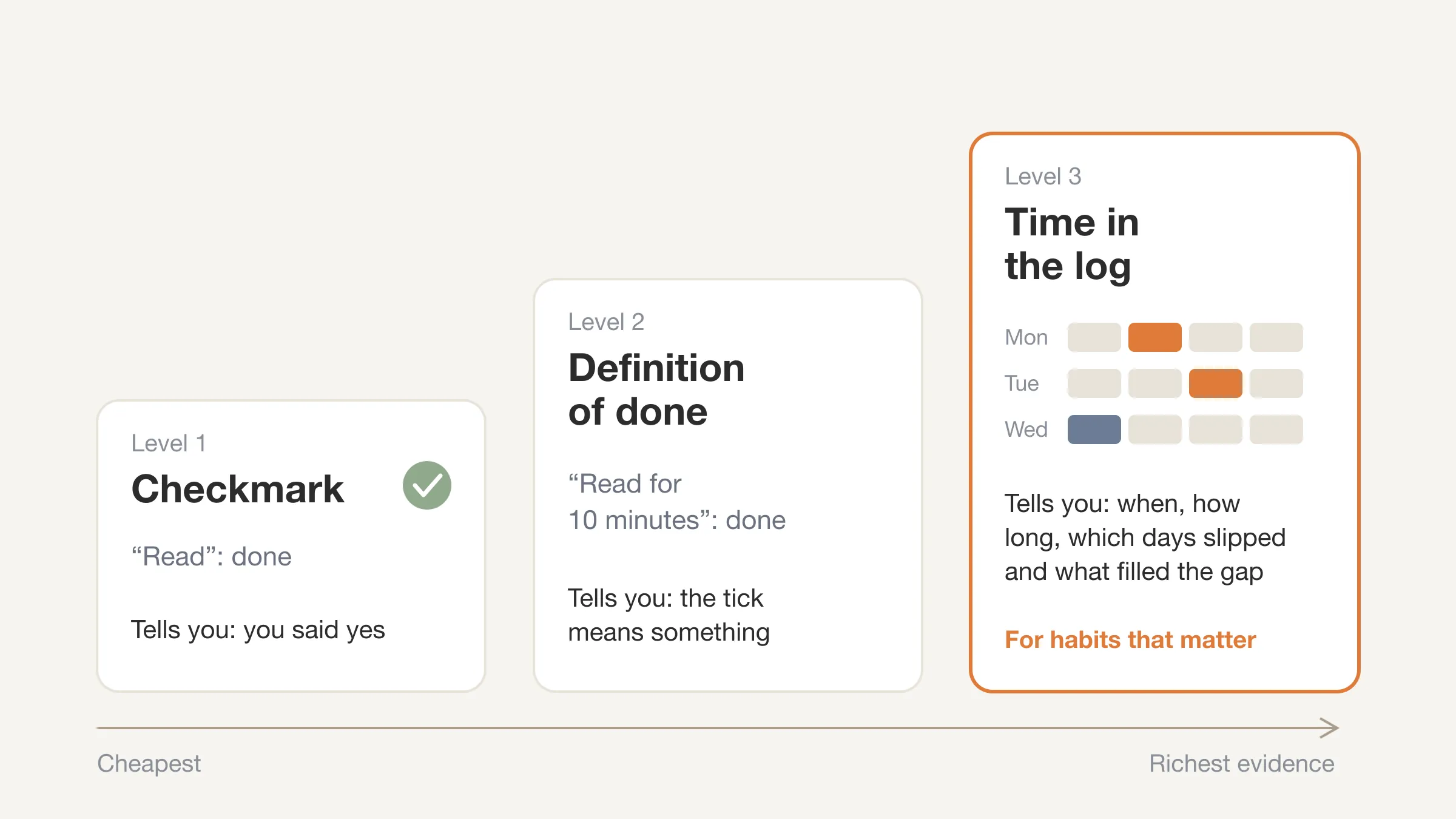
Level 1: the checkmark
You tap done. It is fast and good enough for habits that are binary and low stakes, such as taking a vitamin or making the bed. The weakness is that the tick can be generous. "Read a bit" can mean one line or one hour.
Level 2: a definition of done
Write what "done" means in the habit's name. "Read for 10 minutes" is better than "read". "Walk to the end of the street and back" is better than "exercise". If the definition is clear, the tick means something.
Level 3: time in the log
For habits that matter, log the block. A habit that takes 15 minutes shows up as one block on your day. After two weeks you can answer questions a streak cannot: did it happen at the same time each day, which days did it slip, and what filled the gap on those days.
This is also the cheapest way to see whether a habit fits your life or only your intentions. If your "30-minute study" habit never shows up as two blocks in the log, the plan is the problem, not you.
What should you do when you miss a habit?
You will miss days. Plan for it now so one miss does not become a month.
- Have a minimum version. Two minutes of stretching counts. One page counts. The aim is to keep the pattern alive.
- Do not miss twice, if you can help it. One missed day rarely matters, based on the 2010 study above. A second miss starts a new pattern.
- Look for the cause, not the culprit. If you missed because you were traveling, sick or short on sleep, the habit is fine. If you missed because it never had a time, give it one.
- Change the habit before you change yourself. If a habit fails three weeks in a row, make it smaller or move it to a different part of the day.
For more on making a habit stick, habit stacking ties a new habit to something you already do, and micro-habits shows how to start with the smallest version.
How do you choose a habit tracker to use?
You can track habits on paper, in a spreadsheet or in an app. All three work. What matters is that you look at it every day.
- Paper or a printed grid is fast and has no notifications. Our free habit tracker template gives you a printable grid.
- A spreadsheet lets you count and chart. It needs you to open it.
- An app can remind you and show trends. If you want to compare options, the best habit tracker apps compared lists ten with honest notes.
Beyond Time keeps habits alongside the rest of your day. You pick the habits you want, they appear in your day, and the log shows when and for how long they happened. Habits can run daily or on chosen weekdays, and they sit next to your routines, which are grouped into Health, Life, Work and Sleep. The AI reflection reads the logged day, so it can show where time leaked and suggest one or two changes for tomorrow.
What is a good habit tracker setup for the first month?
A simple plan:
- Choose one habit from the list that connects to something you want.
- Define done in a sentence, with a minimum version.
- Give it a time: after breakfast, after lunch, before bed.
- Track it for 14 days with a checkmark, and log the block for at least a week so you can see how it fits.
- Review at day 14. Is it automatic, hard, or irrelevant? Keep, shrink or drop it.
- Only then add a second habit.
If you want to sort the first few days of your log into categories, the daily time log template gives you a copyable sheet.
Give your habits a place in your day
Log the day in 15-minute blocks, tick your habits, and see the week by category. Free for two weeks, everything unlocked.
Try Beyond Time freeFrequently Asked Questions
What are good habits to track?
Good habits to track are small, specific and repeatable, such as a 10-minute walk, one page of reading, a glass of water on waking, or writing down tomorrow's top priority. Choose one to three that connect to something you care about.
How many habits should I track at once?
Track one to three habits at once. Start with one at its minimum version, add a second after a few weeks if the first feels automatic, and add a third only if both are holding.
How long does it take to form a habit?
It varies widely. A 2010 study in the European Journal of Social Psychology found it took between 18 and 254 days for volunteers to reach a plateau of automaticity, and that missing one day did not materially affect the process. Plan for weeks, not days.
What is the difference between a habit and a routine?
A habit is a single repeated behavior, like a 10-minute walk. A routine is a sequence of behaviors, like a morning routine of water, stretching and planning. Habits are the parts, and routines are how they fit together in a day.
How do I track habits without an app?
Use a paper grid, a spreadsheet or a notes page with one row per habit and one column per day. Tick each day you do it. A printable habit tracker template is the quickest way to start.
What should I do if I miss a habit?
Do the minimum version the next day and try not to miss twice in a row. Then ask why you missed. If it keeps happening, make the habit smaller or give it a fixed time.
Should I track habits with time as well as checkmarks?
For habits that matter, yes. A checkmark shows the habit happened. A time log shows how long it took, when it happened and what it displaced. You do not need to do this for every habit, only for the ones you care about most.
Habit tracker ideas: start with one
The best habit tracker ideas are small enough to survive your worst day and specific enough to check. Choose one from the list, define done, give it a time, and track it for 14 days. Expect the habit to take weeks to settle, and expect to miss a day.
Your time is limited, and each habit takes a share of it. Pick the habits worth the hours, then see where the hours really go. If you want help, Beyond Time puts your habits next to a 15-minute log of the day, so you can see whether the habit fits.
Put this into practice
Free tools that match this article.
Habit Tracker Template
Create a free printable habit tracker template — weekly or monthly. Customize your habits and download a clean PDF in seconds.
Try Habit TrackerHabit BuildingHabit Stack Builder
Use habit stacking to build new habits by attaching them to your existing routines.
Try Habit Stack BuilderHabit Building30-Day Challenge Generator
Build any habit with a personalized 30-day challenge featuring daily tasks and weekly milestones.
Try 30-Day ChallengeAssessmentLife Audit Tool
Score your life in 6 key areas and get a personalized action plan to create balance and fulfillment.
Try Life AuditKeep exploring this topic
Atomic Habits summary
Apply the core behavior-change principles behind lasting habits.
Habit stacking guide
Attach new behaviors to routines you already do every day.
Life audit guide
Review the areas of life that need more attention and intention.
Personal development plan
Create a growth plan that connects identity, habits, and goals.
Related Articles

How Many Minutes in a Week? 10,080, and Where They Go
How many minutes in a week? 10,080, or 6,720 waking minutes at 8 hours of sleep. See the minutes in each activity for an average week and how many are left.
Daily Goals: How to Set 1-3 That Get Done (With Examples)
Daily goals work when you set one to three and size them in 15-minute blocks. See examples, how to link them to weekly goals, and a two-minute check at night.

Bucket List Ideas: 100 Ideas Grouped by Theme and Lead Time
100 bucket list ideas grouped by theme and tagged by lead time: now, this year, or years ahead. Count the weeks you have, then pick ten. Start your list today.

How to Stop Doomscrolling: 9 Practical Fixes That Work
How to stop doomscrolling: add friction, swap in better habits and check your Screen Time against a real log of your day. Nine fixes, with sources. Try one.

Life Plan Template: A One-Page Plan With Weekly Costs
A free life plan template you can copy: eight areas of life, one outcome each, and a weekly time cost so your plan fits the 112 waking hours you really have.
How Many Work Weeks in a Year? 52 Minus Your Time Off
How many work weeks in a year? 52 on paper, usually 46 to 50 after holidays and leave. See the table by days off, 2026's count and the weeks left this year.