
How to Journal: Start in 5 Minutes With Any Format
Learn how to journal in five minutes a day: pick a format, a time and a first line. Includes seven formats, starter prompts and ways to make the habit stick.
To start journaling, pick one place to write, one time of day and a five-minute timer. Then write one true sentence about today and keep going until the timer stops. That is a complete journal entry. You can improve the format later. The only thing that matters at the start is that the entry exists.
Most people who want to learn how to journal stall on the same three questions. What do I write about? How long should it take? What if I miss a day? This guide answers all three, compares seven formats so you can pick one that fits your life, and shows why a simple log of your day can work as the shortest journal there is.
Key takeaways
- Start with five minutes and a single line. A small entry you actually write beats a long one you plan.
- There is no correct format. Free writing, lists, one line a day and prompts all count.
- A journal records how a day felt. A time log records what happened. Used together they cover both halves.
- Journaling is a habit, not a treatment. If low mood or worry is heavy or constant, talk to a doctor or mental health professional.
How do you start journaling if you have never done it?
Start by shrinking the job until it is hard to skip. A first journal does not need a beautiful notebook, a theme or a plan for the year. It needs a pen or a phone, five minutes and a rule you can follow on a tired night.
Here is a starting routine you can use today:
- Pick a time you already have. After brushing your teeth, with your first coffee, or when you sit down on the train. Attach the entry to something that already happens every day.
- Set a five-minute timer. When it ends, you are allowed to stop. Often you will not want to, but you are allowed.
- Write the date and one factual sentence. "Tuesday. Rain all day, worked from the kitchen table." Facts are easier to start with than feelings.
- Add one more thing. What went well, what bothered you, or what you want to remember. One sentence is enough.
- Close the book. Do not reread it tonight. Rereading comes later, and only if you want it.
Five minutes a night for a year adds up to about 30 hours of attention aimed at your own life. That is a small price for a record of what your year actually held.
What do you need to start a journal?
Almost nothing. The best tool is the one you will actually open.
- Paper is slower, which some people like. It has no notifications and nothing else to tap. The cost is that you have to carry it and find a pen.
- A notes app or document is always with you and easy to search later. The cost is that your phone is full of other things asking for attention.
- A voice memo works if typing and writing both feel like a chore. You can talk for two minutes while you walk.
Pick one and use it for two weeks before you decide it is wrong. Switching tools is a common way to avoid the habit while feeling busy with it.
Privacy matters more than people expect. If you worry that someone will read your entries, you will edit yourself, and the journal stops being honest. Choose a place only you can open: a locked app, a notebook in a drawer, or a document with a password.
Which journaling format should you choose?
There are many ways to journal. These seven cover most of what people do. Try one for a week and see how it feels.
| Format | How it works | Time | Best for |
|---|---|---|---|
| Free writing | Write without stopping or editing until the timer ends | 5 to 15 min | Clearing your head, finding out what you think |
| Morning pages | Three pages of longhand writing first thing, an idea from Julia Cameron's The Artist's Way | 20 to 30 min | People who want a daily mental dump and have time for it |
| One line a day | A single sentence about the day | 1 min | Beginners, busy people, long-term memory keeping |
| Gratitude list | Three specific things you noticed went well | 2 min | Ending the day on something good |
| Prompted journaling | Answer one question from a list | 5 min | People who stare at a blank page |
| Brain dump | List every open loop, worry and task on your mind, unsorted | 5 min | Busy minds, Sunday nights, before planning |
| Bullet journal | A system of short bullets for tasks, events and notes, created by Ryder Carroll | 5 to 10 min | People who want one notebook for planning and reflection |
Free writing
Set a timer, start writing and do not stop to fix a word. If you run out of things to say, write "I have nothing to say" until something else shows up. It will. The point is to get past the part of your mind that edits.
One line a day
This is the most underrated format. One honest sentence a day gives you 365 sentences by the end of the year. Reading them back, you will see patterns that no single day showed: the months you were tired, the weeks you were happy, the things you kept coming back to.
Brain dump
A brain dump is not really a diary. It is a place to put everything that is circling in your head so it stops circling. Write it all, in any order. Afterward, circle the one or two things that need action this week and leave the rest on the page.
See where today actually went
Log your day in 15-minute blocks, then add a line about how it felt. Two minutes in the morning, two at night.
Try Beyond Time freeWhat should you write about when you journal?
Start with what happened, then add what you noticed. Most blank-page problems come from trying to write something profound. You do not need to. A few starting points:
- What did I do today that I want to remember?
- What took more energy than I expected?
- What am I looking forward to tomorrow?
- What is one thing I am avoiding, and why?
- What would I tell a friend who had the day I just had?
If you want a bigger set to choose from, pick a different question each night for a week and note which ones led to the most honest writing. Those are the ones to keep.
You can also journal around a theme for a month: sleep, a project, a relationship, a decision you are trying to make. A narrow focus makes it easier to see change. If the theme is your goals, a five-minute daily goal review works the same way.
How long and how often should you journal?
Five minutes, most days, is a good place to start. Daily is easiest to turn into a habit because there is no decision to make. Two or three times a week also works if daily feels heavy, as long as the days are fixed so you are not deciding each time.
There is research on this, with limits worth knowing. The best-known work is on "expressive writing" by psychologist James Pennebaker. In its classic form, people wrote about a stressful or emotional experience for about 15 to 30 minutes a day, for one to five consecutive days. Pennebaker and Chung describe how this procedure was set up, and they also describe the results with care: reviews of the studies found small average effects, and a 2003 review by Meads concluded the evidence was not sufficient to adopt the method in clinical practice. One more detail: comparison groups were typically asked to write about something superficial, such as how they use their time.
What that means for you: journaling may help you process a hard stretch, and many people find it clarifying. It is not a proven treatment, and the research was about writing on a specific emotional topic, not about daily diary entries in general. Treat it as a useful habit, not as a medical tool.
How do you make journaling stick?
Make the habit smaller than your motivation on your worst day. Most journals stop in the second or third week, when the novelty fades and a busy evening gets in the way. Plan for that week now.
- Set a minimum version. On bad days, the entry is one sentence. "Tired. Skipped the gym. Went to bed." That still counts, and it keeps the chain unbroken.
- Attach it to an anchor. Write right after something that already happens daily. If you need a reminder, set it to the anchor, not to a clock time.
- Keep the tool within reach. Leave the notebook on your pillow or the app on your home screen.
- Do not catch up. If you miss three days, start again today. Writing "I missed a few days" is a fine first line. Long catch-up entries turn the habit into a chore.
- Skip the rereading for now. Pick a day each month to look back. The rest of the time, writing is the job.
- Let it be boring. Most entries will be ordinary. That is what makes the unusual ones stand out.
If you already follow an evening routine or a night routine for better sleep, journaling fits in the last five minutes before you switch the lights off. The night routine planner can help you place it.
Can a time log be your journal?
Yes, and it is the shortest journal you can keep. A journal usually records how the day felt. A time log records what the day actually contained. Each tells you something the other cannot.
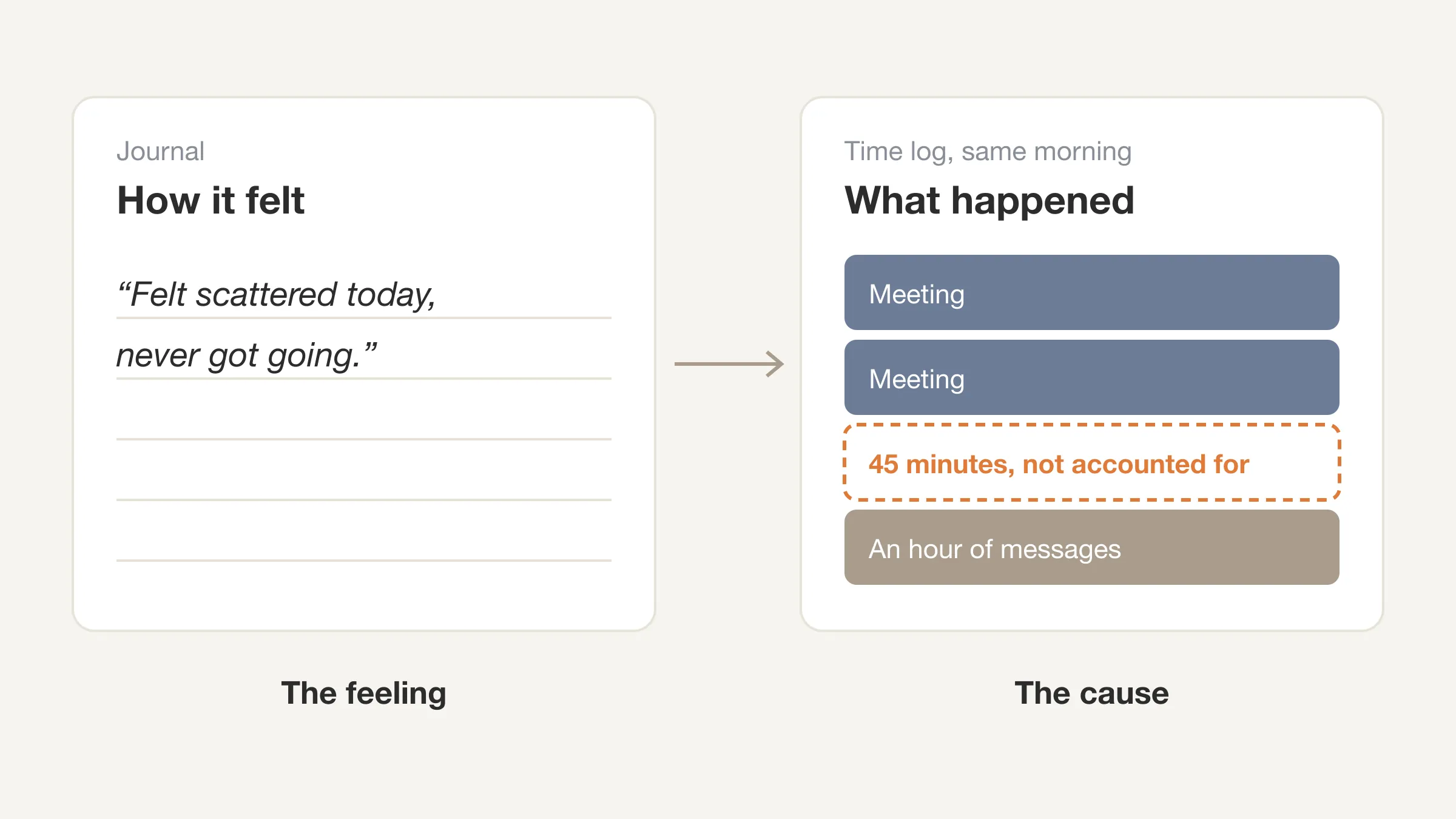
Think about the difference. A journal entry might say, "Felt scattered today, never got going." A log would show that the morning had two meetings, a 45-minute gap you cannot account for and an hour of messages. Together they explain the scattered feeling. The journal gives you the feeling. The log gives you the cause.
Logging also takes less effort than writing. A day has 96 fifteen-minute blocks. In Beyond Time you open Log time, pick a block and pick what you were doing, grouped as Health, Life, Work or Sleep. Blocks you did not log stay marked as "Not logged," so the gaps are visible. It takes about two minutes in the morning and two at night. If you want the full method, read the 15-minute time block method and grab the daily time log template to try it on paper first.
At the end of the day, End your day asks you to rate how health, life and work felt from 1 to 10 and lets you add a line if you want. That is a journal entry in under a minute: three numbers and a sentence. The numbers become a trend you can scan across weeks, and the line holds whatever you would have written anyway. When you want help reading the pattern, the AI reflection looks at the logged day and tells you what went where you meant it to, where time leaked and one or two changes for tomorrow.
You do not need an app for any of this. A paper log and a notebook do the same job. The app only removes the friction.
Journal in numbers and one line
Rate how health, life and work felt from 1 to 10, add a sentence, and see the week's pattern.
Try Beyond Time freeWhat if you do not like writing?
You can journal without writing paragraphs. Pick whichever of these suits you.
- Speak it. Record a two-minute voice note while you walk or wash dishes.
- Use a word. Pick one word for the day and a reason in a few words.
- Take a photo. One photo a day with a caption of five words.
- Draw or list. A small sketch, a mood color or a list of three things.
- Use numbers. Rate the day from 1 to 10 for energy, mood or focus. Over a month, the numbers show a shape.
A journal is a record you can read later. It does not have to look like a diary.
What are the most common journaling mistakes?
- Starting too big. Thirty minutes a day lasts a week. Five minutes can last years.
- Writing for an imagined reader. If you are polishing sentences, you are not journaling. Write the way you think.
- Only writing when things are bad. If you only open the journal in a crisis, it becomes a record of crises. Add small, good days too.
- Looping. Writing the same worry in the same words every night is rumination on paper. If the entry is not changing, change the question: "What is one small thing I can do about this?" or "What would I say to a friend?"
- Judging the entry. There are no grades. An entry that says "Nothing happened" is still a record of a day.
- Never looking back. Once a month, spend ten minutes reading the last few weeks. Notice what repeats. Look at the time audit guide if you want to turn what repeats into a plan.
When should you talk to a professional?
Journaling is a way to notice and organize your thoughts. It is not therapy and it does not replace care. This is general information, not medical advice.
Consider talking to a doctor or mental health professional if low mood, worry or hopelessness lasts most of the day for two weeks or more, if it affects your sleep, work or relationships, or if journaling keeps pulling you into dark thoughts instead of easing them. If you are thinking about harming yourself, in the United States you can call or text 988 to reach the 988 Suicide and Crisis Lifeline, free and open 24 hours a day. In an emergency, call 911, or your local emergency number.
Frequently Asked Questions
How do I start a journal if I have never written one?
Choose a time, set a five-minute timer and write the date plus one factual sentence about your day. Add one more sentence about what went well or what bothered you, then stop when the timer ends. Repeat tomorrow.
How long should I journal each day?
Five minutes is enough to start. Longer sessions of 15 to 30 minutes are used in research on expressive writing, but they are not required for the habit to be useful, and shorter entries are easier to keep up.
What should I write in my journal?
Write what happened and what you noticed: something you want to remember, something that took energy, something you are avoiding, something you look forward to. If you are stuck, answer one question and stop.
Is it better to journal in the morning or at night?
Neither is better, so use whichever you will actually do. Morning entries tend to be about intentions and mental clutter. Evening entries tend to be about what happened and how it felt. Pick the time that already has a gap in it.
Should I use a paper notebook or an app?
Use the one you will open every day. Paper has fewer distractions. An app is always with you and easier to search. Try one for two weeks before changing.
What if I miss a day of journaling?
Start again the next day and do not write a long catch-up entry. One line such as "Missed three days, back today" is enough. Missing a day is normal, and a minimum version for bad days keeps the habit alive.
Does journaling improve mental health?
It may help some people process stress, but the evidence is mixed and the effects found in studies are small on average. It is a useful habit, not a treatment. If you have persistent low mood or anxiety, talk to a health professional.
How to journal, in short
To journal, pick a time, set five minutes and write one true sentence about today. Choose a format that matches how you think, keep a minimum version for bad days and look back once a month. If words feel like work, a short log of the day with three ratings and a line gets you most of the way. Your time is limited. A few minutes of attention a day is a good way to see where it goes.
See where it goes
Log the day in 15-minute blocks, rate it 1 to 10, add a line. Your first two weeks are free, all features included.
Try Beyond Time freePut this into practice
Free tools that match this article.
Weekly Schedule Template
Plan your week with a free printable weekly schedule template for goals, routines, and focus blocks.
Try Schedule TemplateHabit BuildingHabit Tracker Template
Create a free printable habit tracker template — weekly or monthly. Customize your habits and download a clean PDF in seconds.
Try Habit TrackerTime ManagementTime Blocking Template
Map your day into focused time blocks with a free printable time blocking template.
Try Time BlockingHabit BuildingHabit Stack Builder
Use habit stacking to build new habits by attaching them to your existing routines.
Try Habit Stack BuilderKeep exploring this topic
Atomic Habits summary
Apply the core behavior-change principles behind lasting habits.
Time blocking guide
Turn priorities into protected calendar blocks.
Habit stacking guide
Attach new behaviors to routines you already do every day.
15-minute time blocks
Plan and review your day with more realistic precision.
Related Articles

How Many Minutes in a Week? 10,080, and Where They Go
How many minutes in a week? 10,080, or 6,720 waking minutes at 8 hours of sleep. See the minutes in each activity for an average week and how many are left.

Bucket List Ideas: 100 Ideas Grouped by Theme and Lead Time
100 bucket list ideas grouped by theme and tagged by lead time: now, this year, or years ahead. Count the weeks you have, then pick ten. Start your list today.

How to Stop Doomscrolling: 9 Practical Fixes That Work
How to stop doomscrolling: add friction, swap in better habits and check your Screen Time against a real log of your day. Nine fixes, with sources. Try one.

Life Plan Template: A One-Page Plan With Weekly Costs
A free life plan template you can copy: eight areas of life, one outcome each, and a weekly time cost so your plan fits the 112 waking hours you really have.
How Many Work Weeks in a Year? 52 Minus Your Time Off
How many work weeks in a year? 52 on paper, usually 46 to 50 after holidays and leave. See the table by days off, 2026's count and the weeks left this year.

Second Brain Method Explained: CODE, PARA and Who It Suits
A second brain is a trusted place outside your head for notes and ideas. See how Tiago Forte's CODE and PARA work, who it suits, and what notes can't tell you.