Quality Time: What It Means and How to Make More of It
Quality time is undivided attention shared with someone. See what counts, 25 ideas by relationship, and how to check how much quality time you really had.
Quality time is time you spend with someone, or with yourself, where your attention is fully on the moment and the other person. A short dinner with phones away counts. A long evening on the same couch with everyone looking at a screen mostly does not.
That definition is easy to agree with and hard to measure, which is why most people overestimate how much quality time they have. This guide explains what quality time means, gives you 25 ideas grouped by relationship, and shows you how to check how much you actually had last week. It is not about guilt. It is about seeing the hours clearly enough to give the best ones to the people who matter.
Key takeaways
- Quality time means undivided attention and a shared experience. Length matters less than presence, but you still need some time for presence to happen.
- Most people have more "together" time than quality time. The difference is attention.
- Ideas work best when they are small and repeatable: a 15-minute walk, a weekly dinner, a call on the same day each week.
- Counting your quality blocks for one week shows whether it matches what you say matters.
What does quality time mean?
Quality time has two ingredients:
- Attention. You are there. Your phone is away, your mind is not on the next task, and you are listening.
- Shared experience. You are doing something with the other person, even if the something is just talking, walking or cooking.
Counselor Gary Chapman made the phrase famous in The Five Love Languages (1992), where "quality time" is one of five ways he says people tend to give and receive affection. It is a popular framework from counseling practice, and plenty of people find it useful as a conversation starter. You do not have to accept all of it to take the practical point: for many people, undivided attention is what makes time together feel like time together.
Quality time is not the same as quantity of time. It is also not the same as expensive time. A weeknight walk with a friend can be more "quality" than a weekend trip where everyone is on their phones.
It also applies to time with yourself. An hour alone with a book you chose is quality time. An hour of scrolling alone is just an hour.
Is quality time more important than quantity?
Both matter, and the honest answer is that it depends on the relationship and the stage of life.
Research on parents and children is a good example. A 2015 study in the Journal of Marriage and Family by Melissa Milkie, Kei Nomaguchi and Kathleen Denny used time-diary and survey data from the Panel Study of Income Dynamics. It covered children aged 3 to 11 and adolescents aged 12 to 18. The researchers found that the total amount of time mothers spent with younger children was not clearly linked to the children's behavior, emotions or academic results. For adolescents, more engaged time was linked to fewer delinquent behaviors, and time that was engaged with both parents mattered in some ways (Milkie, Nomaguchi and Denny, 2015, abstract). The study measured the amount and type of time, not how good that time felt, so treat it as one careful look, not the final word.
What you can safely take from it: more hours do not automatically mean better outcomes, and the kind of time matters. But you cannot have quality moments without any time at all. Most good conversations happen in the middle of ordinary hours, not in scheduled "quality" slots. The practical goal is enough time, with enough attention, often enough.
How much time do we actually spend together?
Here is a useful anchor. According to the U.S. Bureau of Labor Statistics' 2025 American Time Use Survey, people spent an average of 35 minutes a day socializing and communicating in 2025, down from 41 minutes in 2015. Watching TV was the leisure activity that took the most time, at 2.6 hours a day. Adults living with a child under 6 spent about 2.3 hours a day on primary childcare, while adults whose youngest child was 6 to 17 spent about 47 minutes (BLS, American Time Use Survey 2025 results).
These are averages across very different lives, so do not judge yourself against them. They show the shape of the problem: for many people, time with others is a small slice of the day, and it is easy for that slice to be shared with a screen.
Here is the math on your own week. A week has 168 hours, and if you sleep about 8 hours a night you are awake for about 112 of them. That is 448 fifteen-minute blocks. On Thursday 15 October 2026 there are 77 days left in the year, which is exactly 11 weeks. If you gave one more hour a day of real attention to the people you love, that is 7 hours a week and 77 hours before the year ends. It is not a huge change. It adds up.
See your week in hours
Log your day in 15-minute blocks and see how much time went to the people and things you care about.
Try Beyond Time freeWhat are 25 quality time ideas?
Pick a few that fit the person and the time you have. Short and repeatable beats grand and rare.
With a partner
- A 15-minute check-in with no phones. Sit down, ask one real question, listen.
- A weekly dinner out or in, same night every week. The routine is what makes it survive busy weeks.
- A walk after dinner. Walking side by side makes talking easier.
- Cook together once a week. Split the tasks and talk while you chop.
- A shared project. Plant a garden, learn a recipe, plan a trip. A project gives you something to talk about besides logistics.
With children
- Ten minutes of child-led play. Let them choose and follow their lead. You are there to join in, not direct.
- A weekly one-on-one outing. One child, one adult, any small place: a park, a bakery, a library.
- Bedtime talk. Five minutes at bedtime when everything is quiet often gets the most honest conversation.
- Cook or build something together. It does not need to turn out well.
- With teenagers, drive somewhere together. Side-by-side time is easier than face-to-face for many teens.
With friends
- A standing call or walk. Same day, same time, every week or two.
- Do something with your hands. Cook, hike, play a game, work on a project. Activities take the pressure off conversation.
- A small, regular meetup. Coffee on the first Saturday of the month will happen more reliably than "let's catch up soon".
- A shared challenge. Train for a 5K, read the same book, learn something together. A friend also makes a natural accountability partner for goals you share.
- Say yes to the short version. A 20-minute coffee counts. You do not need a whole evening.
With parents and family
- A weekly call at a fixed time. It becomes a ritual both sides can count on.
- Ask for one story. "Tell me about the first place you lived." You will learn something and they will feel heard.
- Cook a family recipe together. Write it down while you do.
- Visit for a purpose. A project, a meal, a walk. A visit with a small plan is easier to enjoy.
- Record or write what they say. Time with older relatives is limited in a way we do not always notice. If the thought is heavy, you do not have to dwell on it. Let it simply nudge you to go.
With yourself
- A solo walk without headphones. Twenty minutes.
- One hour a week of something you chose. Not something you should do.
- A morning quiet block. Ten minutes before the day starts. See our morning routine research for ideas.
- A weekly review. Look back, then pick one thing to look forward to. Our guide to weekly reviews shows how.
- A day with no plan. Occasionally leave a block open on purpose and see what you reach for.
How do you protect quality time when life is busy?
Intentions are not enough. Three small moves help.
Put it on the calendar. If a weekly dinner is not on the calendar, work will take it. If work keeps winning, the ideas behind slow productivity, doing fewer things at a natural pace, can free the evenings. A named, recurring slot ("Thursday 7 pm: dinner") is much harder to lose than "sometime this week".
Make the phone boring during that time. Put it in another room, or turn on a focus mode. The point is not discipline. It is lowering the number of decisions you have to make in the moment.
Use small blocks. You do not need three hours. A fifteen-minute block is enough to ask a good question and hear the answer. A day has 64 waking blocks. Finding two or three for the people you love is realistic even in a busy week. Our guide to the 15-minute time block method explains how to see them.
If you worry that you are not spending enough time with the people you love, our post on work-life balance and goal setting can help you reset the shape of the week. The aim is not to feel guilty. It is to make a choice you can feel good about.
How do you check how much quality time you actually had?
This is the part nobody does, and it changes things.
Most people estimate their quality time by feel, and feel is unreliable. A week of shared evenings in front of a TV can feel like time together without having much of the attention part. A hectic week with one great walk can feel better than it was in hours.
The fix is a simple log. For one week, record your day in fifteen-minute blocks. Then add one more column: who was with me, and was I really there? You are not grading yourself. You are counting.
At the end of the week:
- Count the blocks. How many fifteen-minute blocks were spent with the people who matter most? Multiply by 15 for minutes.
- Count the quality blocks. How many of them had full attention, no phone, a shared experience?
- Compare with what you would say matters. If family and friends are the top of your list and they got 90 minutes of a 112-hour week, that is worth knowing. If they got 14 hours and you feel guilty anyway, that is worth knowing too.
- Pick one change. Not five. One block, once a week, protected.
Our daily time log template gives you a ready-made grid. If you would rather do it in an app, Beyond Time lets you log blocks by routine, grouped as Health, Life, Work and Sleep, so "Life" shows how much of the week went to relationships, hobbies and rest. The weekly view shows every hour of the week split by category, and the AI reflection points out where time leaked and suggests one or two changes. For a method that starts from the 168 hours, see our post on the 168-hour week framework.
A note on guilt
If the numbers surprise you, the right response is curiosity. Most people in the middle of busy lives have less quality time than they would like, and the useful move is a small change, not a promise to be a different person. If you feel persistent low mood or anxiety about your relationships that does not ease, it is worth talking to a doctor or a therapist.
What does quality time look like in a week?
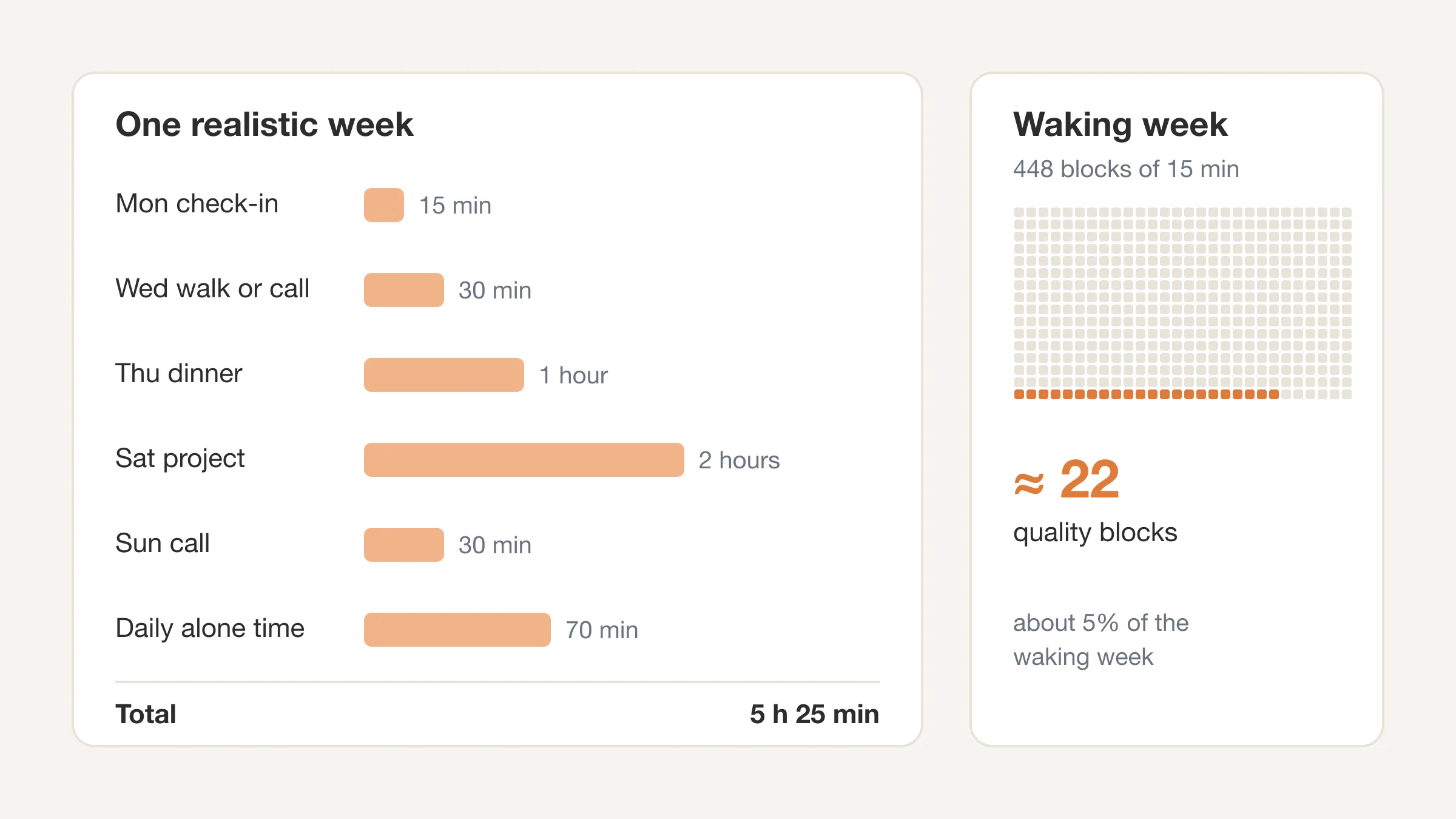
A realistic example (an illustration, not data) for someone who works full time and has a partner and a friend or two:
| When | What | Time |
|---|---|---|
| Monday | 15-minute phone-free check-in after dinner | 15 min |
| Wednesday | Walk with a friend or a call | 30 min |
| Thursday | Weekly dinner, same night | 1 hour |
| Saturday | A shared project or outing | 2 hours |
| Sunday | Call a parent or relative | 30 min |
| Daily | Ten minutes alone with no screen | 70 min |
That is about 5 hours and 25 minutes in a week, or roughly 22 fifteen-minute blocks out of 448. It is a small share of the week and it could change how the week feels. If that seems like too much, start with one row.
For a gentle way to build the habit around it, our guide to habit stacking shows how to attach a new routine to an old one. The weekly schedule template is a good place to put the slots.
Count the hours that matter
One week of logging shows how much time went to the people you love. See it, then change one block.
Start your free trialFrequently Asked Questions
What is quality time?
Quality time is time spent with another person, or by yourself, with your full attention on the moment. It combines presence (phones away, mind in the room) with a shared experience, such as talking, cooking, walking or playing. It does not require money or long stretches of time.
Is quality time more important than quantity?
Both matter. Research on parents and children suggests that simply adding hours does not guarantee better outcomes and that the kind of time matters, but you still need enough time for good moments to happen. A realistic goal is enough time, with real attention, on a regular schedule.
How much quality time should you spend with your partner?
There is no standard number, and what feels right differs by couple. A practical start is a short daily check-in and one longer protected block each week, then adjust based on how you both feel. Counting the blocks for one week shows you where you are now.
What are some quality time ideas for busy people?
Use small blocks: a 15-minute phone-free check-in, a walk after dinner, a weekly call at a fixed time or a 20-minute coffee. Short, regular, protected time usually works better than big plans that keep getting postponed.
How do you know if you are getting enough quality time?
Log a week in 15-minute blocks, mark which blocks were spent with the people who matter to you, and note which of those had full attention. Compare the count with what you say matters. If there is a gap, pick one block a week to protect.
Can you have quality time with yourself?
Yes. Time alone with a book, a walk or a hobby you chose counts when you are fully there for it. It helps to schedule it like any other appointment, because it is easy to give away.
Quality time is attention you can count
Quality time is undivided attention shared with someone, and it is easy to overestimate. Most people have more time together than quality time together, and the difference is whether the phone is away and the mind is in the room.
On 15 October 2026 you have 11 weeks left in the year. Count last week's quality blocks, pick one to protect, and add one more. If you want to see where your hours go, Beyond Time shows the week in blocks, so the time that matters is easy to find and easy to grow.
Put this into practice
Free tools that match this article.
Weekly Schedule Template
Plan your week with a free printable weekly schedule template for goals, routines, and focus blocks.
Try Schedule TemplateTime ManagementTime Blocking Template
Map your day into focused time blocks with a free printable time blocking template.
Try Time BlockingTime ManagementWeekly Schedule Optimizer
Generate an optimized weekly schedule with AI-powered time blocking for maximum productivity.
Try Schedule OptimizerFocusFocus Session Planner
Create AI-optimized focus sessions with structured work blocks and refreshing breaks.
Try Focus PlannerRelated Articles

Digital Minimalism: A Gentle 30-Day Declutter That Sticks
Digital minimalism means using technology only where it serves what you value. Try a gentle 30-day declutter, then measure the hours that came back. Start here.
Slow Productivity: Cal Newport's Ideas and How to Use Them
Slow productivity means doing fewer things at a natural pace with high quality. Here is Cal Newport's idea in plain words, and how to check your hours.
Quarter Life Crisis: Signs, Causes and a Way Through It
A quarter life crisis is a stretch of doubt about career, relationships and direction in your 20s or early 30s. Learn the signs, causes and a way through it.
How to Romanticize Your Life: 15 Small Ways to Start Today
How to romanticize your life without spending money: 15 small rituals, a one-week experiment, and a way to see which hours were worth savoring. Start today.

Four Thousand Weeks: Lessons and How to Use Them
Four Thousand Weeks by Oliver Burkeman, summarized in plain words, with the math of how many of your weeks are gone and what to do with the rest. Start here.
Habits of Successful People: 6 That Have Real Evidence
The habits of successful people that research actually supports: sleep, movement, if-then plans, tracking, focus and self-testing. Sources included. Test one.