
Time Anxiety: Signs, Causes and Calm Ways to Cope With It
Time anxiety is the dread that time is slipping away. Learn the common signs, why it grows when days feel unaccounted for, and calm practices that help.
Time anxiety is a persistent worry or dread about time: that it is passing too fast, that you are running out of it, or that you are wasting it. It is not a medical diagnosis. It is a plain-language name for a feeling many people recognize, often late on a Sunday, on a birthday, or at the end of a day that seems to have gone nowhere.
If you are reading this because the feeling is heavy, start with the simplest point: wanting to use your time well is not the problem. The distress comes from not being able to see what your time is doing. Vague dread grows in the dark. Specific facts usually shrink it.
This guide covers what time anxiety looks like, why it grows when your hours feel unaccounted for, and calm, practical steps. It is general information, not medical advice, and it ends with when to talk to a professional.
Key takeaways
- Time anxiety is a common name for dread about time passing or being wasted. It is not a formal diagnosis.
- It tends to grow when days blur together and you cannot say where the hours went.
- Your time is limited. Seeing exactly where it goes replaces vague dread with facts you can act on.
- If the worry is constant, affects sleep or daily life, or feels unmanageable, talk to a doctor or mental health professional.
What is time anxiety?
Time anxiety is anxious thinking about time itself. It can mean fear of aging, a sense of being behind in life, a feeling that every hour must be used well, or dread of time passing without anything to show for it.
You may also see the word chronophobia. It is sometimes used informally for an intense fear of time or of time passing. It is not a term to self-diagnose with. If you are searching for it, what matters is not the label but whether the worry is affecting your life.
Time anxiety overlaps with other things: general worry, perfectionism, burnout, and the pressure of big life milestones. It also shows up around specific moments, such as New Year, birthdays and the end of a semester. It is useful to separate three flavors:
- Passing: "Time is going too fast, and I cannot stop it."
- Wasting: "I should be doing something more useful with this hour."
- Running out: "There is not enough time to do what matters."
Each calls for a different response, and the practices below touch all three.
What are the signs of time anxiety?
The signs are a mix of thoughts, feelings and habits. You do not need all of them. Common ones include:
Thoughts
- Frequent thoughts like "where did the day go?" or "I'm falling behind."
- Counting how many years or weeks you have left, and feeling worse afterward.
- Guilt when you rest, because rest feels like wasted time.
- Comparing your timeline to other people's.
Feelings
- A tight or restless feeling on Sunday evenings or at the end of a day.
- Dread on birthdays or at the turn of the year.
- Feeling rushed even when nothing is urgent.
Habits
- Overscheduling, or packing every hour so nothing is "wasted."
- Constantly checking the clock or calendar.
- Avoiding planning at all, because looking at the calendar is uncomfortable.
- Trouble relaxing or falling asleep because your mind lists what you did not do.
One sign alone is not a reason to worry. A pattern that is frequent, hard to switch off, or getting worse is what deserves attention.
Why does time anxiety grow when your time feels unaccounted for?
Uncertainty feeds anxiety, and an unaccounted day is uncertain. If you finish a day unable to say what you did with the hours, your mind fills the gap with the worst version: "I did nothing," "I wasted it," "I will never catch up."
Three things make this worse.
Days blur. When days are alike, memory compresses them, so a week feels like it vanished. Our guide to why time goes by so fast explains how routine shrinks the past. A shrunken past feels like lost time.
Estimates are unreliable. Most of us guess where time went. For many people the guess leans toward guilt: the hour you scrolled is easier to recall than the three hours you did something useful. You may be doing better than you think, or worse. Either way you do not know.
The totals are big and abstract. "A lifetime" or "a year" cannot be pictured. A day can. That is why time anxiety eases when the unit gets smaller and more concrete.
This is not to say a log cures anxiety. It does not. It removes one specific input to it: the unknown.
How much time do you actually have?
More is known than it feels like. A week has 168 hours. Roughly 56 of them, about a third, go to sleep for most adults who sleep eight hours. That leaves around 112 waking hours. If your waking day runs from 7 am to 11 pm, that is 16 hours, or 64 blocks of 15 minutes, a day.
Those numbers do two things. They show that your time is limited, which is a fact you cannot change. And they show that it is countable, which is something you can work with. A day of 64 blocks is small enough to see in full on one screen.
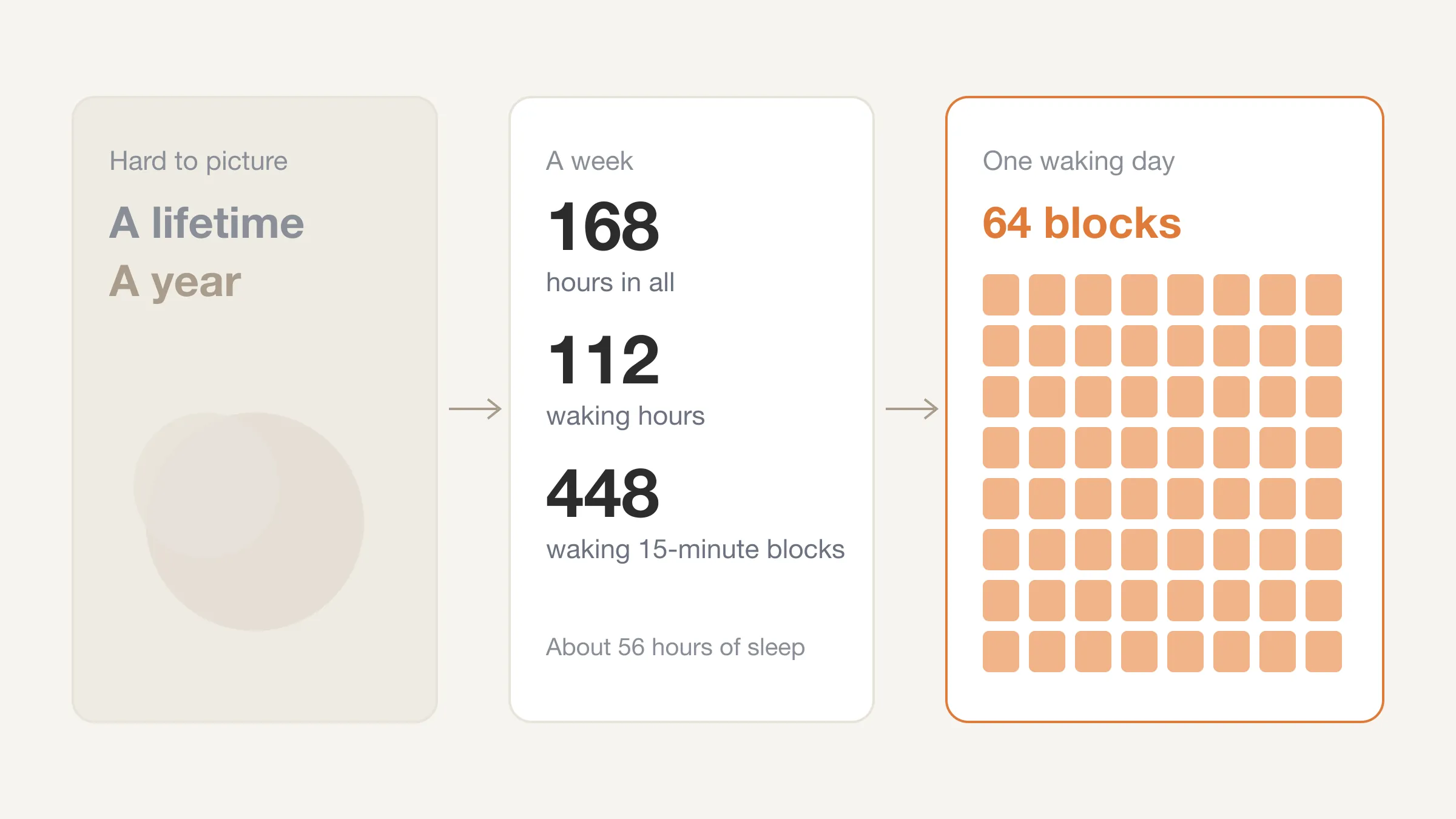
If you want the full breakdown, see how many hours are in a week. It shows that the answer is both 168 and a much smaller number once sleep and work are subtracted.
Counting should be calming, not morbid. The goal is not to stare at a countdown. It is to replace "I have no idea" with "I know roughly what I have."
See where today goes
Log your day in 15-minute blocks, two minutes in the morning and two at night. Replace the vague dread with a day you can see.
Try Beyond Time freeWhat practices help with time anxiety?
These are general, low-pressure practices. None replaces professional help if you need it.
Look at one day, not a lifetime
When your thinking jumps to years, bring it back to today. What are the next 64 blocks? What is the one thing that would make today feel fine? A single day is workable.
Write down what happened
At night, spend two minutes writing what you did, in rough order. Not what you should have done. This shows you a day was not empty, even a hard one. A paper note is enough.
Log in 15-minute blocks for a few days
A short log makes the day concrete. Split the day into 15-minute blocks and note what each held. Do it for three days. Notice how many blocks are accounted for and how many are "not logged." You do not need to fix anything yet. Our time audit guide shows how to run a simple one, and time tracking for beginners covers keeping it light.
Decide what the day is for
Pick one to three things that matter today. Not twelve. When you know what counts as a good day, other hours stop feeling like failures.
Schedule rest on purpose
Rest is part of using time well. Put it in the plan. Sleep matters most: when you are short on it, small worries can feel bigger. If evenings are the hard part, a calmer wind-down is worth building. Our night routine guide is a place to start.
Limit the countdowns
Some people find life-in-weeks charts clarifying. Others find them heavy. If looking at how many weeks are left makes you feel worse, skip it. Use the day-sized view instead.
Can tracking your time make anxiety worse?
It can, if you use it to judge yourself. A log is a record, not a verdict. If you find yourself scoring each day or feeling guilty over blank blocks, loosen it.
A few guardrails:
- Keep it short. Two minutes in the morning and two at night is plenty. If it grows, shrink it.
- Treat gaps as information. A "not logged" block is not a failure. It is a block you cannot account for, which is useful to know.
- Skip bad days. You can leave a day blank without it ruining anything.
- Stop if it feeds the worry. If logging increases your anxiety instead of lowering it, pause and consider talking to someone.
In Beyond Time, you start your day by noting how you slept and choosing the few goals that matter. You log time by picking a block and what you were doing, with routines grouped as Health, Life, Work and Sleep. At night you end your day by rating how health, life and work felt from 1 to 10. The AI reflection reads the logged day and tells you what went where you meant it to, where time leaked, and one or two changes for tomorrow. The aim is to be specific, not to grade you.
What is the difference between time anxiety and an anxiety disorder?
Time anxiety is a theme, while an anxiety disorder is a clinical condition diagnosed by a professional. You can have worry about time without having a disorder. And an anxiety disorder can include worry about time among many other worries.
The U.S. National Institute of Mental Health describes anxiety disorders as involving more than occasional worry: the anxiety does not go away, is felt in many situations and can get worse over time, and can interfere with work, school and relationships. See the NIMH page on anxiety disorders.
Only a qualified professional can tell you which applies to you. This article cannot.
When should you talk to a professional?
Consider talking to a doctor or mental health professional if the worry is constant, hard to control, or getting in the way of your life. Examples include trouble sleeping most nights, avoiding work or relationships because of it, physical symptoms such as a racing heart, or feeling unable to enjoy anything.
If you are struggling or having thoughts of suicide, in the U.S. you can call or text 988 to reach the 988 Suicide & Crisis Lifeline. In a life-threatening situation, call 911. Outside the U.S., contact your local emergency number or crisis service.
Asking for help is a sensible response to a real problem. It is not an overreaction.
Frequently Asked Questions
What is time anxiety?
Time anxiety is a common name for persistent worry about time: that it is passing too fast, being wasted or running out. It is not a formal medical diagnosis, but the distress is real and worth taking seriously.
Is chronophobia the same as time anxiety?
Chronophobia is an informal term some people use for intense fear of time or its passing. Time anxiety is a broader everyday phrase. Neither is something to self-diagnose, so talk to a professional if the fear is severe.
What causes anxiety about time passing?
There is no single cause. Common contributors include birthdays and life milestones, comparing yourself to others, perfectionism, burnout and days that blur together so you cannot say where the time went.
How do you stop feeling anxious about time?
You may not stop it entirely, but you can reduce it. Focus on one day at a time, write down what happened, log your day in 15-minute blocks for a few days, and schedule real rest. If it persists, talk to a professional.
Can a time log help with time anxiety?
For some people, yes. A short log replaces "I did nothing" with a specific record, and unknowns feed anxiety. If logging makes you feel worse or turns into self-judgment, stop and consider talking to someone.
When is time anxiety a sign to see a doctor?
See a doctor or mental health professional if the worry is constant, disrupts sleep, work or relationships, or comes with physical symptoms. If you have thoughts of suicide, call or text 988 in the U.S.
Time anxiety, in short
Time anxiety is dread about time passing, being wasted or running out. It grows in the dark, when days blur and you cannot say where the hours went. Your time is limited, and that is exactly why it helps to see it.
Start small. Look at one day. Write down what happened. Log it in 15-minute blocks for three days and read the result without judging it. If the worry stays heavy, talk to a professional.
When you are ready, Beyond Time gives you the day in 64 blocks and the week in one view, so you can see where it goes. For a free paper version, try the weekly schedule template.
See where it goes
Start your day, log time in 15-minute blocks, end your day, then see your week. Two weeks free, everything unlocked.
Download Beyond TimePut this into practice
Free tools that match this article.
Weekly Schedule Template
Plan your week with a free printable weekly schedule template for goals, routines, and focus blocks.
Try Schedule TemplateTime ManagementTime Blocking Template
Map your day into focused time blocks with a free printable time blocking template.
Try Time BlockingTime ManagementWeekly Schedule Optimizer
Generate an optimized weekly schedule with AI-powered time blocking for maximum productivity.
Try Schedule OptimizerFocusFocus Session Planner
Create AI-optimized focus sessions with structured work blocks and refreshing breaks.
Try Focus PlannerRelated Articles
How Many Minutes in a Week? 10,080, and Where They Go
How many minutes in a week? 10,080, or 6,720 waking minutes at 8 hours of sleep. See the minutes in each activity for an average week and how many are left.

Bucket List Ideas: 100 Ideas Grouped by Theme and Lead Time
100 bucket list ideas grouped by theme and tagged by lead time: now, this year, or years ahead. Count the weeks you have, then pick ten. Start your list today.

How to Stop Doomscrolling: 9 Practical Fixes That Work
How to stop doomscrolling: add friction, swap in better habits and check your Screen Time against a real log of your day. Nine fixes, with sources. Try one.
Life Plan Template: A One-Page Plan With Weekly Costs
A free life plan template you can copy: eight areas of life, one outcome each, and a weekly time cost so your plan fits the 112 waking hours you really have.
How Many Work Weeks in a Year? 52 Minus Your Time Off
How many work weeks in a year? 52 on paper, usually 46 to 50 after holidays and leave. See the table by days off, 2026's count and the weeks left this year.

Second Brain Method Explained: CODE, PARA and Who It Suits
A second brain is a trusted place outside your head for notes and ideas. See how Tiago Forte's CODE and PARA work, who it suits, and what notes can't tell you.