Hobbies to Try: 50+ Ideas Sorted by Weekly Time and Cost
Hobbies to try, 50+ ideas sorted by hours a week and cost to start. Find the hours first, test one for four weeks, and keep what sticks. Pick yours today.
The best hobbies to try are the ones that fit the hours you really have. A hobby that needs eight hours a week will not survive a week with two spare evenings, no matter how good it looks online. So this list sorts more than 50 hobbies by the weekly time each one needs and by what it costs to start.
Today is 29 September 2026. There are 93 days left in the year, 94 counting today, which is 13 full weeks. A hobby you start this week gets 13 weeks of attempts before 2027, which is enough to know whether it is for you.
Key takeaways
- A new hobby needs a realistic 2 to 5 hours a week. Over 13 weeks, 3 hours a week is 39 hours, or 156 fifteen-minute blocks.
- The average American aged 15 and over has about 5.1 hours of leisure and sports a day (BLS, 2024). More than half of it is television. Your own number is the one that matters.
- Sort hobbies by weekly hours and start cost, not by how impressive they sound.
- Log one week before you choose. The free hours are usually different from the ones you guess.
How many hours do you actually have for a hobby?
The best public figure comes from the U.S. Bureau of Labor Statistics. Its American Time Use Survey reported for 2024 that people aged 15 and over averaged 5.07 hours a day on leisure and sports. Watching TV was 2.60 hours a day, the largest single piece. Socializing and communicating averaged 0.59 hours, and sports, exercise and recreation 0.31.
Multiply by seven and you get about 35.5 hours of leisure a week and 18.2 hours of TV. That is an average over a whole population, including retirees and teenagers, so it is not a promise about your week. But it makes one point: most people have more hours for a hobby than they believe, and fewer than they would like.
A new hobby at 3 hours a week is about 8 percent of that average leisure time, and under 3 percent of a 112-hour waking week. Here is what different weekly commitments add up to by the end of the year, starting this week:
| Hours a week | Hours in 13 weeks | Fifteen-minute blocks |
|---|---|---|
| 1 | 13 | 52 |
| 2 | 26 | 104 |
| 3 | 39 | 156 |
| 5 | 65 | 260 |
| 8 | 104 | 416 |
Four weeks at 3 hours is 12 hours. For most hobbies, that is enough to tell if you like it, which is all a trial needs to do.
Find out where your free hours really are
Log your day in 15-minute blocks. Two minutes in the morning, two at night. Your free hours show up as the gaps.
Try Beyond Time freeHow do you choose a hobby to try?
Skip "what is popular" and ask five plain questions.
- Making, moving or learning? Pick the verb that sounds best. Making (pottery, sewing, baking), moving (running, climbing, dance) and learning (a language, an instrument, chess) give different kinds of satisfaction.
- Alone or with people? A solo hobby fits odd hours. A group hobby, like a choir or a climbing night, comes with a built-in schedule and built-in accountability.
- How many hours a week can I protect? Not "find", protect. Name the actual blocks.
- What can I spend to start? Many hobbies have a cheap beginner version.
- Does it need daylight, weather or a place? Outdoor hobbies shrink in winter. Check that you can do it in the season you are in.
One more test: pick the hobby you would be glad to be doing in a year, not the one that sounds best in a conversation. If you would be pleased to be a person who does it, it is probably right.
The estimates in the lists below are rough planning figures for a beginner, not measured data, and they will vary by person. Cost labels are for starting out: free, low (a small purchase), mid (some gear or a class), high (serious equipment or fees).
Which hobbies take an hour or two a week?
These fit almost any week. They are the best answer if your honest free time is small, or if you want a first step that is easy to repeat.
- Journaling (1 to 2 hours, free). A notebook and ten minutes a day. It also helps with the habit of looking at your days.
- Sketching (1 to 2 hours, low). A pencil and a cheap pad. Draw what is on the desk.
- Houseplants (1 hour, low). Weekly watering and a monthly repotting. They teach patience.
- Birdwatching (1 to 2 hours, free to low). Start from a window or a park. A free identification app helps.
- Cooking one new recipe a week (2 hours, low). A real hobby in disguise.
- Baking bread (2 hours, low). Much of the time is waiting, which is easy to fit.
- Reading a book a month (2 hours, free). A library card is enough.
- Stargazing (1 to 2 hours, free). Learn five constellations first.
- Walking photography (1 to 2 hours, free). Use your phone, and shoot one theme for a month.
- Hand lettering or calligraphy (1 to 2 hours, low).
- Jigsaw puzzles (1 to 2 hours, low). Good for evenings when you want to do something but not decide.
- Crosswords or sudoku (1 hour, free to low).
- Origami (1 hour, low).
- Tea or coffee tasting (1 hour, low). Keep a note of what you tried.
- Board games with friends or family (2 hours, low). It fits a standing weekly slot.
- Herb gardening on a windowsill or balcony (1 hour, low).
- Learning chess (1 to 2 hours, free). Play short games online.
- Writing letters or postcards (1 hour, low).
- Collecting something small, like coins, stamps, shells or records (1 to 2 hours, low).
- Listening to full albums, with no screen (2 hours, free). A hobby, honestly.
Which hobbies take three to five hours a week?
This is where most skill hobbies live. You can see progress at three hours a week within a couple of months. At this level, protecting specific blocks matters more than motivation.
- Guitar, ukulele or piano (3 to 4 hours, low to mid). Short daily practice beats one long session.
- A language (3 to 5 hours, free to low). Daily contact matters more than long sessions.
- Running (3 hours, low). Three runs of 30 to 60 minutes a week.
- Swimming (3 hours, low to mid). Pool fees are the main cost.
- Cycling (3 to 5 hours, low to high). Start on any working bike.
- Yoga or pilates (3 hours, free to mid). Free videos at home, or a class for feedback.
- Painting (3 to 4 hours, low to mid). Start with a small set of acrylics or watercolor.
- Pottery classes (3 to 4 hours, mid). Wheel time is hard to find at home, so a studio helps.
- Knitting or crochet (3 hours, low). Easy to do while listening to something.
- Sewing (3 to 4 hours, mid). A basic machine and a pattern.
- Woodworking basics (3 to 5 hours, mid). Start with hand tools and simple joints.
- Writing (3 hours, free). A page a day adds up. Fiction, essays or letters all count.
- Coding a small project (3 to 5 hours, free). Pick something you want to use.
- Indoor climbing (3 hours, mid). Social, physical, and a defined session length.
- Dance classes (2 to 4 hours, low to mid). A weekly class is a ready-made schedule.
- Martial arts (3 to 4 hours, mid). Class fees and a uniform.
- Singing in a community choir (2 to 3 hours, low). Rehearsal night plus a bit of practice.
- Volunteering regularly (3 hours, free). A hobby that makes the week feel bigger.
- Photography with editing (3 to 4 hours, low to high). A phone is enough to start.
- Fermenting, like sauerkraut or kombucha (2 hours, low). Hands-on time is small; the waiting is long.
- Model building or miniatures (3 to 4 hours, low to mid).
- Podcasting or audio storytelling (3 to 5 hours, low). A phone and free editing software.
- Drawing comics or illustration (3 to 5 hours, low).
- Weight training (3 hours, low to mid). Three sessions of 60 minutes.
Which hobbies need six hours or more, or big blocks?
These are not for a first month in a busy season. They reward a long weekend or a standing Saturday morning. If you pick one, name the Saturday now. Several of them, like hiking or sailing, also make good picks for a summer bucket list of weekend ideas.
- Vegetable gardening (4 to 8 hours in season, low to mid). Heavy in spring, lighter in summer.
- Hiking and backpacking (6 or more hours, low to high). A day hike is a full morning with travel.
- Fishing (4 to 8 hours, low to mid). Slow, outdoors and mostly waiting.
- Sailing (6 or more hours, mid to high). Lessons first, boats later.
- Mountain biking (3 to 6 hours, mid to high). Bikes and trail access are the main costs.
- Community theater (6 to 10 hours in a production, free to low). A fixed rehearsal calendar.
- Training for a race (4 to 8 hours, low). A fixed finish line makes it easier to keep going.
- Restoring furniture, a bike or a car (4 to 10 hours, mid to high). Needs space and tools.
- Home brewing (a brew day of 4 to 6 hours, mid). Long gaps in between.
- Beekeeping (a few hours a week in season, high). Check local rules, training and equipment before committing.
- Learning to fly or to scuba dive (6 or more hours, high). Often learned in blocks.
- Woodturning or blacksmithing (4 to 6 hours, mid to high). Often needs a shared workshop.
What if I do not know what I would like?
Try a sampler. Pick three hobbies from three groups and give each two weeks at about 3 hours a week, which is roughly 6 hours each. After six weeks, you have 18 hours of evidence about what you like. That is more useful than 18 hours of research.
Note two things after each session: how you felt during, and how you felt going back the next time. Some hobbies are fun while you are doing them and a chore to begin. Others are the reverse. You want the ones you look forward to.
If you need ideas that are social, look at the group hobbies in the lists above. A weekly class or club is easier to keep than a solo plan. If you need ones that are easy to fit, go to the shortest lists. Both work.
Where will the hours come from?
This is where most hobby plans stall. The hours are in your week, but not where you think.
One week of logging answers it. In a daily time log, you mark each 15-minute block with what you did and let the empty ones show as gaps. It takes about two minutes in the morning and two at night. At the end of the week, you can see the real hours that are free, and what they were spent on. The idea is the same one behind the 168 hours framework: you start from the whole week, not the hours you imagine.
A few things you will probably find:
- Fragments. Ten minutes here and there, which add up to hours but do not feel like it.
- Soft spots. Time that was not a choice, like a long scroll or an extra episode. Not a crime, but a source of hours.
- Fixed slots. A weekly standing time, like Sunday morning or Tuesday after dinner, works better than "when I can".
When you have your free blocks, put the hobby on the calendar like any other appointment. The time-blocking template or the weekly schedule template can hold it. If you plan in the morning, a five-minute daily plan is a good place to protect the blocks. And if you tend to put things off, the post on how to stop procrastinating covers the starting problem.
Plan the hobby, then check the week
Beyond Time shows every hour of your week split into Health, Life and Work, with the gaps marked. See what you actually had to spend.
Start your two-week free trialHow do you run a four-week hobby test?
A trial turns "I should try this" into a decision.
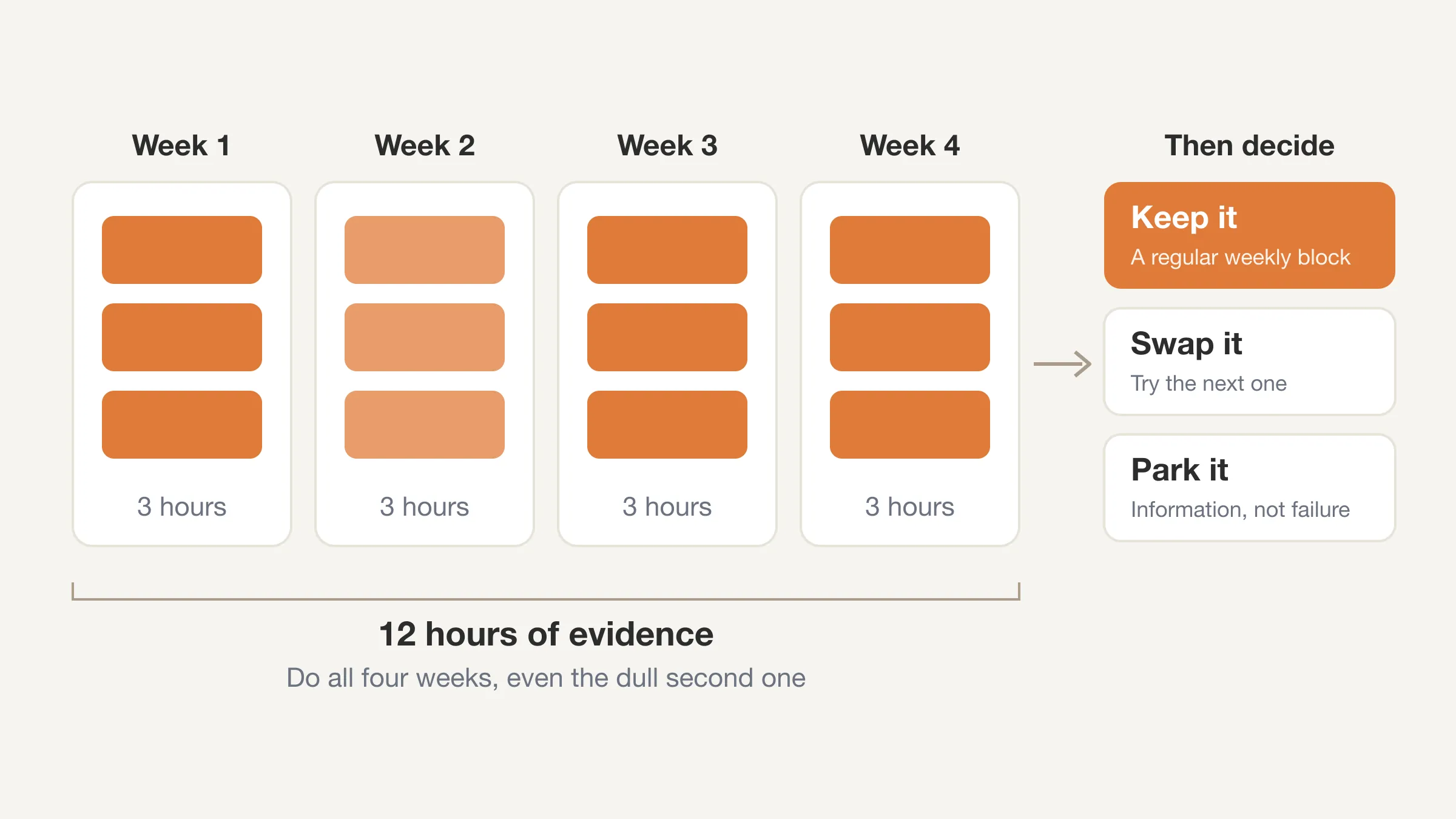
- Pick one hobby. Not three at once.
- Choose your hours. Two or three blocks a week, 60 to 90 minutes each, put on the calendar.
- Keep the first purchase small. Rent, borrow or buy the cheapest version.
- Do all four weeks. Even if the second week is dull. Many hobbies are slow at the start.
- Check in at the end. Did you do it, did you look forward to it, would you keep going?
Then decide. Keep it, swap it, or park it. A hobby you tried and set aside is not a failure. It is information. A hobby you kept is a regular block in your week.
If you want help making it a habit, the list of habit tracker ideas has simple ways to track a weekly practice, and the free habit tracker template is a printable start.
What if I try a hobby and quit?
You will, sometimes. The usual reasons are:
- The time was not real. The hours you picked were already spoken for. Go back to the log.
- The start cost was too high. You bought gear for a person you hoped to become. Start cheaper next time.
- It was not your kind of thing. That is fine. You learned that in four weeks, not four months.
- The weather or season changed. An outdoor hobby in a short winter day needs an indoor backup.
None of these means you are bad at hobbies. They are all scheduling and fit problems, and they are fixable.
Frequently Asked Questions
What are good hobbies to try at home?
Journaling, sketching, baking bread, houseplants, knitting, jigsaw puzzles, chess and writing all work at home and need little gear. They sit in the one-to-three-hours-a-week range, so they fit a busy week.
How many hours a week should I spend on a new hobby?
Two to five hours a week is a good starting range. Over 13 weeks, 3 hours a week gives you 39 hours, which is enough to learn the basics and judge whether you like it.
How do I find time for a hobby?
Log a normal week in 15-minute blocks and look at the gaps. Then give the hobby one or two fixed slots, like Tuesday after dinner or Saturday morning, instead of waiting for free time to appear.
What are cheap hobbies to try?
Journaling, birdwatching, stargazing, walking photography, reading, chess, language learning with free tools, writing and running all cost little to nothing to start. The labels in the lists above show each hobby's start cost.
How do I know if a hobby is right for me?
Try it for four weeks at a steady two or three sessions a week. If you look forward to the sessions and you are still curious at the end, it is a good fit. If you only feel obliged, move on.
How much leisure time do people actually have?
In the U.S. Bureau of Labor Statistics 2024 time-use survey, people aged 15 and over averaged about 5.1 hours a day of leisure and sports, with 2.6 hours of that spent watching TV. Your own number can be very different.
You have 13 weeks left in the year. See where they go.
Log the day in 15-minute blocks, end it with a quick rating, and let the AI reflection show where your time went and what to change tomorrow.
Try Beyond Time freePick one hobby, find the hours, then see where it goes
The best hobbies to try are the ones that fit the hours you can protect. Start with the weekly time and the start cost, pick one from the list, and test it for four weeks at about 3 hours a week.
Your time is limited, and a week of logging shows where it goes, so you know which hours are really free. If you want a second idea for the season, the fall bucket list is a good place to look, and a hobby is a good way to use the weekends on it.
Sources: U.S. Bureau of Labor Statistics, American Time Use Survey 2024 results, published June 26, 2025 (leisure and sports 5.07 hours a day, watching TV 2.60, socializing and communicating 0.59, sports, exercise and recreation 0.31). Weekly figures are the daily averages multiplied by 7. Hobby hour and cost ranges are planning estimates, not measured data. Day and week counts are computed for 29 September 2026.
Put this into practice
Free tools that match this article.
Weekly Schedule Template
Plan your week with a free printable weekly schedule template for goals, routines, and focus blocks.
Try Schedule TemplateTime ManagementTime Blocking Template
Map your day into focused time blocks with a free printable time blocking template.
Try Time BlockingTime ManagementWeekly Schedule Optimizer
Generate an optimized weekly schedule with AI-powered time blocking for maximum productivity.
Try Schedule OptimizerFocusFocus Session Planner
Create AI-optimized focus sessions with structured work blocks and refreshing breaks.
Try Focus PlannerRelated Articles

How Many Minutes in a Week? 10,080, and Where They Go
How many minutes in a week? 10,080, or 6,720 waking minutes at 8 hours of sleep. See the minutes in each activity for an average week and how many are left.

Bucket List Ideas: 100 Ideas Grouped by Theme and Lead Time
100 bucket list ideas grouped by theme and tagged by lead time: now, this year, or years ahead. Count the weeks you have, then pick ten. Start your list today.

How to Stop Doomscrolling: 9 Practical Fixes That Work
How to stop doomscrolling: add friction, swap in better habits and check your Screen Time against a real log of your day. Nine fixes, with sources. Try one.
Life Plan Template: A One-Page Plan With Weekly Costs
A free life plan template you can copy: eight areas of life, one outcome each, and a weekly time cost so your plan fits the 112 waking hours you really have.
How Many Work Weeks in a Year? 52 Minus Your Time Off
How many work weeks in a year? 52 on paper, usually 46 to 50 after holidays and leave. See the table by days off, 2026's count and the weeks left this year.

Second Brain Method Explained: CODE, PARA and Who It Suits
A second brain is a trusted place outside your head for notes and ideas. See how Tiago Forte's CODE and PARA work, who it suits, and what notes can't tell you.