How to Stop Procrastinating: 7 Evidence-Based Fixes
How to stop procrastinating: treat it as a mood problem, not laziness. Seven fixes backed by research, plus a log that shows what delay costs. Start today.
To stop procrastinating, make the first step so small that starting costs almost nothing, decide in advance when and where you will do it, and go easy on yourself about the last delay. Procrastination is less a time-management problem than a feeling-management one: we put off tasks that feel bad, and the delay buys short-term relief.
That framing changes the fix. If you are not lazy and not broken, you do not need more willpower. You need to lower the emotional price of starting, and you need an honest look at where the delayed hours actually go. This guide gives you seven fixes with the research behind each, then a way to check what is working.
On 8 September 2026 there are 114 days left in the year, about 16 weeks. At 16 waking hours a day that is 1,824 hours. Something you have been avoiding for a month has already used up a slice of them. The good news is that the next hour is still yours.
Key takeaways
- Researchers define procrastination as voluntarily delaying something you intend to do, even though you expect to be worse off for it.
- A leading explanation is mood repair: avoiding a task relieves a bad feeling now and costs you later.
- The fixes that have evidence behind them are small first steps, if-then plans, self-forgiveness, less friction and nearer deadlines.
- A time log shows the real cost of delay in blocks, which is more motivating than guilt.
What is procrastination, and why do we do it?
In his meta-analysis of the research, psychologist Piers Steel describes procrastination as voluntarily delaying an intended action despite expecting to be worse off for the delay (Steel, 2007). The "despite" is the point. This is not rest and it is not careful planning. It is delay you know is a bad deal.
Across 691 correlations, Steel found the strongest and most consistent predictors were task aversiveness, how far off the payoff is, low self-confidence about completing the task, and impulsiveness. Note what is missing: nothing in that list is simple "laziness".
Is procrastination about mood?
Largely, yes. Fuschia Sirois and Timothy Pychyl argue that procrastination is a short-term mood repair strategy: when a task brings up boredom, anxiety or self-doubt, putting it off feels better right now, and the cost lands on your future self (Sirois and Pychyl, 2013). The relief reinforces the habit, so next time the urge is stronger.
This view is also why "just try harder" fails. Pushing against a bad feeling with willpower is the exact condition in which the avoidance wins. For the five common types and the neuroscience, see our companion piece on the psychology of procrastination. This guide is the practical sequel: what to do, in order, and how to check that it worked.
How do you stop procrastinating? Start by naming what you are avoiding
Before you pick a fix, spend one minute on a single question: what, specifically, feels bad about starting? The honest answers usually fall into a few buckets, and each has a different best fix.
| What it feels like | Likely cause | Best first fix |
|---|---|---|
| "I don't know where to begin" | The task is too big or vague | Shrink the first step (Fix 1) |
| "I'll do it when I feel like it" | Waiting for motivation | Decide when and where (Fix 2) |
| "I'm already behind, why bother" | Shame about past delay | Forgive the last lapse (Fix 3) |
| "I keep getting pulled away" | Cues and friction | Change the environment (Fix 4) |
| "It's not due for weeks" | Distant payoff | Pull the deadline closer (Fix 5) |
This is a rule of thumb, not a diagnosis. You can have more than one at once. Pick the one that matches today and try it for a week.
Fix 1: How do you make the first step small enough to start?
Big goals invite delay because the payoff is far away and the work looks endless. A classic experiment gave children who struggled with and disliked arithmetic one of three setups: near-term subgoals, a distant goal, or no goal. Those with subgoals progressed fastest and ended up with more skill, confidence and interest (Bandura and Schunk, 1981). The authors' reasoning is that nearby targets give you immediate direction, while a distant one makes it easy to slack off now.
Apply it by shrinking the first step until it is nearly silly. "Write the report" becomes "open the file and write the title". "Clean the garage" becomes "put on shoes and move one box". You are not promising to finish. You are promising to start for five minutes.
Try this: write the smallest visible action on a sticky note. Do only that. Then decide whether to stop. Most of the time, you will not.
Fix 2: How do you decide when and where, so you do not wait for motivation?
Waiting until you feel like it hands the decision to your mood, which is the thing causing the delay. Motivation tends to follow action rather than lead it, which is why staying motivated over the long term depends more on systems than on feelings. An if-then plan takes the decision out of the moment: "If it is 9:30 and I have made coffee, then I will open the report at my desk."
A meta-analysis of 94 tests found this kind of implementation intention had a medium-to-large effect on goal attainment (Gollwitzer and Sheeran, 2006). A later analysis of 642 tests found effect sizes between 0.27 and 0.66 depending on the outcome, with larger effects for if-then plans, for highly motivated people and for rehearsed plans (Sheeran, Listrom and Gollwitzer, 2024). So it helps, with an honest asterisk: the size varies.
Put the plan in your calendar as a block, with a clock time. A named block is harder to drift past than a vague intention. The time blocking guide shows how.
Fix 3: Why does forgiving yourself reduce procrastination?
It sounds backward, but guilt is a bad feeling, and bad feelings are the fuel. If you beat yourself up for delaying, the task becomes more aversive, and you delay again.
In a study of first-year students, those who forgave themselves for procrastinating before the first exam procrastinated less before the second, and the link ran through lower negative feeling (Wohl, Pychyl and Bennett, 2010). Two caveats matter. The study was observational, so it does not prove forgiveness caused the change. And the effect showed up for students who had procrastinated heavily the first time.
Forgiveness here does not mean excusing it. It means acknowledging the delay, saying "that happened, and it cost me", and then moving to the next small step instead of spiraling.
Fix 4: How do you reduce friction and cues?
You do not need to resist temptation if it is not in reach. In experiments with nearly 800 smartphone users, people did worse on cognitive tests when their phone was on the desk, even face down and silent, than when it was in another room (Ward and colleagues, 2017). The effect was strongest among people most dependent on their phones. Not every later attempt to repeat the experiment has found the effect (Ruiz Pardo and Minda, 2022), so treat this as a cheap experiment, not settled science.
Practical moves:
- Phone in another room for the first block of hard work.
- Close the tabs that are not the task.
- Put the thing you need in front of you the night before: the document open, the shoes by the door.
- Make the avoided task the easiest thing available, and the distraction the hardest.
None of this is willpower. It is arranging the room so the first step is the path of least resistance.
See where the delay goes
Log your day in 15-minute blocks. Two minutes in the morning, two at night, and the hours you lose to putting things off become visible.
Try Beyond Time freeFix 5: How do you pull a distant deadline closer?
Piers Steel and Cornelius König's temporal motivation theory says, in short, that motivation rises with how much you expect to succeed and how much you value the outcome, and falls the further away the payoff is (Steel and König, 2006). That is why a deadline three weeks away feels weaker than one tomorrow, even if the work is the same.
You can borrow this effect. Break the big deadline into dated checkpoints: a draft outline by Thursday, section one by Monday. Tell someone, or put it where you will see it. Small dated deliverables convert a distant payoff into a near one.
You can also make the near-term payoff real. Pair the avoided task with something you like, such as a favorite playlist or a good coffee, but only for the task. That raises the value of starting now.
Fix 6: How do you keep going once you have started?
Starting is the hard part, but it is not the only part. Two habits help you keep going.
Define done. "Work on the thesis" never ends, so you can never feel finished. "Methods section: 300 words" does. A clear end makes it easier to start, because you know the cost.
Leave yourself the next step. When you stop, write one line about what to do next. The next session begins with motion instead of a blank page. This also helps with attention: researchers have found that unfinished tasks leave part of your attention behind, which they call attention residue (Leroy, 2009). A parked note gives the unfinished task somewhere to rest.
If a task is huge or you freeze up often, the perfectionist's guide to getting things done covers the standard-setting side.
Fix 7: Why should you log the day, and what will it show?
This is the fix most guides skip, and it is the one that makes the others honest. Procrastination hides in the gaps: the 20 minutes before you start, the "quick check" that became an hour, the afternoon that "disappeared". Memory smooths those gaps over. A log does not.
People are also poor judges of how long tasks take. In one study, honors students predicted their thesis would take 33.9 days and it took 55.5, with only about 30 percent finishing by their own forecast (Buehler, Griffin and Ross, 1994). If your sense of your day is too optimistic, your sense of how much you procrastinate is probably off too, in either direction. Some people discover they delay less than they feared. Others find a two-hour hole every afternoon.
There is also evidence that watching progress helps. A meta-analysis of 138 studies (about 20,000 participants) found that prompting people to monitor goal progress promoted goal attainment, with larger effects when progress was physically recorded (Harkin and colleagues, 2016). Most of the studies were about health, so carry it over with care.
Here is the simplest way to use a log against procrastination:
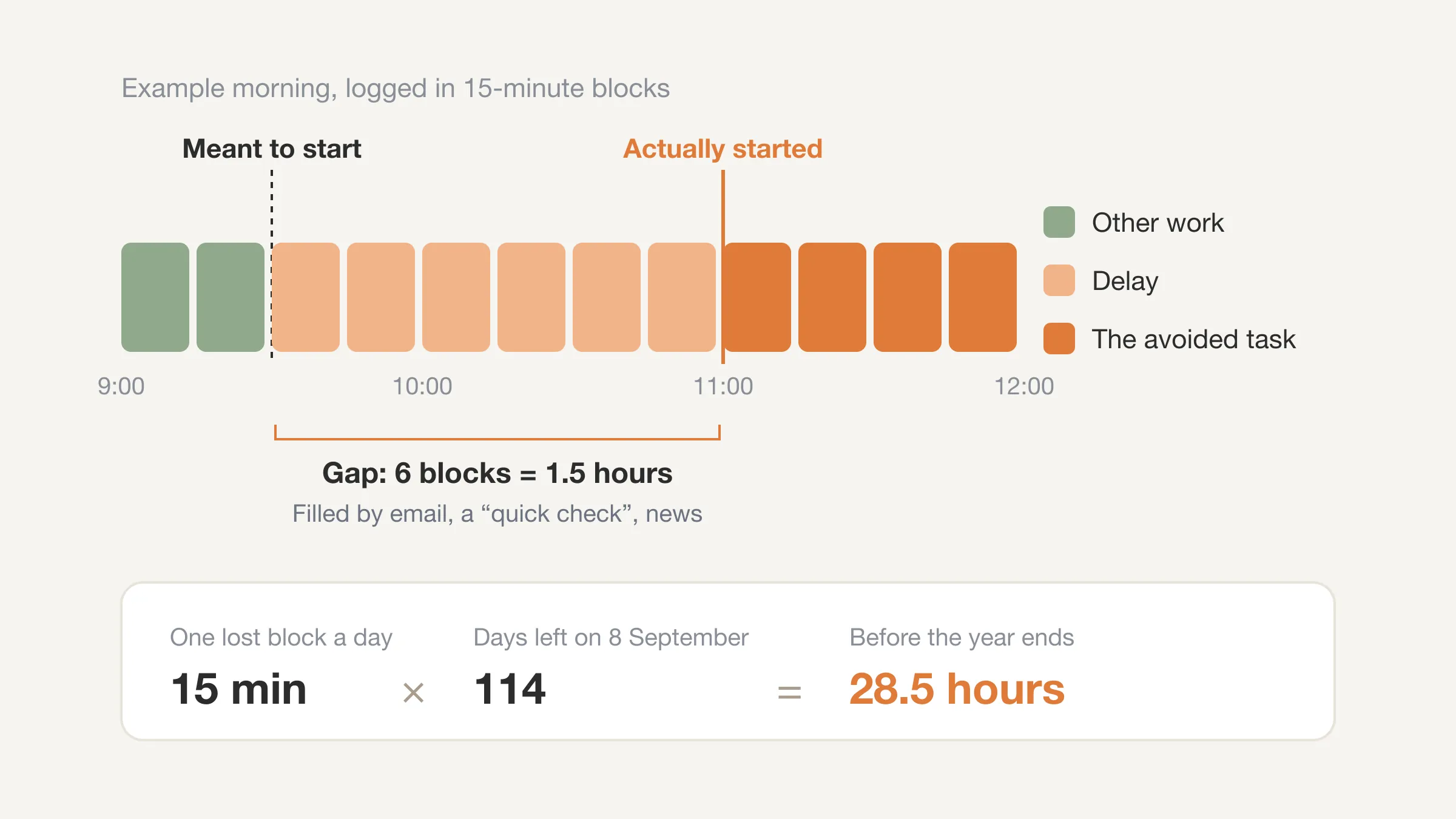
- Log the day in 15-minute blocks for one week. A waking day has 64 of them.
- Mark the block where you meant to start the avoided task, and the block where you actually did.
- Count the gap. That gap is the cost of delay, in your own hours.
- Look at what filled it. That is your cue to change, usually by Fix 4.
Do not use the number to scold yourself (see Fix 3). Use it the way you would use a map. With 1,824 waking hours left this year, one lost block a day is 114 blocks, about 28.5 hours. That is not a disaster, and it is not nothing. Our guide to how to do a time audit goes deeper.
What does a five-minute start look like in practice?
Here is the whole thing in one short routine you can run today.
- Name it. Say what you are avoiding and what feels bad about it, in one sentence.
- Shrink it. Write the smallest first action.
- Schedule it. Pick a clock time and a place, today.
- Clear it. Phone in another room, tabs closed, materials out.
- Start for five minutes. Then decide whether to continue.
- Log it. Mark the block you started in.
Run it for one task, not ten. Habits form from repetition, and one task repeated beats a big reset that lasts three days. If you slip, forgive it and run the routine again tomorrow.
When is it more than procrastination?
Sometimes chronic delay is a sign of something else, such as attention difficulties, depression, anxiety or burnout. Our general information here is not a diagnosis. If delay is constant, causes you real distress, or affects your work, studies or relationships, talk to a doctor or a licensed mental health professional.
If you have ADHD or suspect it, the strategies here may need adjusting, and our guide to productivity with ADHD covers systems built for it.
Frequently Asked Questions
What is the fastest way to stop procrastinating right now?
Shrink the first step and do it for five minutes. Open the file, put on your shoes, write one sentence. You are only committing to five minutes, and you can stop after that if you want to.
Why do I procrastinate even when I know it will hurt me?
Because avoiding the task relieves a bad feeling now, and the cost comes later. Researchers describe procrastination as short-term mood repair, where your present self wins over your future self (Sirois and Pychyl, 2013).
Is procrastination just laziness?
No. Steel's meta-analysis points to task aversiveness, distant payoffs, low self-confidence and impulsiveness as key predictors, not a lack of effort.
Does the Pomodoro technique help with procrastination?
It can, because a 25-minute block is a small, bounded first step. Choose a length you will actually keep. See our guide to focus sessions beyond the timer.
How long does it take to stop procrastinating?
There is no fixed number. One study of habit formation found the median time for a new behavior to feel automatic was 66 days, with a range from 18 to an estimated 254 days (Lally and colleagues, 2010). Expect weeks, not days, and judge progress by your log.
Can procrastination be a good sign?
Sometimes. If you keep avoiding one task, it may mean the goal no longer fits, or the plan is wrong. A log helps tell the difference: if you delay only that one thing, ask whether it still matters.
How to stop procrastinating: the short answer
To stop procrastinating, shrink the first step, decide when and where you will do it, forgive the last lapse, remove the cues that pull you away, and bring the deadline closer. Then look at your day in 15-minute blocks to see what delay really costs and whether the fixes are working.
Your time is limited: 114 days remain this year as of 8 September. Seeing where they go is the honest mirror that makes every other fix stick.
Log the first block you start
Beyond Time shows your day in 96 fifteen-minute blocks. Its AI reflection points out where time leaked and suggests one or two changes. Free for two weeks.
Try Beyond Time freePut this into practice
Free tools that match this article.
Weekly Schedule Template
Plan your week with a free printable weekly schedule template for goals, routines, and focus blocks.
Try Schedule TemplateTime ManagementTime Blocking Template
Map your day into focused time blocks with a free printable time blocking template.
Try Time BlockingTime ManagementWeekly Schedule Optimizer
Generate an optimized weekly schedule with AI-powered time blocking for maximum productivity.
Try Schedule OptimizerFocusFocus Session Planner
Create AI-optimized focus sessions with structured work blocks and refreshing breaks.
Try Focus PlannerKeep exploring this topic
Related Articles
Productivity Tips: 25 That Hold Up, and Why They Work
25 productivity tips grouped by plan, focus, finish and review, each with the evidence behind it. Start with the one tip that makes the other 24 work.
How Many Minutes in a Week? 10,080, and Where They Go
How many minutes in a week? 10,080, or 6,720 waking minutes at 8 hours of sleep. See the minutes in each activity for an average week and how many are left.
Bucket List Ideas: 100 Ideas Grouped by Theme and Lead Time
100 bucket list ideas grouped by theme and tagged by lead time: now, this year, or years ahead. Count the weeks you have, then pick ten. Start your list today.

How to Stop Doomscrolling: 9 Practical Fixes That Work
How to stop doomscrolling: add friction, swap in better habits and check your Screen Time against a real log of your day. Nine fixes, with sources. Try one.

Life Plan Template: A One-Page Plan With Weekly Costs
A free life plan template you can copy: eight areas of life, one outcome each, and a weekly time cost so your plan fits the 112 waking hours you really have.
How Many Work Weeks in a Year? 52 Minus Your Time Off
How many work weeks in a year? 52 on paper, usually 46 to 50 after holidays and leave. See the table by days off, 2026's count and the weeks left this year.