How to Get Over Mental Blocks: Break Through Now
Feeling stuck? Learn how to get over mental blocks with a system to diagnose causes, break through instantly, and prevent their return.
The cursor is blinking. You've opened the document, maybe renamed it twice, maybe checked email, maybe reorganized your desktop, and still nothing moves. You know the task matters. You might even know exactly what the outcome should be. But your brain won't cooperate.
That's the part most advice misses. A mental block usually isn't a character flaw or a motivation problem. It's a state. Sometimes it's fear. Sometimes it's overload. Sometimes it's burnout wearing a productivity mask. If you treat all of those the same way, you stay stuck longer than necessary.
The practical way to learn how to get over mental blocks is to stop chasing random tips and start using a system. Diagnose the block. Break the freeze. Build a setup that makes the next block less likely. Then track what helps, so you're not relearning the same lesson every week.
Table of Contents
- That Blank Page Staring Back at You
- Identify Your Mental Block's True Cause
- Immediate Techniques to Break the Freeze
- Build a Routine to Prevent Future Blocks
- Actionable Exercises and Micro-Routines
- Track Your Progress and Stay Accountable
- From Being Stuck to Unstoppable
That Blank Page Staring Back at You
A founder sits down to write an investor update and suddenly starts checking Slack. A student opens a thesis draft and spends half an hour changing the font. A manager knows a hard conversation needs to happen, but keeps adding smaller tasks to the day instead. Different jobs, same pattern. The work isn't impossible. It just feels impossible to enter.
That frozen feeling can wreck more than a single task. It drags confidence down with it. The longer you stare at something you “should” be able to do, the easier it is to assume the problem is you.
It usually isn't.
Mental blocks are better treated as signals than verdicts. They point to friction somewhere in the system. Once you identify that friction, the work gets more mechanical and less mysterious. That matters, because momentum rarely returns through insight alone. It returns when you reduce friction enough to act again.
Mental blocks don't need a dramatic breakthrough. They need a reliable process that gets you moving before avoidance hardens into a habit.
Identify Your Mental Block's True Cause
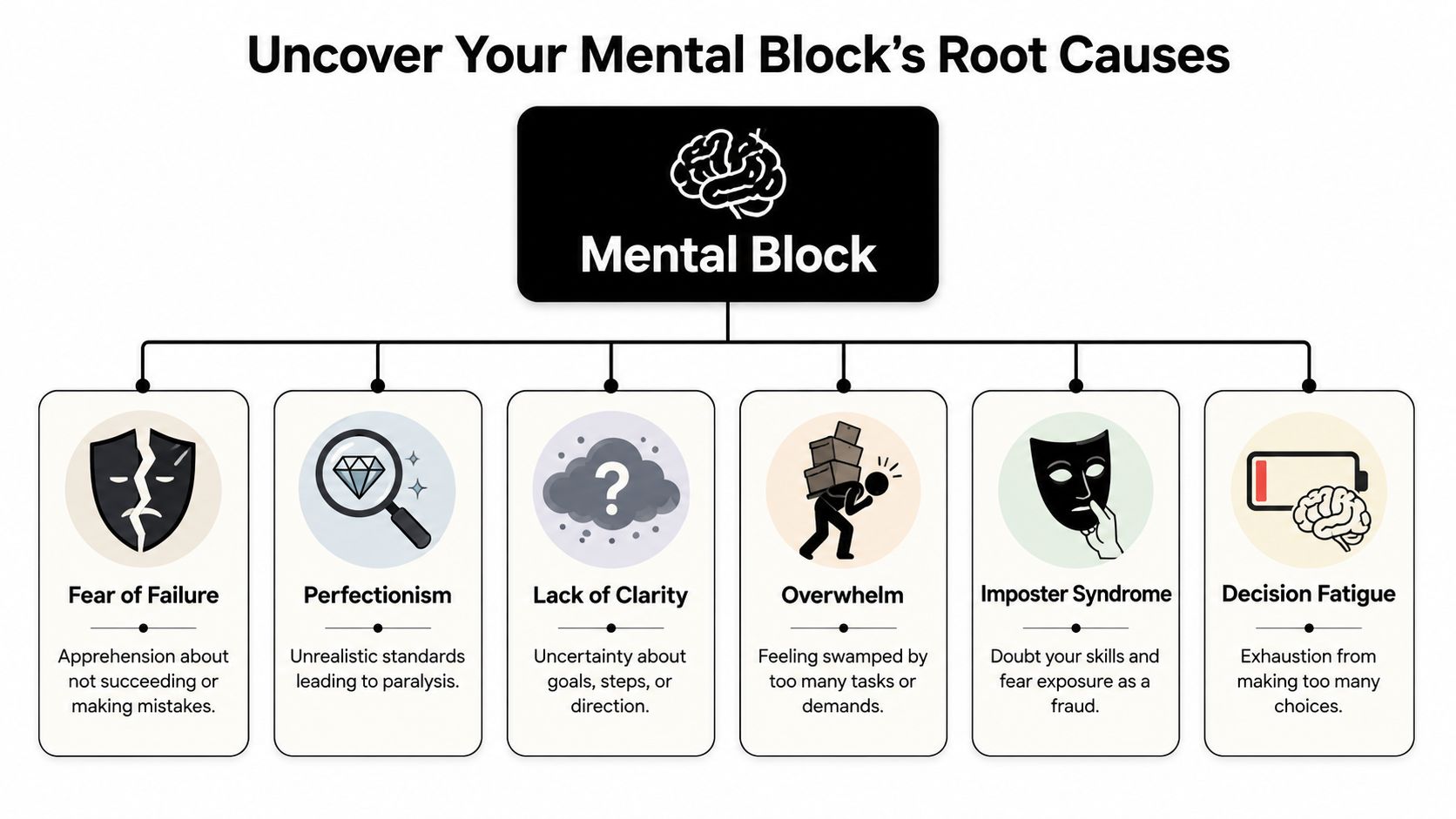
If you misdiagnose the block, you pick the wrong fix. People call themselves lazy when they are anxious. They force output when they are depleted. They seek inspiration when the issue is that the task is still too vague to start.
Mental blocks often come from fear, negative self-talk, cognitive distortions, or overload, and practical guidance recommends slowing down, writing things out, and examining your thinking rather than relying on willpower alone, as noted in Sage Clinic's overview of mental blocks.
Fear feels different from overload
A fear-based block usually sounds like this in your head: “What if I do this badly?” “What if people see I'm not ready?” “What if I try and it proves something about me?” The work feels charged. Your body often tightens before you even begin. You might procrastinate, but the procrastination is really self-protection.
A perfectionism block is more polished and more deceptive. You still look productive. You make outlines, tweak templates, compare tools, rewrite the first paragraph, and delay anything that would expose imperfect work. The standard is so high that starting feels dangerous.
For many people, perfectionism and anxiety travel together. If that's your pattern, THERAPSY's insights on managing anxiety give a useful lens for understanding why high standards so often turn into paralysis instead of performance.
A burnout block feels heavier. You're not only avoiding the task. You're struggling to care, concentrate, or recover. The issue isn't just resistance. It's reduced capacity. The wrong move here is to increase pressure and call it discipline.
A quick self-diagnosis check
The fourth common category is overload. This one shows up when the task has too many moving parts, too many decisions, or no clear entry point. People often say, “I don't know where to start,” which usually means the project hasn't been reduced into workable units.
Ask yourself these questions:
- What emotion appears first: Fear, irritation, dread, numbness, or confusion?
- What thought repeats: “It has to be great,” “I can't do this,” “I'm too tired,” or “There's too much”?
- What behavior follows: Avoidance, obsessive refining, low-energy drifting, or jumping between tasks?
- What would help most: Safety, permission to be imperfect, actual recovery, or clearer next steps?
Here's the trade-off often overlooked:
| Block type | What helps | What usually fails |
|---|---|---|
| Fear | Lower stakes, smaller exposure, present-focus | Self-criticism |
| Perfectionism | Drafts, limits, version one thinking | More polishing before starting |
| Burnout | Recovery, boundaries, reduced load | Pushing harder |
| Overload | Sequencing, chunking, externalizing tasks | Keeping it all in your head |
Practical rule: If you can't name the block, don't trust your first fix.
Write the problem out in plain language. “I'm blocked because I haven't defined the first deliverable.” “I'm blocked because I'm scared of feedback.” “I'm blocked because I'm mentally cooked.” That sentence alone can save hours of fake effort.
Immediate Techniques to Break the Freeze
When you're deep in a freeze, analysis can become another delay tactic. You need something physical and concrete enough to interrupt the stall.

Use your body first
Mental blocks are often reinforced by a stress response. One recommended reset is deep breathing and muscle relaxation for 30 to 60 seconds, including breathing in through the nose for about 5 seconds and then exhaling slowly, as outlined in EBSCO's mental blocks guidance.
That matters because a stressed brain narrows attention. You don't need a perfect mindset before starting. You need enough calm to regain choice.
Try this reset in order:
- Plant your feet: Sit back or stand up. Feel contact with the floor.
- Inhale through your nose for about 5 seconds: Don't force a giant breath.
- Exhale slowly: Let the shoulders drop.
- Relax one muscle group: Jaw, hands, or shoulders usually works fastest.
- Name one visible next action: Not the project. The action.
A lot of creative and distributed teams use similar state-shifting habits before focused work. If you work remotely, some of the strategies to boost remote team creativity are useful because they focus on reducing friction and restarting collaboration without adding pressure.
Shrink the work window
Once your body calms down, reduce the size of the commitment. Time-boxing works because it turns “finish this” into “enter this for a short block.” The Pomodoro Technique is commonly recommended for this exact reason in the same EBSCO guidance above.
Use a short script:
- Open the task
- Set one focused interval
- Define the finish line for that interval
- Stop when the interval ends
- Choose whether to continue
That finish line should be tiny. Draft the opening bullet list. Rename the file and write three ugly sentences. Sort the research notes into keep and discard. Small starts beat noble intentions.
If you need a structured way to narrow attention before you begin, this guide on improving focus and clarity is a helpful companion to the reset process.
A short walkthrough can help if your brain resists text instructions. Use it after you've already identified the next tiny action:
The trade-off here is simple. Short resets work because they interrupt the freeze. They fail when you turn them into a way to avoid the task entirely. A pause should lead back into action, not away from it.
Build a Routine to Prevent Future Blocks
You don't prevent mental blocks by trying to become tougher. You prevent them by designing work so your brain doesn't have to fight the same friction every day.
A core strategy is breaking large tasks into smaller, measurable steps, a pattern closely aligned with the SMART framework: Specific, Measurable, Attainable, Relevant, and Time-bound. Practical guidance highlights that this reduces cognitive overload and lowers the activation energy needed to start, as described in Mendi's discussion of mental blocks and SMART goals.
Turn vague goals into visible steps
“Launch the product” is not a useful daily instruction. Neither is “write the paper” or “get in shape.” Those are outcomes. Your nervous system responds better to visible, finite actions.
A better breakdown looks like this:
- Specific: What exactly gets produced next?
- Measurable: How will you know this step is done?
- Attainable: Is this small enough for your current capacity?
- Relevant: Does this move the main goal forward?
- Time-bound: When does this step happen?
Instead of “prepare investor materials,” a practical step is “draft problem slide points before lunch.” Instead of “study chemistry,” use “complete one problem set and flag confusing questions.” The project gets less emotionally loaded when the next action is concrete.
Build anti-block rituals into the week
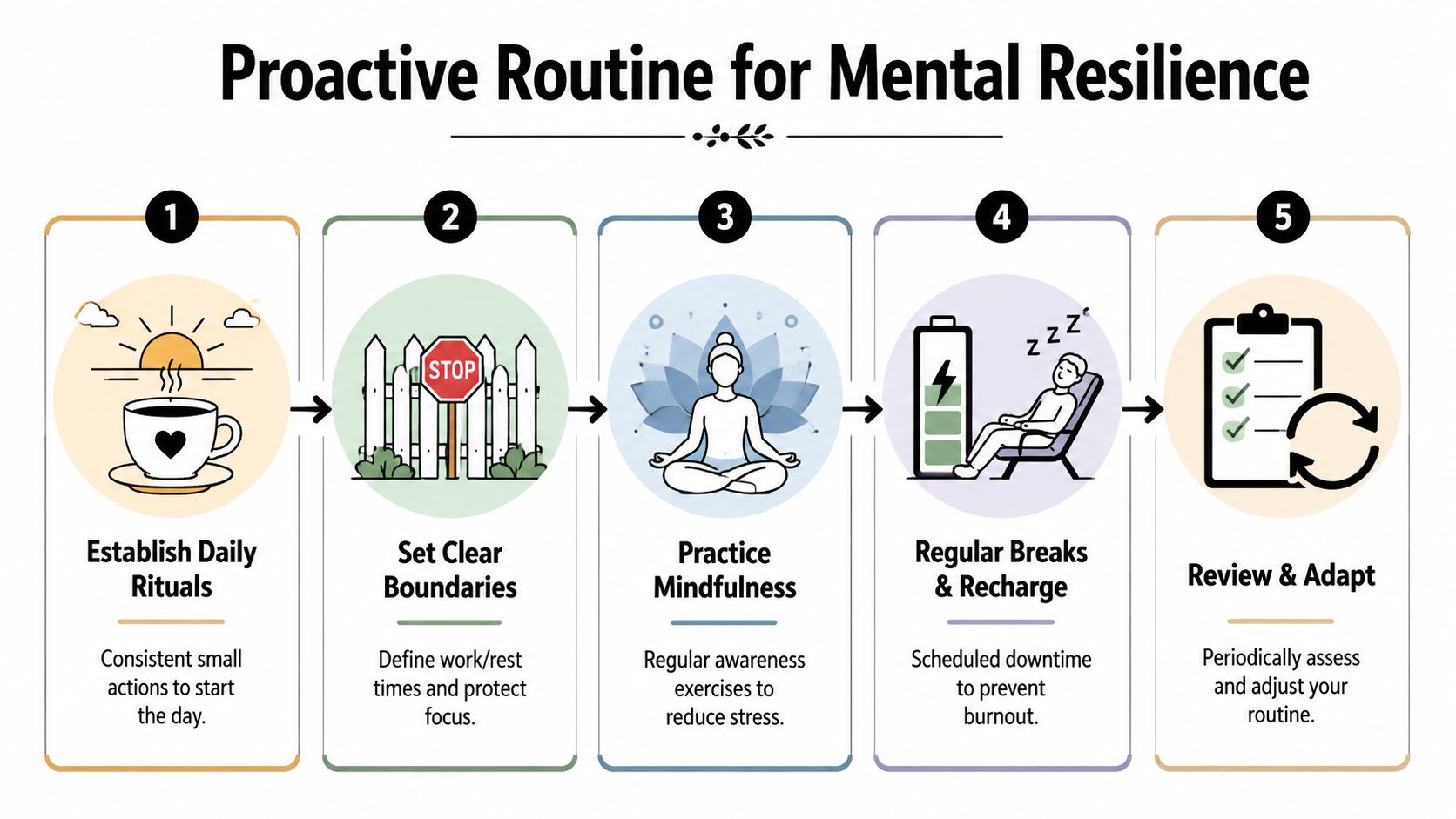
Prevention lives in routine, not inspiration. The best anti-block routines are boring on purpose. They remove decisions before stress arrives.
A workable weekly setup usually includes:
| Routine element | Why it helps |
|---|---|
| Daily startup ritual | Reduces decision fatigue at the beginning of work |
| Defined work blocks | Creates a predictable container for effort |
| Planned breaks | Prevents stress from accumulating unnoticed |
| Review points | Catches drift before it becomes avoidance |
One routine I recommend often is the micro-start ritual. At the end of each day, leave behind the first step for tomorrow in plain language. Don't leave yourself a project. Leave yourself an entry point.
Leave fewer decisions for your future self. Most blocks grow in the gap between intention and a clear first move.
If you want a stronger structure around the routines that support this kind of work, this piece on how to build better habits fits well with the SMART breakdown approach.
Prevention also means accepting trade-offs. A calendar with no margin invites blocks. A to-do list full of ambiguous tasks invites blocks. A week built entirely around urgency invites blocks. Reliable momentum comes from smaller commitments you can repeat.
Actionable Exercises and Micro-Routines
You don't need a giant reset every time you get stuck. Most blocks respond better to small, repeatable drills that match the kind of friction you're facing.
The reset routines that work fastest
The Brain Dump works well for overload. Take a page or whiteboard and empty everything onto it. Tasks, worries, loose ends, unanswered questions. Don't organize while dumping. Once it's out, circle only what matters for the next work block.
The Ugly Start works for perfectionism. Open the document and intentionally write a rough version. Bad wording is allowed. Repetition is allowed. Missing transitions are allowed. The point is to create raw material instead of waiting for polished output.
The Talk-It-Out Reset works when thoughts feel tangled. Explain the problem aloud to a colleague, coach, friend, or even to yourself while walking. Some blocks loosen the moment language becomes external instead of staying trapped in your head.
Sometimes the brain doesn't need more effort. It needs the problem moved into speech, writing, or a diagram.
If your work is performance-based or highly pressure-sensitive, resources that help you access sport psychology in Kelowna can be useful examples of how practitioners handle fear, confidence disruption, and present-moment recovery in a structured way.
Micro-routines for recurring patterns
One of the most practical methods from elite coaching is detachment + reframing + present-focus. The move is simple. Briefly disengage, reframe the setback as non-catastrophic, then put full attention on the immediate next step. One coaching cue used for this is the sharp reality check “did you die?”, which interrupts overidentification with failure and restores task focus, as described in this sport coaching discussion of mental blocks.
Use that method like this:
- Detach briefly: Stand up, step back, look away from the task.
- Reframe the stakes: This is uncomfortable, not catastrophic.
- Return to the present: What is the next rep, sentence, call, or decision?
Then there's the Five-Minute Start. Commit to beginning for a very short, clearly bounded period. The benefit isn't magical motivation. It's reduced resistance. Once you've crossed the threshold, continuing gets easier.
Another strong option is the Parallel Task Reset. If one task is jammed, switch briefly to a simpler adjacent action that still supports the same project. Format the deck. Sort the notes. Label the files. You keep momentum without pretending distraction is progress.
If you want to make these drills easier to run consistently, a simple focus session planner can help you predefine the start action, work window, and stopping point.
Track Your Progress and Stay Accountable
A bad day can feel like proof that you are the problem. It usually is not. What helps is a record detailed enough to separate the block from the story you tell yourself about it.
Tracking turns mental blocks into something you can diagnose, test, and reduce. That matters because getting unstuck is rarely about one clever trick. It is about seeing which trigger showed up, which response worked, and which conditions keep producing the same stall.
What to track when you feel stuck
Keep the log short enough that you will use it. For each block, capture five things:
- The task that triggered it
- The likely type of block
- What you did in response
- Whether you restarted or stayed stuck
- The context, such as time, location, energy, or what happened right before
That is enough to spot patterns without creating another administrative task.
After a couple of weeks, the signal usually gets clearer. You may find that writing tasks stall because the brief is fuzzy, that hard decisions go badly late in the day, or that certain meetings leave you mentally overloaded for the next hour. Once those patterns are visible, the fix gets more specific. You can define tasks earlier, protect high-focus windows, or add a reset buffer after draining events.
Tools help when they make this easier to record and review. Beyond Time by Tribble Software Private Limited is one example. It maps goals into milestones, ties them to routines, and lets you compare planned work with actual follow-through. That makes it easier to catch a recurring gap between intention and execution.
Use a regulation loop instead of self-criticism
Self-criticism feels productive because it is intense. In practice, it usually hides the mechanics of the block.
A better system is a 6-step regulation loop: notice the block, name the feeling, pause, explore the trigger, choose the next action, and act. Therapy in a Nutshell's guidance on overcoming mental blocks also points out that recurring blocks often improve faster when a coach, therapist, or trusted peer helps you identify what you cannot see clearly on your own.
Use that loop as a review tool, not just a rescue tool in the moment. If you keep noticing the same emotional pattern before the same kind of work, stop calling it random. Treat it like a repeatable problem with inputs, behaviors, and outcomes you can change.
Here is a simple weekly review:
| Question | Purpose |
|---|---|
| Where did I stall most often? | Finds repeated triggers |
| What got me moving again? | Identifies effective interventions |
| Which tasks stayed vague? | Shows where planning failed |
| Do I need support? | Flags blocks that shouldn't be handled alone |
Accountability works best when it is specific. A vague promise to "do better this week" creates pressure without direction. A concrete check-in, such as sending a peer your top task by 9 a.m. or reviewing your block log every Friday, creates a real feedback loop.
Some blocks need outside help. If the same task repeatedly triggers panic, numbness, or total shutdown, treat that as a signal to involve a therapist, coach, mentor, or manager. Persistence matters, but so does escalation when self-management stops working.
From Being Stuck to Unstoppable
Mental blocks aren't unusual. What matters is whether you respond with guesswork or with a system. Diagnose the cause. Use a fast reset to break the freeze. Build routines that reduce future friction. Track the pattern so each block teaches you something.
Start smaller than you think you should. One task. One reset. One measurable next step. That's how people learn how to get over mental blocks in real life. Not by waiting to feel ready, but by making it easier to begin and easier to begin again.
If you want a structured way to turn stuck goals into daily, workable actions, Tribble Software Private Limited offers Beyond Time, an AI-powered goal achievement system that maps objectives into milestones, routines, and habits with built-in tracking. It's a practical option for people who do better with a visible plan, consistent prompts, and a tighter accountability loop than a normal to-do list provides.
Put this into practice
Free tools that match this article.
Time Blocking Template
Map your day into focused time blocks with a free printable time blocking template.
Try Time BlockingTime ManagementWeekly Schedule Optimizer
Generate an optimized weekly schedule with AI-powered time blocking for maximum productivity.
Try Schedule OptimizerTime ManagementWeekly Schedule Template
Plan your week with a free printable weekly schedule template for goals, routines, and focus blocks.
Try Schedule TemplateAssessmentProductivity Score Calculator
Discover your productivity score and get personalized recommendations to improve.
Try Productivity ScoreKeep exploring this topic
Related Articles

How to Track Multiple Goals Without Getting Overwhelmed
Learn a proven system for managing multiple goals simultaneously without losing focus or burning out. Practical frameworks for tracking 3-5 goals at once.
Deep Work: The Cognitive Superpower of the 21st Century
Learn the science of deep work and practical techniques to reclaim your focus in an age of constant distraction. See how deep concentration becomes your edge.
Accountability Partner Guide: Achieve Goals Faster
Learn how to find, structure, and get the most from an accountability partner. Research shows accountability can boost goal achievement by up to 95%.
Work-Life Balance Goal Setting: A Framework That Actually Works
Learn how to set goals across work and life without sacrificing one for the other. A practical framework for balancing ambition with wellbeing.
Why New Year's Resolutions Fail (And Goal Setting That Works)
Discover why 80% of New Year's resolutions fail by February and learn a science-backed goal-setting system that creates lasting change all year round.
The Perfect Morning Routine: 2026 Template
Build a morning routine backed by research. Get a proven template with habits, time blocks, and actionable tips to start every day with energy and focus.