Master the 5 Stages of Team Development: Boost Performance
Unlock team potential with our guide to the 5 stages of team development. Master forming, storming, norming, performing, and adjourning with actionable tactics.
You've probably seen this play out. A new team starts with energy, smart people, and a deadline that already feels too close. The kickoff meeting goes well. Everyone sounds aligned. Then a week later, work overlaps, decisions stall, two people hold differing views on priorities, and the manager starts spending half the day translating between functions.
That's not unusual. It's the normal life cycle of a team.
The 5 stages of team development give leaders a useful map for what's happening beneath the surface. Used well, the model helps you stop reacting to every awkward meeting and start managing the system that produces team behavior. Value isn't memorizing stage names. It's learning what to watch, what to change, and how to know whether the team is progressing.
Table of Contents
- Why Understanding Team Stages is a Leadership Superpower
- Stage 1 Forming Navigating Initial Uncertainty
- Stage 2 Storming Turning Conflict into Clarity
- Stage 3 Norming Building Your Team's Operating System
- Stage 4 Performing Unleashing Collective Momentum
- Stage 5 Adjourning Closing a Chapter and Capturing Knowledge
- How to Measure and Accelerate Team Development
Why Understanding Team Stages is a Leadership Superpower
A lot of leadership advice treats team problems like isolated incidents. One missed handoff means you need better accountability. One tense meeting means you need conflict training. One quiet sprint review means morale is slipping.
In practice, those signals usually belong to a pattern. That's why Tuckman's model still matters. Bruce W. Tuckman's original 1965 model identified four stages, and in 1977 he and Mary Ann Jensen added adjourning as the fifth stage that most managers use today, as noted in this overview of Tuckman's model history. The reason it has lasted is simple. Leaders keep seeing the same sequence: uncertainty, friction, alignment, strong execution, then closure.
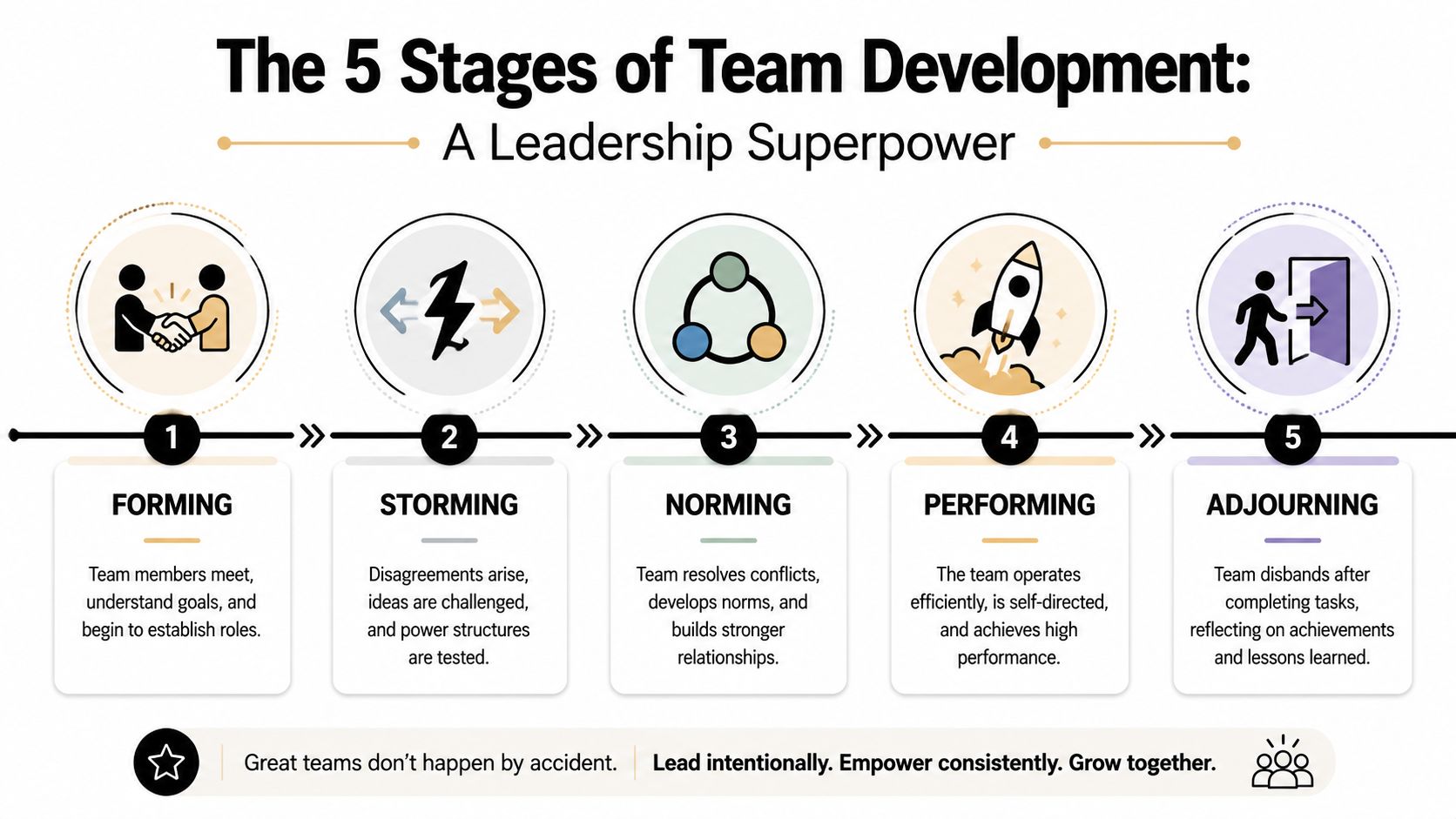
That longevity matters because teams still fail in familiar ways. New members wait for direction. Strong opinions collide. Roles blur. Informal habits form before anyone designs them. Then leaders wonder why output feels inconsistent.
A manager's job is to shape the conditions
If you lead engineers, marketers, operators, or cross-functional project teams, the model works best as a field guide. It tells you what the team probably needs from you right now.
Practical rule: Don't ask, “What's wrong with this team?” Ask, “What stage-like behavior am I seeing, and what system change would help?”
That shift changes your response. Instead of lecturing people to collaborate better, you define decision rights. Instead of forcing harmony, you channel disagreement into structured debate. Instead of celebrating speed too early, you build norms that make speed sustainable.
Good leaders also know stage progression isn't only about output. It's about engagement. Teams with clear expectations and healthy interaction patterns tend to contribute more openly, which is why resources like Firacard's insights on team engagement are useful alongside classic team-development theory.
The model is most useful when you instrument it
Most articles stop at definitions. That's where managers get stuck. They can label the stage but can't manage it.
The better approach is operational. Tie each stage to visible routines, decision rules, and a few observable signals. Then the 5 stages of team development stop being theory and start becoming a leadership dashboard.
Stage 1 Forming Navigating Initial Uncertainty
Forming is polite, hopeful, and usually less productive than it looks.
People are meeting each other, trying to understand the mission, and watching for social cues. In engineering teams, this often shows up as healthy-sounding kickoff meetings followed by vague ownership, duplicated work, and long pauses in chat. Nobody wants to create friction yet, so confusion stays hidden.
What forming actually looks like
The team is not dysfunctional. It's underdefined.
People ask careful questions. They defer to the manager. They avoid challenging assumptions because they don't yet know the boundaries, the decision-makers, or the cost of being wrong. This is why leaders who mistake politeness for alignment usually pay for it later in storming.
A strong start comes from reducing ambiguity early.
Your first-week checklist
Use the first few meetings to lock down basics that teams often leave fuzzy.
- Mission clarity: State what problem the team exists to solve, in plain language.
- Success criteria: Define what good looks like for the project or quarter.
- Role boundaries: Say who leads which workstream, even if you expect adjustments later.
- Decision path: Explain how product, technical, and operational decisions will get made.
- Communication rhythm: Set expectations for meetings, async updates, and escalation.
A kickoff without these elements is socialization, not alignment.
In forming, the team doesn't need inspiration first. It needs orientation.
Build safety through structure
Psychological safety in early-stage teams doesn't come from telling people to speak up. It comes from proving that speaking up is useful and safe.
Ask specific questions instead of broad ones. “What risks do you see in this plan?” works better than “Any thoughts?” Short, structured prompts also help quieter members contribute without competing for airtime. If you want a simple way to make those early meetings less awkward and more revealing, these check-in questions for meetings are practical and easy to apply.
A lightweight team charter helps here. It doesn't need to be a corporate document. One page is enough if it covers:
- Purpose: Why this team exists right now
- Scope: What's in and out
- Responsibilities: Initial ownership by person or function
- Norms: How the team communicates and resolves blockers
A simple example from a software team
Consider a product squad starting work on a new onboarding flow. In week one, the manager notices active discussion but no clear owner for analytics instrumentation. Design assumes engineering will define events. Engineering assumes product already has. No one is wrong. The system is incomplete.
A good manager fixes that in one pass. They assign ownership, define a review cadence, and document the workflow. That doesn't eliminate future conflict. It creates the baseline that makes future conflict productive instead of chaotic.
Stage 2 Storming Turning Conflict into Clarity
Storming gets a bad reputation because many leaders only notice it when meetings get tense. But conflict itself isn't the problem. The question is whether the team is debating the work or compensating for broken structure.
Most guides flatten this stage into “people disagree.” That's incomplete. A more useful lens is diagnostic. As noted in Asana's discussion of team-stage nuance, a common gap is distinguishing true storming from teams that are under-resourced, unclear on roles, or operating without good communication norms. That matters because the model is best treated as a framework for recognizing behavioral patterns, not a deterministic sequence.

Healthy storming versus structural failure
Here's the distinction I use.
| Signal | More like healthy storming | More like a structural problem |
|---|---|---|
| Conflict target | Ideas, trade-offs, priorities | People, functions, or hidden power |
| Decision quality | Debate sharpens the plan | Debate repeats without resolution |
| Role clarity | Owners are known, but disagree | Owners are vague or overlapping |
| Resource context | Team can execute after decision | Team can't execute even with decision |
| After the meeting | Next steps become clearer | Everyone leaves with different interpretations |
If your team keeps revisiting the same argument, don't assume they're “just storming.” Check whether they're missing authority, staffing, time, or decision rules.
Questions a manager should ask in the moment
When conflict spikes, use direct triage questions:
- What exactly are we disagreeing about? Scope, sequencing, quality bar, or ownership?
- Who has decision authority here?
- What information is missing?
- If we made the call now, could the team execute it?
- Is this conflict about strategy, or is it frustration leaking from workload and ambiguity?
Those questions separate normal friction from a team design problem.
A team in healthy storming sounds sharp but increasingly clear. A team with structural issues sounds repetitive.
What works under pressure
A manager's job in storming is not to calm everyone down as fast as possible. It's to convert heat into clarity.
Useful tactics include:
- Structured debate: Give each side a fixed window to argue its case and trade-offs.
- Decision memo: Write the decision, owner, rationale, and revisit trigger before the meeting ends.
- Role reset: If conflict keeps landing on ownership seams, redraw responsibilities immediately.
- Escalation rules: Define what the team can decide alone and what needs executive input.
What doesn't work is vague encouragement. “Let's collaborate better” won't fix a product strategy argument if nobody knows who owns the final call.
A startup team debating whether to prioritize activation or retention may sound dysfunctional from the outside. If the leader forces quick consensus, the disagreement goes underground. If the leader surfaces assumptions, names the decider, and commits to a test plan, the conflict becomes an asset. That's storming doing its job.
Stage 3 Norming Building Your Team's Operating System
Norming is where a team stops improvising and starts running on shared defaults.
This stage matters more than most leaders realize. Teams don't reach strong execution just because conflict fades. They reach it because they replace friction with working agreements. MIT recommends establishing flexible, inclusive norms because successful norming helps people express real ideas, shifts energy toward team goals, and improves productivity. MIT's guidance also aligns with Asana's recommendation to use a RACI chart to clarify who is Responsible, Accountable, Contributing, and Informed for each task, as described in MIT's team development guidance.
Treat norms like infrastructure
Leaders often treat norms as soft culture work. They're not. They are operating infrastructure.
If your team has no clear standard for response time, meeting prep, documentation, or decision handoff, people fill the gap with personal habits. That creates invisible friction. One person thinks silence means agreement. Another thinks silence means unresolved risk. Then execution slows for reasons nobody can name.
Build a lightweight operating system the team can follow.
The core pieces to define
A strong norming pass usually includes these elements:
- Decision rules: Which decisions require consensus, which need a single owner, and which can be made independently.
- Communication expectations: How fast people should respond in Slack, email, or project tools, and what counts as urgent.
- Meeting discipline: Which meetings are mandatory, what pre-reads are expected, and when a meeting should be canceled.
- Documentation standard: Where specs, decisions, and action items live.
Documentation is usually where norming breaks down first. Teams talk clearly in the room, then lose the thread a week later because the record is scattered. If that sounds familiar, GitDocAI's guide to solve your documentation messes is worth reviewing.
Use RACI to end recurring ownership drift
RACI is simple and powerful because it forces precision. It answers four different questions that teams often mash together into “ownership.”
| Role | What it means in practice |
|---|---|
| Responsible | The person doing the work |
| Accountable | The single owner who answers for the outcome |
| Contributing | People providing input or support |
| Informed | Stakeholders who need visibility |
The big win is not the chart itself. It's the conversation required to complete it.
Leadership move: If the same task causes confusion twice, put it into a RACI. Don't wait for the third failure.
For teams that need examples of explicit norms, this team norms sample is a helpful reference point.
What good norming feels like
The team becomes easier to manage because less energy gets wasted on translation. People know where to look, how to escalate, and what good collaboration looks like here.
That doesn't mean conflict disappears. It means conflict has rails. When those rails hold, the team is ready for performing.
Stage 4 Performing Unleashing Collective Momentum
Performing is what most leaders think they're building from day one. In reality, teams earn it.
At this stage, the group no longer relies on the manager to coordinate every move. Commitment to the mission is high and team competence is also high, while accomplishments are measured and celebrated, according to Institute of Project Management's description of the performing stage. That's why this stage shows up in startups, enterprises, and project-based teams across industries.

What changes in a high-functioning team
You can spot performing without asking for a survey.
The team resolves many issues before they hit your calendar. People challenge each other without damaging trust. Handoffs are faster because expectations are already understood. Quality improves because the team protects standards internally instead of waiting for the manager to enforce them.
The manager's role changes too. You spend less time directing work and more time clearing obstacles, protecting focus, and coaching individuals.
What managers should do less of
When teams reach performing, some leaders accidentally drag them backward.
Common mistakes include:
- Overriding decisions: Stepping into choices the team can already handle
- Adding meetings: Creating reporting layers that interrupt momentum
- Reassigning ownership casually: Undermining autonomy for short-term convenience
- Fixing every issue personally: Teaching dependency instead of judgment
A performing team still needs support. It just needs a different kind.
Strong teams don't need less leadership. They need leadership aimed at leverage instead of control.
A useful way to think about this shift is visual. This short clip captures the idea of team development and how leadership behavior changes as the team matures.
What to measure here
In performing, stop using presence as a proxy for contribution. Look at execution quality, reliability of commitments, and whether the team can absorb change without losing coherence.
A strong team launching a major campaign or shipping a critical feature usually shows the same pattern. The plan is visible. Owners move early. Risks surface before deadlines. Wins get recognized. The manager still matters, but as a multiplier rather than a traffic controller.
Stage 5 Adjourning Closing a Chapter and Capturing Knowledge
Adjourning is easy to skip because by the end of a project everyone wants to move on. That's a mistake.
When teams disband without closure, they lose two things. People lose the chance to recognize what they built, and the organization loses hard-earned knowledge. In project-heavy environments, that's how the same problems keep reappearing under new team names.
Why this stage deserves real management
A finished project still creates work. Someone has to document decisions, transfer context, and make sure lessons survive the team that generated them.
Adjourning also matters emotionally. Even short-lived teams form habits, trust, and identity. Closing well helps people transition without carrying unresolved frustration into the next project.
A useful retrospective checklist
Keep the closeout practical. A good retrospective should capture what future teams can reuse.
- What worked: Which routines, decisions, or tools clearly helped execution
- What dragged: Where the team lost time due to ambiguity, delays, or rework
- What changed midstream: Which assumptions turned out to be wrong
- What should become standard: Practices worth adopting in the wider organization
- What must be documented: Decisions, dependencies, owners, and unresolved risks
Closure is not ceremonial. It is operational handoff plus meaning.
Recognition belongs here too. Celebrate the result, name the growth, and make contribution visible. Teams that end well create stronger starting conditions for the next team.
How to Measure and Accelerate Team Development
Most leaders can describe the 5 stages of team development. Fewer can measure where their team is and fewer still can speed up the move from one stage to the next.
That's where instrumentation matters. If you connect each stage to a few concrete objectives, routines, and review points, the model becomes manageable. You stop asking whether the team “feels better” and start asking whether the system is producing the behaviors you need.
Turn each stage into an objective
You don't need a complex scorecard. You need stage-specific goals with observable completion criteria.
Here's a practical example:
| Stage | Objective | What to track |
|---|---|---|
| Forming | Build clarity fast | Team charter completed, owners assigned, cadence established |
| Storming | Convert friction into decisions | Open conflicts logged, decision owners named, unresolved dependencies surfaced |
| Norming | Standardize collaboration | RACI completed for key workflows, documentation location agreed, communication norms adopted |
| Performing | Increase autonomous execution | Fewer escalations, cleaner handoffs, more decisions resolved inside the team |
| Adjourning | Preserve lessons and close cleanly | Retrospective completed, key decisions documented, handoff finished |
These are not vanity metrics. They're management controls.
Use routines, not just goals
An objective without a routine is just a wish.
If the team is in forming, hold short alignment check-ins and review role clarity explicitly. If it's in storming, create a recurring conflict-resolution forum where disagreements get resolved with owners and dates. If it's in norming, review whether the team is following the rules it agreed to.
This is also where productivity measurement gets more useful. Instead of asking only who is busy, look at whether time is moving the team toward stage-appropriate outcomes. Tooling Studio's guide on strategies to measure team productivity offers useful framing for measuring work in a way that supports better management decisions.
Planned versus actual effort reveals hidden drag
Many teams think they're storming when they are instead paying a tax on poor coordination. One of the clearest signals is the gap between planned effort and actual effort on collaborative work.
If recurring tasks keep taking longer than expected, ask why. Was the work itself hard, or did the team lose time to unclear ownership, missing inputs, or rework from weak norms? That's a better management question than “Why is this team slower than expected?”
For a grounded framework on this, Beyond Time's piece on productivity measurement is useful because it connects goals, routines, and actual execution rather than treating productivity as generic busyness.
A simple instrumentation loop
Use a repeating loop each week:
- Identify the current stage-like pattern
- Set one objective that fits that stage
- Attach a routine to support it
- Track visible evidence, not vibes
- Adjust the system when the team stalls
That loop keeps the model practical.
Teams rarely need more motivation. They need tighter feedback between what the leader expects, what the team does every week, and what the work system makes easy or hard.
The biggest shift is this. Don't use Tuckman's model to label the team after the fact. Use it to design interventions in real time. That's how the 5 stages of team development become a measurable leadership playbook instead of a workshop slide.
If you want a system that turns team and personal objectives into milestones, routines, and daily execution, Tribble Software Private Limited builds Beyond Time to do exactly that. It helps translate goals into actionable roadmaps, connect them to habits and time tracking, and create the feedback loop that makes progress visible instead of guesswork.
Put this into practice
Free tools that match this article.
Goal Setting Worksheet
Turn a vague goal into milestones, habits, blockers, and a weekly review plan.
Try Goal WorksheetTime ManagementWeekly Schedule Template
Plan your week with a free printable weekly schedule template for goals, routines, and focus blocks.
Try Schedule TemplateHabit BuildingHabit Tracker Template
Create a free printable habit tracker template — weekly or monthly. Customize your habits and download a clean PDF in seconds.
Try Habit TrackerTime ManagementTime Blocking Template
Map your day into focused time blocks with a free printable time blocking template.
Try Time BlockingRelated Articles
The New Manager's Goal-Setting Playbook: First 90 Days
Just promoted to manager? Set yourself up for success with this 90-day goal-setting framework covering team goals, personal development, and quick wins.
How to Track Multiple Goals Without Getting Overwhelmed
Learn a proven system for managing multiple goals simultaneously without losing focus or burning out. Practical frameworks for tracking 3-5 goals at once.
Accountability Partner Guide: Achieve Goals Faster
Learn how to find, structure, and get the most from an accountability partner. Research shows accountability can boost goal achievement by up to 95%.
5-Year Plan Template: Build Your Life Roadmap Step by Step
Build your life with this step-by-step 5 year plan template. Set goals across 5 key life domains and break them into year-by-year milestones you can act on.
How to Set Life Priorities: A Framework for What Matters Most
Learn how to set priorities in life with a proven values-based framework. Discover what matters most and start building goals aligned with your life today.
Life Audit: The Complete Guide to Redesign Your Life
A life audit helps you step back, evaluate every major area of your life, and redesign it with intention. Discover how to do yours in five clear steps.