
Winning Exam Preparation Strategies for Top Scores
Ditch cramming. Our guide to exam preparation strategies covers scheduling, active recall, and practice tests to help you learn smarter and achieve top scores.
Most exam advice fails for a simple reason. It treats preparation like a bag of disconnected tips. Make a timetable. Highlight notes. Do practice questions. Sleep well. That sounds sensible, but it breaks down the moment real life intervenes, your schedule slips, or anxiety shows up on test day.
Strong exam preparation strategies work better as an operating system. You need a target, a plan that fits your actual week, study methods that build recall instead of familiarity, practice that trains performance under pressure, and a feedback loop that tells you what to adjust. When those pieces connect, studying stops feeling chaotic and starts feeling controlled.
Table of Contents
- Define Your Target and Set Measurable Milestones
- Build a Dynamic Study Schedule That Bends Not Breaks
- Master High-Leverage Study Techniques
- Implement a Rigorous Practice and Assessment Routine
- Use Daily Tracking to Build Unstoppable Momentum
- Troubleshoot Common Exam Prep Roadblocks
Define Your Target and Set Measurable Milestones
Students usually do not underprepare because they are lazy. They underprepare because their goal is too blurry to run a plan against.
“Study more” produces the same problem every time. You can spend hours working and still have no idea whether you are getting closer to a pass, a distinction, or just another stressful week of revision. Strong exam preparation works like an operating system. The target sets the direction, milestones tell you what to do next, and both give the rest of the plan something concrete to follow.
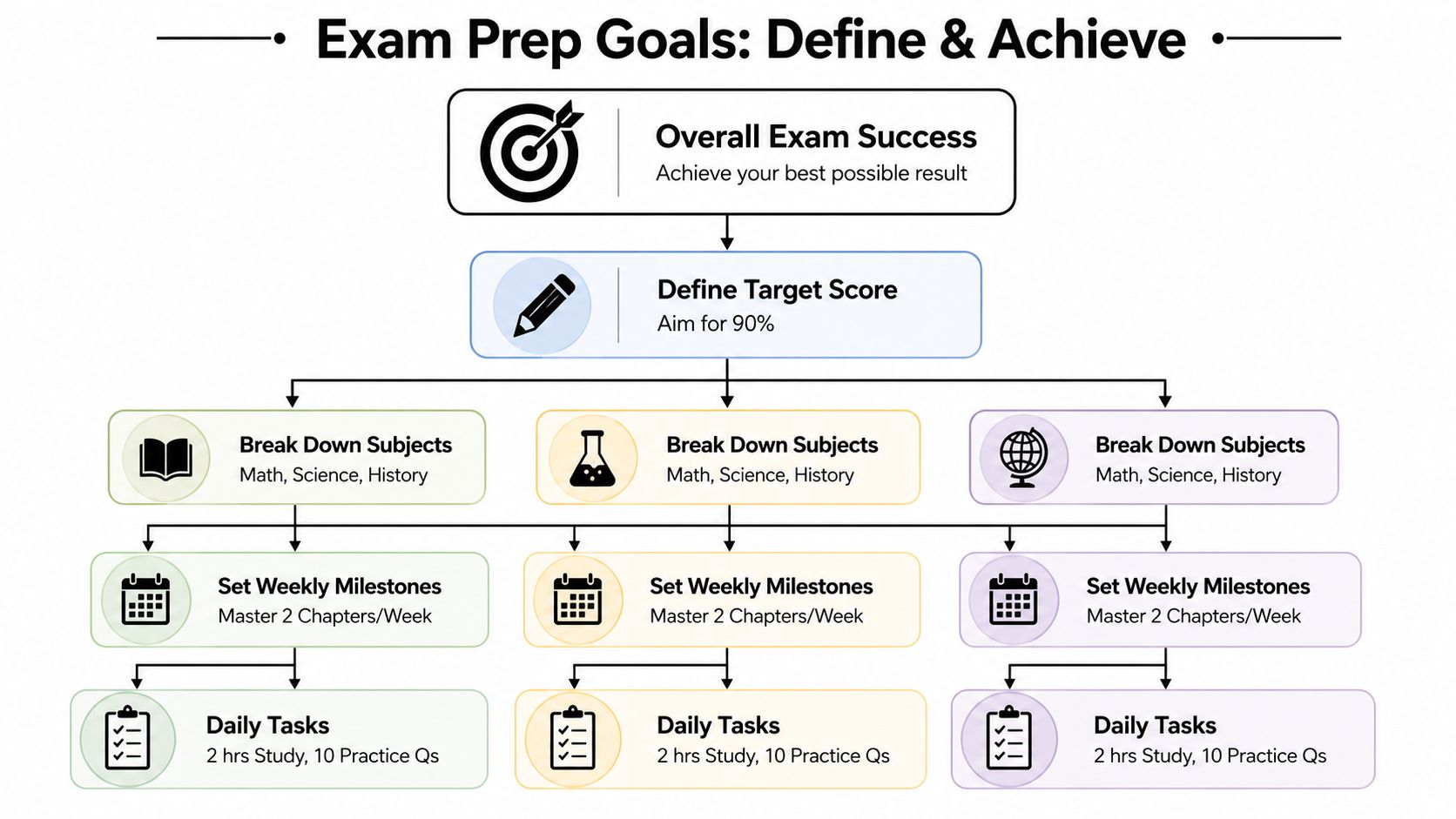
Turn a vague goal into a real target
Start with the result you need, then define it in terms you can verify. “Do well in biology” is too loose to guide daily decisions. “Reach the distinction band,” “pass with a margin,” or “raise organic chemistry from weak to reliable” gives you something you can build backward from. If your exam board publishes grade boundaries, use them. If it publishes topic weightings, use those too.
A simple OKR-style structure works well here because it forces specificity:
| Layer | What to write |
|---|---|
| Objective | The exam outcome you want |
| Key results | Observable proof you're on track |
| Milestones | Topic-level wins by week |
| Daily actions | Specific study tasks |
A practical version looks like this:
- Objective: Earn a top result in biology.
- Key result: Complete timed practice without major gaps in core topics.
- Milestone: Finish cell biology, genetics, and physiology in planned sequence.
- Daily action: Review flashcards, answer short-response questions, mark mistakes.
The trade-off is simple. A narrower target feels less inspiring than “ace everything,” but it is far more useful. Clear constraints improve decision-making. If you want a sharper framework for setting score-driven goals, the guide on how to improve exam scores is useful because it forces you to define success in measurable terms instead of vague ambition.
Practical rule: If a milestone cannot be tested, it is too vague.
Build milestones you can actually check
Once the target is set, break the syllabus into units small enough to assess accurately. Large labels such as “finish chemistry” hide weak spots. Smaller units expose them. “Master bonding, stoichiometry, and acids and bases, then complete mixed questions” tells you exactly what done looks like.
This is also where cognitive science becomes practical. Students retain more when they revisit manageable chunks and pull information from memory repeatedly, instead of rereading large sections until they feel familiar. The point is not to make the plan look tidy. The point is to make the next review session possible on a tired Wednesday evening, not just on your most motivated day.
Use checkpoints that produce evidence:
- Recall check: Can you explain the topic from memory without notes?
- Question check: Can you answer topic-specific questions accurately?
- Error check: Can you explain why your wrong answers were wrong?
- Timing check: Can you complete the work under mild time pressure?
Keep those milestones in one visible system. A simple roadmap with target score, topic list, deadlines, and review points is enough. If you want a model for building that structure, this article on goal setting for students shows how to turn broad ambitions into trackable milestones.
The psychological benefit is real. A defined target clears the fog. Measurable milestones turn “I'm behind” into “I need to fix topic three before Friday.” That shift is psychologically powerful. Students rarely panic over a clear problem. They panic over uncertainty.
Build a Dynamic Study Schedule That Bends Not Breaks
Most students don't fail because they lack a calendar. They fail because they build one that assumes they'll behave like a machine.
The classic rigid timetable looks impressive on Sunday night and collapses by Tuesday afternoon. Classes run late. You get tired. One task takes longer than expected. Then the whole plan starts to feel broken, and broken plans are easy to abandon.

Why rigid timetables fail fast
One of the biggest gaps in mainstream exam advice is the lack of personalized, context-driven study scheduling. Verified guidance notes that many learners rely on self-paced preparation without structured support, and medical education literature has found that structured, anxiety-managing programs designed for individual schedules improve performance, while rigid one-size-in all plans tend to fail under real-world constraints (TopUniversities exam preparation study tips).
That matches what serious students learn quickly. A schedule only works if it fits your actual life.
Don't ask, “What's the ideal study week?” Ask better questions:
- When am I mentally sharpest?
- Which days are unstable because of classes, work, or commuting?
- What blocks are reliable enough for hard tasks?
- Where do I need buffer time because life always spills over?
A schedule should absorb disruption, not collapse because of it.
Build around energy and constraints
Use time blocks, but keep them flexible. I prefer a three-layer schedule rather than an hour-by-hour fantasy.
| Layer | Purpose | Example |
|---|---|---|
| Anchor blocks | Non-negotiable high-focus study time | Morning problem-solving session |
| Support blocks | Lighter review or admin work | Flashcards, summary sheet cleanup |
| Buffer blocks | Overflow and catch-up | Move unfinished tasks here |
This works better because not all study tasks deserve the same slot. Put demanding work, such as derivations, essay planning, or difficult recall, into your best mental window. Put lower-friction tasks into tired periods.
A useful weekly method looks like this:
- Map fixed commitments first. Lectures, work shifts, family responsibilities, commute.
- Place two or three anchor study blocks where your attention is strongest.
- Add lighter support blocks around them.
- Leave white space. If every hour is packed, the schedule is already fragile.
- Review nightly. Shift tomorrow's tasks based on what happened today.
If you like planning visually, a time-blocked calendar system can help you separate deep work, light review, and buffer time without overloading every day.
Here's the trade-off. A rigid plan gives you the illusion of control. A dynamic schedule gives you actual control. You'll study fewer “perfect” hours on paper, but you'll complete more meaningful work over time.
Master High-Leverage Study Techniques
High scores rarely come from studying more. They come from using methods that match what the exam asks you to do. If your prep system is built on rereading, highlighting, and neat summaries, you are training recognition. Exams reward retrieval, choice, and application under pressure.
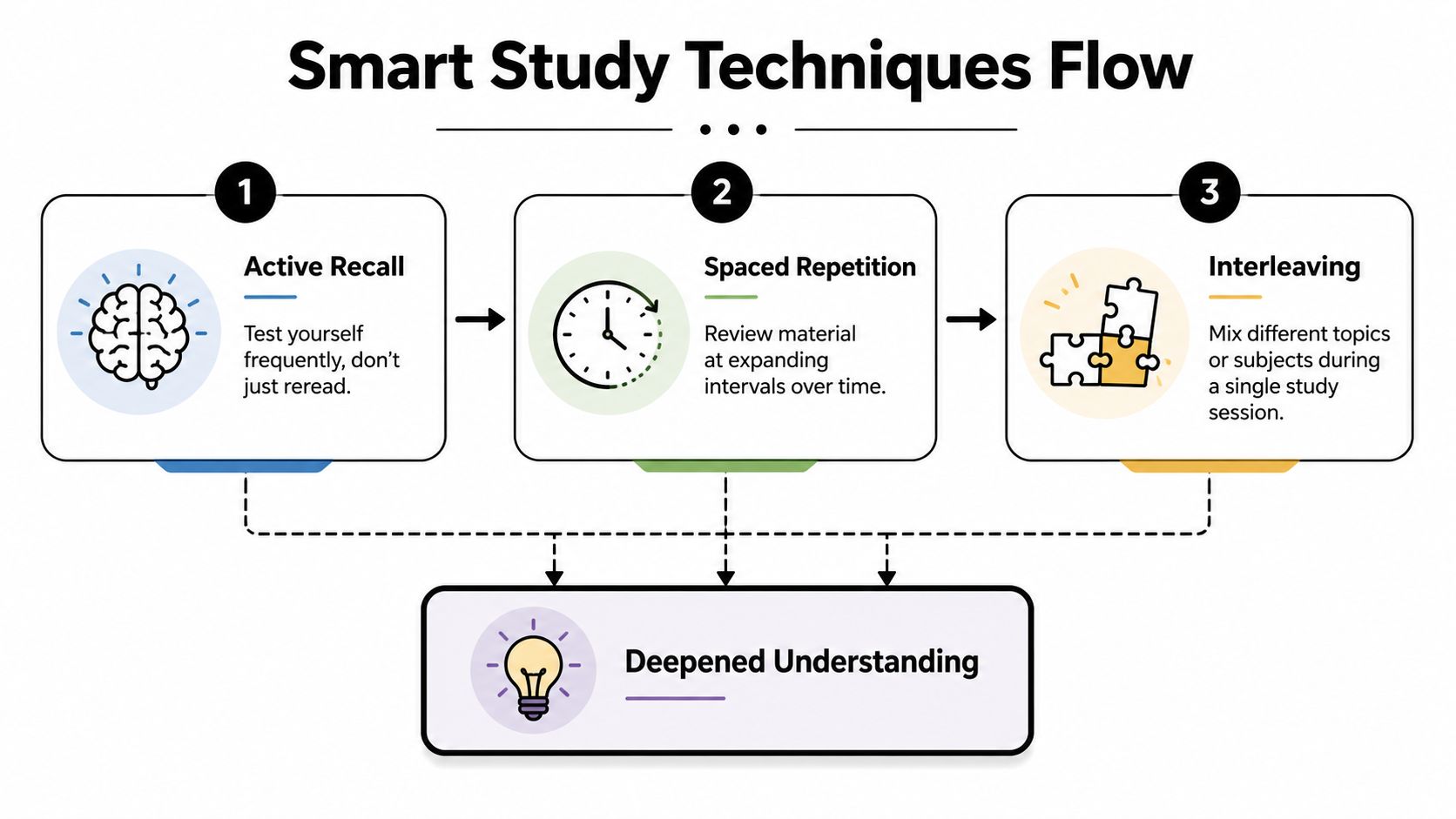
The study methods that pay off most consistently force you to do three things. Pull information out of memory, compare your answer against a standard, and revisit it after enough time has passed for forgetting to start. That loop fits the operating system approach to exam prep. Your schedule creates the reps, your techniques create the learning signal, and your tracking shows which topics still break under load.
Use recall before review
Start with a closed book and a blank page.
Before reading notes, force an answer from memory. Write the definition, solve the problem cold, sketch the process, explain the concept out loud, or answer a past-paper prompt without support. Then compare your output against notes, mark schemes, or model answers.
The loop itself is more important than the label:
- Recall the material without help.
- Check your answer against a reliable reference.
- Correct gaps and errors while they are still visible.
- Repeat the same prompt later, after a delay.
Replace “Do I recognize this?” with “Can I produce it on demand?”
Many students waste hours polishing notes on a topic they have never tested. A better method is to convert each topic into prompts that resemble exam demands. History needs argument questions and comparison prompts. Science needs definitions, calculations, diagrams, and explanation questions. Languages need translation and grammar production. Law, medicine, and business need application scenarios that force you to choose, not just remember.
If you want a practical bank of formats to turn passive review into active work, this guide can help you boost your exam scores.
Later in the cycle, shift from isolated prompts to fuller sets. Flashcards are useful for facts and short cues. They are weaker for sequencing steps, structuring essays, choosing methods, or deciding which principle applies. Those are exam actions, so they need exam-shaped practice. If you need a faster way to map topics into recall sessions, spaced reviews, and mixed sets, use a study plan generator for exam prep.
A useful walkthrough of these methods is below.
Space and mix your practice
Once recall is part of your routine, stop treating a topic as finished after one long session. Memory does not work that way. You need repeated retrieval across time, with enough spacing to make the next attempt effortful.
A simple pattern works well:
- First pass: Learn the topic and test it the same day.
- Second pass: Return after a short gap and retrieve again.
- Third pass: Review after a longer gap.
- Final passes: Mix the topic into broader sets and past-paper work.
Interleaving adds another layer. Instead of doing twenty nearly identical questions in a row, rotate between related but distinct problem types. That increases difficulty in the short term, which is useful. It trains problem selection, not just procedure repetition. In real exams, nobody tells you which chapter a question belongs to.
Here is the practical difference:
| Passive habit | Better replacement |
|---|---|
| Reread chapter | Answer from memory first |
| Highlight notes | Turn notes into prompts |
| Drill one topic for hours | Mix related topics in one session |
| Cram at the end | Revisit over multiple sessions |
Good techniques should feel demanding in a controlled way. If a method feels easy because everything looks familiar, it is often producing confidence without performance. The goal is to build a prep system where recall, spacing, and mixing are built into the weekly loop, not saved for the final stretch.
Implement a Rigorous Practice and Assessment Routine
Doing questions isn't enough. You need to practice the conditions under which knowledge must be used.
Students often say they “knew the material” but underperformed when the clock started. That usually means their preparation trained understanding in calm conditions, not performance in pressured ones. Those are different skills.

Train the exam, not just the subject
Verified guidance from a 2025 literature review on medical study strategies found that structured preparation programs that explicitly manage anxiety contribute directly to improved exam scores. It also notes that effective test-taking strategies reduce cognitive overload by training learners to apply knowledge under timed conditions, while simple question practice without emotional regulation training doesn't build that skill (Colorado State exam study strategies).
That's why your practice routine needs layers.
Start with this progression:
- Untimed diagnostic work: Find content gaps without pressure.
- Timed topic sets: Learn to retrieve under a clock.
- Mixed papers: Shift between topics without warning.
- Full simulations: Rehearse stamina, pacing, and recovery after mistakes.
If your exam has past papers available, use them strategically rather than hoarding them for the final week. A source like GCSE Past Papers is valuable because it lets you work with real question styles, mark schemes, and recurring traps.
Use anxiety management inside practice
Many students simulate exam conditions badly. They only add a timer. That's incomplete.
Good simulation includes environmental and psychological friction. Sit at a desk, remove distractions, use the allowed materials only, and complete sections in one sitting. Then add a recovery routine for the moments when anxiety spikes or your mind blanks.
Try this during practice:
- Pause briefly when panic rises. Don't keep reading the same line.
- Use one reset cue. Slow breathing, unclench hands, eyes off the page for a moment.
- Restart with a smaller target. Answer one sub-part, define one term, outline one paragraph.
- Keep going without demanding calm first. You don't need perfect composure to perform.
The goal of mock exams isn't to prove you're ready. It's to show you where performance breaks down so you can train that weakness.
After every simulation, run a strict debrief. Don't just mark the score. Classify errors.
| Error type | What it means | What to do next |
|---|---|---|
| Knowledge gap | You didn't know the content | Return to recall practice |
| Application error | You knew it but misused it | Practice mixed questions |
| Timing problem | You ran out of time | Rehearse pacing and skipping |
| Stress error | You blanked or rushed | Repeat under pressure with reset routine |
If you want help organizing mock exams into a sequence instead of a random pile, a study plan generator can help map practice sessions around your timeline and weak areas.
Done properly, rigorous practice changes the emotional texture of exam day. The room still matters. The stakes still matter. But the experience is no longer new.
Use Daily Tracking to Build Unstoppable Momentum
Most students overestimate what they can do in a day and underestimate what they can do in a month. That gap creates guilt, and guilt often turns into avoidance.
Daily tracking fixes that because it replaces self-judgment with evidence. You stop asking, “Why am I so inconsistent?” and start asking, “What conditions produced good work today, and how do I repeat them tomorrow?”
Run a simple momentum loop
Keep this system lightweight. It should take minutes, not become another study task.
Use four daily entries:
- Planned work: What you intended to do.
- Actual work: What you completed.
- Friction point: What interrupted or slowed you down.
- Next focus: The single most important task for tomorrow.
If you want more precision, track study time in short blocks such as 15-minute units. That's long enough to reveal where your time went and short enough to spot drift quickly. You'll start seeing patterns. Maybe your late-evening block is always weak. Maybe recall work is strong before lunch. Maybe admin tasks eat the first part of every session unless you separate them.
Small tracking beats dramatic motivation. Momentum comes from visible follow-through.
Choose one high-leverage focus each day
Don't end the day with a long list. End it with one decisive priority.
That focus should be the task that enables the most progress tomorrow. Examples:
| Situation | Best next focus |
|---|---|
| You're behind on content | Finish one weak subtopic and test it |
| You know content but panic in mocks | Run one timed section with a reset routine |
| You keep postponing hard work | Start with one recall block before anything else |
| You're busy all day | Protect one anchor session and shrink everything else |
The daily question is simple: What one action would make tomorrow a good study day even if the rest goes badly?
Exam preparation strategies become sustainable when combined with these practices: Goals give direction. Scheduling creates opportunity. Study techniques improve learning. Practice builds performance. Daily tracking keeps the whole system honest.
When students stall, it's often not because they need more advice. They need tighter feedback. A few days of honest tracking usually reveals the underlying issue.
Troubleshoot Common Exam Prep Roadblocks
Even a strong system will wobble. The fix isn't to throw it out. The fix is to diagnose the failure point.
When procrastination keeps showing up
Procrastination usually means the task is too vague, too large, or too threatening. Go back to your milestones and shrink the entry point. Don't write “study physics.” Write “answer five force questions from memory and mark them.”
If you keep avoiding a subject, put it in your first anchor block. Hard work placed late in the day often becomes tomorrow's problem.
When burnout or plateaus hit
Burnout often comes from schedule design, not lack of discipline. If every study block is intense, your plan is overloaded. Rebalance it with lighter support sessions and genuine buffer time.
A plateau usually means you've stayed in one mode too long. If you've been reviewing content, switch to mixed retrieval. If you've only done isolated questions, move to timed sections. If scores look flat, inspect error patterns rather than doing more of the same.
When progress stalls, change the training stimulus before you question your ability.
When anxiety takes over near exam day
Don't respond by abandoning practice tests. Tighten the loop instead. Shorter timed sessions, immediate debriefs, and a repeatable reset routine are more useful than last-minute passive review.
The broader lesson is simple. Exam preparation strategies work best when they operate as one connected system. Clear targets reduce drift. Flexible scheduling survives real life. Recall-based study builds durable knowledge. Simulations train performance. Tracking keeps momentum alive. When one part slips, the others help you recover.
If you want a system that turns big goals into measurable milestones, adapts to your real schedule, and helps you maintain daily momentum, Tribble Software Private Limited built Beyond Time for exactly that kind of work. It connects goals, routines, time tracking, and AI-guided next steps so preparation doesn't stay stuck at the planning stage.
Put this into practice
Free tools that match this article.
Weekly Schedule Template
Plan your week with a free printable weekly schedule template for goals, routines, and focus blocks.
Try Schedule TemplateFocusFocus Session Planner
Create AI-optimized focus sessions with structured work blocks and refreshing breaks.
Try Focus PlannerLearningAI Study Plan Generator
Generate a personalized study plan with proven learning techniques for exam success.
Try Study PlannerTime ManagementTime Blocking Template
Map your day into focused time blocks with a free printable time blocking template.
Try Time BlockingKeep exploring this topic
Beyond Time for students
See how students connect semester goals, study blocks, and routines.
Student success guide
Use Beyond Time to plan study sessions, habits, and academic goals.
Time blocking guide
Turn priorities into protected calendar blocks.
15-minute time blocks
Plan and review your day with more realistic precision.
Related Articles

How to Track Multiple Goals Without Getting Overwhelmed
Learn a proven system for managing multiple goals simultaneously without losing focus or burning out. Practical frameworks for tracking 3-5 goals at once.
Accountability Partner Guide: Achieve Goals Faster
Learn how to find, structure, and get the most from an accountability partner. Research shows accountability can boost goal achievement by up to 95%.
5-Year Plan Template: Build Your Life Roadmap Step by Step
Build your life with this step-by-step 5 year plan template. Set goals across 5 key life domains and break them into year-by-year milestones you can act on.
How to Set Life Priorities: A Framework for What Matters Most
Learn how to set priorities in life with a proven values-based framework. Discover what matters most and start building goals aligned with your life today.
Life Audit: The Complete Guide to Redesign Your Life
A life audit helps you step back, evaluate every major area of your life, and redesign it with intention. Discover how to do yours in five clear steps.
How to Stay Motivated: Science-Backed Strategies That Work
Struggling with how to stay motivated on long-term goals? Discover science-backed systems and practical strategies to build lasting motivation that sticks.