How to Stay Consistent with Exercise: A Practical System
Struggling with how to stay consistent with exercise? Learn a proven system to build a lasting habit, overcome setbacks, and integrate fitness into a busy life.
You probably know the cycle already. You have a good week, maybe even a great one. You train hard, eat a little better, feel proud of yourself, then work blows up, classes pile on, sleep gets worse, and the whole routine disappears. A few missed sessions turn into guilt, then into “I'll restart on Monday.”
That pattern usually isn't a motivation problem. It's a systems problem.
People who stay active for years rarely depend on feeling inspired every day. They build routines that still function when life gets messy. That means scheduled time, low-friction defaults, visible tracking, and a fallback plan for bad days. If you want to learn how to stay consistent with exercise, that's the shift that matters most.
The gap isn't in knowing exercise is good for us, but in doing it often enough for long enough that it becomes normal.
Table of Contents
- Why Consistency Beats Intensity for Lasting Results
- Laying the Foundation with a Purpose and a Plan
- Building Your Exercise Habit into Your Daily Life
- Using Data and Accountability to Stay on Track
- The Art of the Comeback What to Do When You Fall Off
- Putting It All Together Sample Plans and Next Steps
Why Consistency Beats Intensity for Lasting Results
Monday goes well. You finish a hard workout, feel fired up, and decide you are back. By Thursday, work runs late, sleep is off, and the plan collapses because it only fit the version of you with extra time and full energy.
I see this pattern constantly with professionals and students. They choose a routine that asks for too much too soon, then treat the breakdown as a character flaw. Usually, the underlying problem is load management. A plan that depends on perfect timing, high motivation, and a clear calendar will fail the moment real life shows up.

Public health numbers make the same point. Many adults know exercise matters, but far fewer keep up enough activity week after week to meet both aerobic and strength guidelines. The gap is rarely knowledge. The gap is repeatability.
Practical rule: Judge your plan by how it performs on low-energy days. If it only works when you feel great, it is too fragile.
That is why consistency produces lasting results. Your body responds to repeated exposure. Your schedule also responds to repetition. A moderate plan done for months will usually beat an aggressive plan done for ten days, especially if you are rebuilding fitness, working long hours, or trying to protect focus for school.
Intensity still has a place. It can improve conditioning, build strength, and keep training engaging. But intensity needs a stable base under it. I would rather see you complete three manageable sessions every week for six months than chase an ambitious routine you abandon after the second stressful week.
The better target is an anti-fragile system. Good weeks let you do more. Bad weeks still have a floor. That floor is your minimum viable dose of exercise, a short, pre-decided session that keeps the habit alive when time, energy, or motivation drops.
For some people, that is a 10-minute walk after work. For others, it is one set of pushups, squats, and a plank. It may not feel impressive, but it does something more useful. It preserves identity, momentum, and the expectation that you still show up.
Boring systems win here. Fixed training windows. Short default sessions. A backup workout for chaotic days. Clear decisions made in advance.
That is how consistency survives real life.
Laying the Foundation with a Purpose and a Plan
Monday starts strong. By Wednesday, work runs late, classes spill over, your sleep is off, and the original workout plan already feels unrealistic. That is the moment your system gets tested. A useful plan still gives you a clear win on a messy day.
A stable exercise habit starts with two decisions. You need a reason that matters to you, and a plan built for your actual week. I have seen smart, disciplined people miss workouts for months because they skipped one of those steps. They had good intentions, but no structure they could follow under pressure.
Start with a reason that holds up under stress
Your reason has to matter on a tired Thursday, not just on a motivated Sunday.
“I want to get fit” sounds fine, but it usually falls apart because it asks you to work for a vague future outcome. Better reasons connect exercise to a problem you feel now.
These are the reasons I see people stick with:
- Professionals who want more stable energy, less stiffness, and a cleaner transition out of work mode
- Founders and managers who need one part of the week that feels intentional instead of reactive
- Students who want better focus, a mental reset between study blocks, and more stamina during demanding periods
- People restarting who want to rebuild self-trust by keeping promises to themselves
Write it in one plain sentence. If it sounds performative or borrowed from social media, rewrite it until it feels true.
Build a weekly plan that survives bad days
The 2018 Physical Activity Guidelines for Americans recommend 150 to 300 minutes a week of moderate-intensity activity, or 75 to 150 minutes of vigorous activity. A large study summarized by the AMA also found that meeting the minimum guideline was linked to a 22% to 31% lower risk of cardiovascular disease mortality, as explained in this AMA report on the exercise amounts associated with longer life.
The practical takeaway is simple. You do not need an extreme routine. You need a repeatable one.
Start with four decisions:
- Choose the kind of training you will consistently do. Walking, lifting, cycling, classes, home workouts, short runs. Compliance matters more than variety at this stage.
- Set a realistic weekly target. Pick a starting amount that fits your current schedule and recovery, not your best-case fantasy week.
- Put it on the calendar. Specific sessions beat vague intentions every time.
- Define your minimum viable dose. This is the smallest version of the workout that still counts on a bad day.
That fourth step is what keeps the plan anti-fragile. If your normal session is 45 minutes, your minimum viable dose might be a 10-minute walk, two strength circuits, or one mile at an easy pace. Small is fine. The point is to remove the all-or-nothing decision that breaks momentum.
For people who like structure, a habit system that turns goals into scheduled actions can help. The useful part is not the tool itself. It is the fact that your fallback plan gets decided before the week gets chaotic.
Match the plan to the season you are in
A good plan respects constraints. That includes deadlines, commute time, sleep, family obligations, travel, and your current fitness level.
If you travel often, plan for the version of exercise you can do in a hotel room or between meetings. Nutrition matters here too. Having a simple travel routine for food makes training easier to sustain, especially if you regularly work on the road. This guide on how to stay healthy on business trips is a useful complement to a realistic exercise plan.
Use this quick filter before you commit:
| Question | Strong answer | Weak answer |
|---|---|---|
| Do you know exactly when you will train? | Specific days and times | “At some point this week” |
| Is the starting target easy enough to repeat? | Feels manageable | Feels like catching up |
| Do you have a bad-day version? | Yes, already defined | No, I will decide later |
| Does it fit your current life? | Yes, even in a busy week | Only if everything goes right |
Plans fail when they depend on ideal conditions.
Build one that still works when the week gets crowded, your energy dips, and your motivation is ordinary. That is the foundation.
Building Your Exercise Habit into Your Daily Life
It is 6:40 p.m. You had every intention of working out after work, then meetings ran late, your energy dropped, and dinner still needs to happen. This is the moment when a motivation-based plan falls apart. A system-based plan still gives you a clear next step.
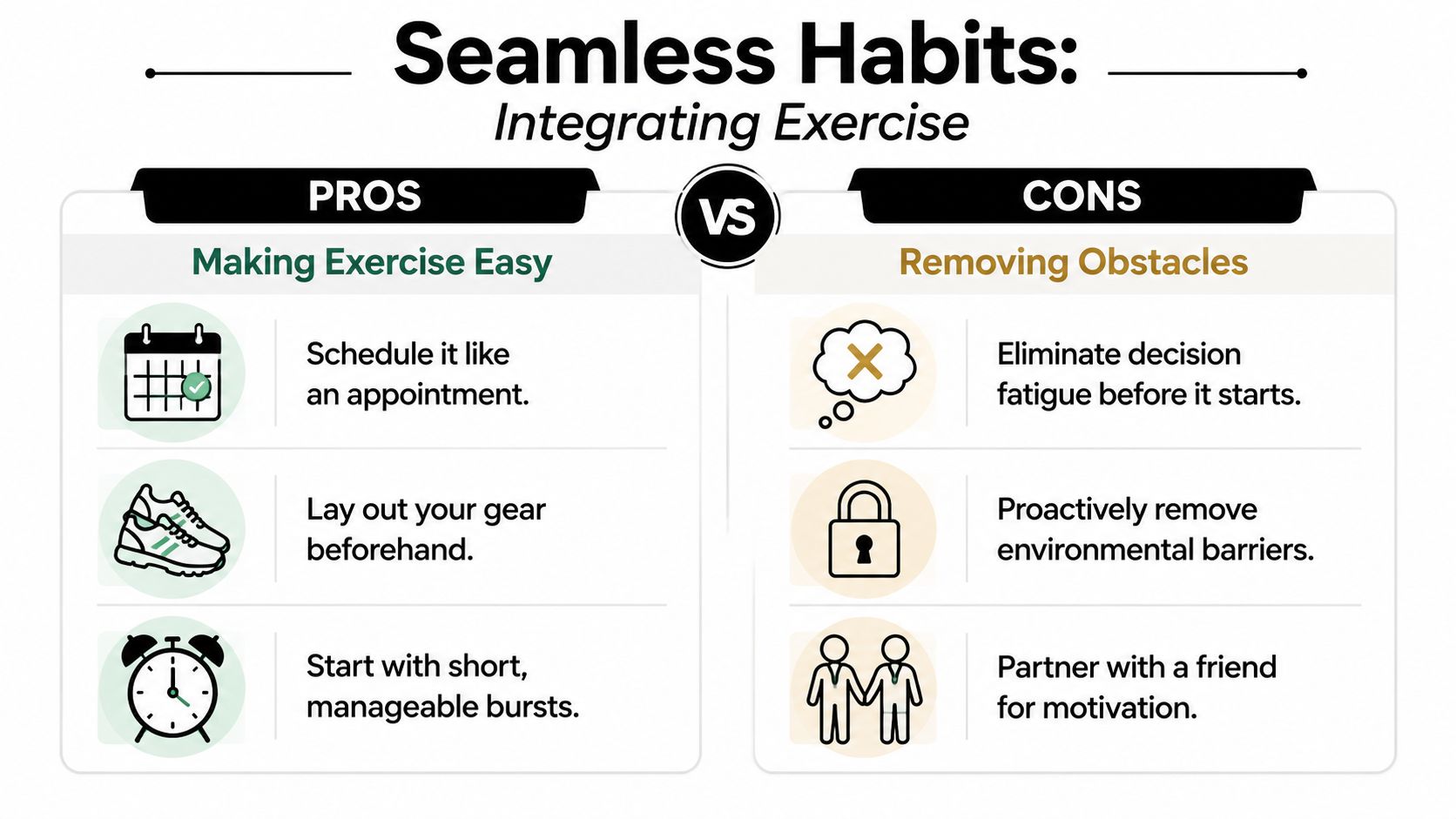
The goal is to make exercise part of your normal operating routine, not a bonus task that only happens on good days. People who stay consistent usually do not have better motivation. They have fewer decisions to make, clearer cues, and a smaller fallback that keeps the streak alive.
Observational research has found an association between exercising at a consistent time and doing more moderate-to-vigorous activity, as discussed in this research article on exercise timing consistency. That matters for one reason. Repetition reduces friction.
Use time anchors your day can actually support
A workout is easier to repeat when it attaches to something that already happens.
Useful anchors include:
- After a fixed event: after your morning coffee, after school drop-off, after your last class
- Inside a fixed window: lunch break, before your shower, right after work
- At the same clock time: 7 a.m. walk, 6 p.m. lift, 8 p.m. mobility session
The point is not perfection. The point is predictability. If your schedule changes often, anchor the workout to a window rather than an exact minute.
I usually tell clients to stop asking, “When will I feel like working out?” and start asking, “What cue starts the session?” That single shift removes a lot of failure points.
Define a minimum viable dose for bad days
This is the piece many exercise plans miss.
You need a standard for days when sleep was poor, work spilled over, or your head isn't in it. Without that standard, people tend to make an all-or-nothing decision. They either do the full workout or skip it entirely. That pattern breaks momentum fast.
Set a minimum viable dose in advance. It should feel almost too easy to refuse. For example:
- 10 minutes of brisk walking
- 1 round of a bodyweight circuit
- 15 squats, 10 push-ups, 30 seconds of plank
- 5 minutes of mobility before bed
A short session still counts because it protects the habit loop. Full sessions build fitness. Small fallback sessions protect consistency. Both matter.
As noted earlier, splitting activity into shorter sessions is a practical way to stay active during packed weeks. If you want a broader habit framework behind that idea, this guide on building better habits for real life connects well with exercise adherence.
Remove friction before the decision point
A good system handles your tired, busy version of you.
Set up the environment so starting takes almost no thought:
- Lay out clothes and shoes the night before
- Decide the workout before the day begins
- Keep one default routine for low-energy days
- Choose options close to home, work, or campus
- Save a short workout on your phone so you are not searching when time is tight
I have seen busy professionals stay consistent with unimpressive-looking routines because those routines were easy to start. I have also seen ambitious plans fail because every session required extra travel, extra gear, or extra willpower.
Simple wins here.
HelpGuide also notes in its guide to starting exercise and sticking to it that shorter activity blocks can still be useful when a full workout does not fit. That is one more reason to keep a short default session ready.
A quick walkthrough can help if you need visual examples of habit-friendly routines:
Build for disruption, not for ideal weeks
Travel, exams, deadlines, sick kids, poor sleep, and heavy work cycles are not unusual events. They are part of normal life. A routine that only works in calm weeks is too brittle.
On disrupted weeks, lower the standard without abandoning the structure. Keep the same cue if possible, shorten the session, and switch to the easiest available format. Hotel gym. Room workout. Fast walk between meetings. Ten minutes before a shower. Continuity beats catching up.
If work travel regularly throws you off, pair your training plan with a food strategy that travels well too. This guide on how to stay healthy on business trips is a useful companion.
What holds up over time is rarely exciting. It is repeatable, pre-decided, and flexible enough to survive a bad Tuesday.
Using Data and Accountability to Stay on Track
You might think tracking is for advanced athletes. It isn't. Tracking is for anyone whose memory becomes suspiciously generous after a rough week.
When you don't measure anything, it's easy to tell yourself you're “basically staying active” while the pattern slips unnoticed. A simple record changes that. You stop judging yourself by intention and start looking at behavior.
Track what actually predicts follow-through
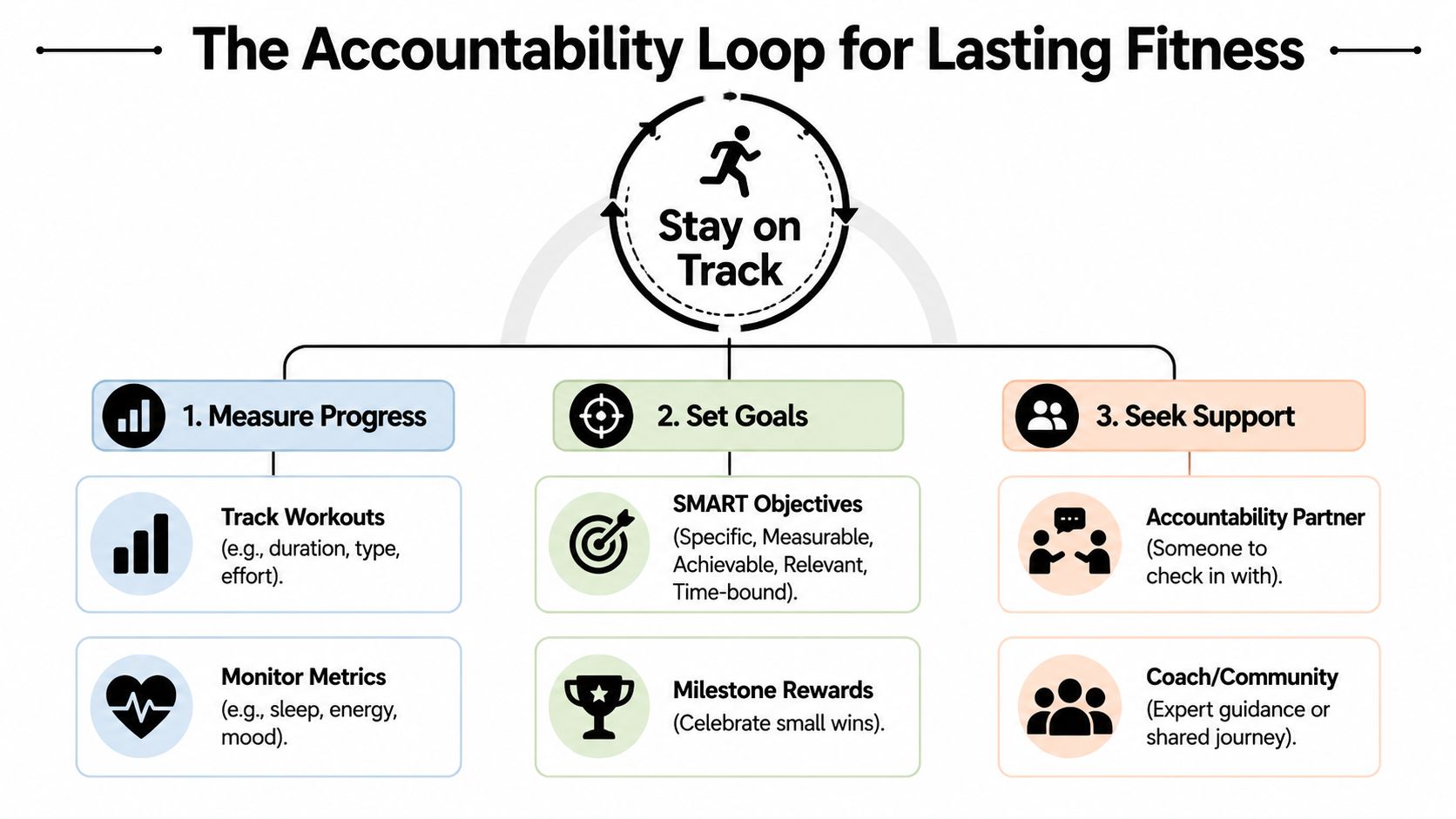
Onelife Fitness emphasizes that behavioral adherence improves when exercise is made measurable, including tracking workouts in a journal or app, scheduling sessions in advance, and using small milestones or rewards to sustain follow-through, in its advice on maintaining a consistent workout routine. It also points out a common trap. Relying only on mood-based motivation.
You don't need a complicated dashboard. Start with a few fields that help you spot drift early:
| What to track | Why it matters |
|---|---|
| Workout completed or missed | Reveals consistency fast |
| Type of session | Shows whether your week is balanced or repetitive |
| Duration | Helps you see your real weekly volume |
| Effort or perceived difficulty | Flags when you're pushing too hard |
| Energy or mood notes | Helps explain patterns, not excuse them |
If you train with weights, recording the exact exercise, load, duration, and perceived difficulty can be useful. If you mostly walk, run, or do classes, keep it simpler. The best tracker is the one you'll still use next month.
If you want app options, a practical roundup of recommended workout tracking software can help you compare formats. Some people do better with a bare-bones log. Others want charts, reminders, and program structure.
Tracking isn't about proving you're disciplined. It's about catching small breakdowns before they become a full stop.
Build an accountability loop, not a guilt loop
Accountability works when it creates visibility, not shame.
The useful forms are straightforward:
- Personal accountability: a journal, app, calendar streak, or weekly review
- Social accountability: a workout partner, coach, class, or simple text check-in
- System accountability: routines tied to goals so you can see what is planned versus what happened
This is one place where connected tools can help because they reduce mental overhead. For example, Beyond Time's workout progress tracking ideas fit well if you want your exercise habit linked to broader goals and daily routines. That kind of setup can be useful for founders, students, and professionals who already manage their life through systems.
A good monthly review asks only a few questions:
- Which sessions happened most reliably?
- Which time slots kept failing?
- Was the problem time, energy, boredom, or overreach?
- What should be simplified next week?
That review keeps you adaptive. Without it, people often keep repeating a plan that clearly doesn't fit.
The Art of the Comeback What to Do When You Fall Off
You are going to miss workouts. That isn't a character flaw. It's normal life.
The danger isn't the missed session. It's the meaning you attach to it. People fall off because they interpret one disruption as evidence that the whole routine is broken. Then they wait for a cleaner week, a better mood, or a fresh Monday. That delay is what turns a small interruption into a lost month.
Define your minimum viable workout
A stronger system uses a minimum viable dose on tough days. Scott Laidler's guidance highlights lowering the workout minimum, focusing on attendance rather than performance, and using rules like never missing more than two workouts in a row, in this article on staying consistent with exercise.
This idea is simple and powerful. On low-energy days, you don't ask, “Can I do the ideal workout?” You ask, “What is the smallest session that still keeps the habit alive?”
Examples of a minimum viable workout:
- A brisk walk when your brain is fried and your schedule is tight
- A short mobility session when you're sore, stiff, or under-recovered
- A few bodyweight movements when you don't have equipment or time
- An abbreviated gym visit where you do the warm-up and one main lift, then leave
A short workout still counts. On bad days, counting matters more than impressing yourself.
This changes the identity of the day. Instead of saying “I skipped,” you can say “I trained lightly” or “I kept the appointment.”
Use rules that stop one miss from becoming a month
You need decision rules before the hard day happens. If you invent them in the moment, you'll bargain your way out of the session.
The most reliable rules are behavioral, not emotional:
- Never miss more than two workouts in a row
- If energy is low, switch to the minimum viable workout
- If the planned slot gets disrupted, reschedule within the same day
- If soreness or recovery is poor, do mobility or walking instead of forcing intensity
What doesn't work is the all-or-nothing script. People tell themselves that if they can't do the full workout, it isn't worth doing. That's false in practice. A reduced session preserves rhythm, protects identity, and makes tomorrow easier.
There's also a maturity to this approach. You stop trying to win every day and start trying to stay in the game. Over months, that matters far more.
Putting It All Together Sample Plans and Next Steps
A reliable exercise system has four parts. Define why it matters. Engineer it into daily life. Track what happens. Adapt when reality interferes.
Below are two sample schedules. They aren't perfect templates. They show how to stay consistent with exercise when your week has real constraints, not ideal ones.
Sample weekly exercise schedules
| Day | The Busy Professional's Plan | The Student's Plan |
|---|---|---|
| Monday | Lunch break brisk walk or gym session | Short workout between classes |
| Tuesday | Commute walk plus brief mobility at home | Campus walk and light stretching after studying |
| Wednesday | Strength session before work or after work | Gym or bodyweight session with a friend |
| Thursday | Minimum viable workout if meetings run late | Recovery walk or mobility if workload is heavy |
| Friday | Short session focused on attendance, not performance | Quick session before evening plans |
| Saturday | Longer workout if energy and schedule allow | Longer recreational activity or gym session |
| Sunday | Light walk, prep gear, schedule next week | Light movement, reset schedule, pre-plan sessions |
A few things to notice:
- The plan uses specific anchors, not random hope.
- It leaves room for a short fallback session.
- It treats lighter days as part of the system, not as failure.
- It assumes your week will change.
If you want more structure around daily planning, this daily routine checklist is a useful complement. Routines stick better when they live inside an overall day design instead of floating on a wish list.
Your next move
Don't try to fix your whole fitness life tonight.
Do this instead:
- Pick one reason you want exercise back in your life.
- Choose one time slot for tomorrow.
- Decide the exact workout, even if it's short.
- Define your minimum viable version in case the day goes sideways.
- Record whether you did it.
That's enough to begin. Not perfectly. Reliably.
The people who stay consistent aren't the ones who never struggle. They're the ones who stop making struggle the end of the story.
If you want a system that connects exercise goals to daily routines, milestones, and accountability, Tribble Software Private Limited offers Beyond Time as one option. It helps turn broad goals into actionable plans, supports habit tracking, and gives you a structure for staying in motion when motivation isn't there.
Put this into practice
Free tools that match this article.
Habit Tracker Template
Create a free printable habit tracker template — weekly or monthly. Customize your habits and download a clean PDF in seconds.
Try Habit TrackerAssessmentLife Audit Tool
Score your life in 6 key areas and get a personalized action plan to create balance and fulfillment.
Try Life AuditHabit BuildingHabit Stack Builder
Use habit stacking to build new habits by attaching them to your existing routines.
Try Habit Stack BuilderPersonal DevelopmentPersonal Development Plan Generator
Generate a personalized development plan with quarterly milestones, skill gaps, and daily habits tailored to your goals.
Try Development PlanKeep exploring this topic
Atomic Habits summary
Apply the core behavior-change principles behind lasting habits.
Life audit guide
Review the areas of life that need more attention and intention.
Habit stacking guide
Attach new behaviors to routines you already do every day.
Personal development plan
Create a growth plan that connects identity, habits, and goals.
Related Articles

How to Track Multiple Goals Without Getting Overwhelmed
Learn a proven system for managing multiple goals simultaneously without losing focus or burning out. Practical frameworks for tracking 3-5 goals at once.
Accountability Partner Guide: Achieve Goals Faster
Learn how to find, structure, and get the most from an accountability partner. Research shows accountability can boost goal achievement by up to 95%.
5-Year Plan Template: Build Your Life Roadmap Step by Step
Build your life with this step-by-step 5 year plan template. Set goals across 5 key life domains and break them into year-by-year milestones you can act on.
How to Set Life Priorities: A Framework for What Matters Most
Learn how to set priorities in life with a proven values-based framework. Discover what matters most and start building goals aligned with your life today.
Life Audit: The Complete Guide to Redesign Your Life
A life audit helps you step back, evaluate every major area of your life, and redesign it with intention. Discover how to do yours in five clear steps.
How to Stay Motivated: Science-Backed Strategies That Work
Struggling with how to stay motivated on long-term goals? Discover science-backed systems and practical strategies to build lasting motivation that sticks.