Professional Development Tracking: A Step-by-Step Guide
Learn how to build a professional development tracking system. This guide covers setting objectives, choosing metrics, and running effective reviews.
You probably already have pieces of a development system. A few course certificates in a folder. Notes from a workshop in Notion. A manager's feedback buried in Slack. A half-finished spreadsheet that tracked learning goals for two weeks before real work took over.
That setup feels productive until you try to answer a simple question: what am I getting better at, and is it changing my work?
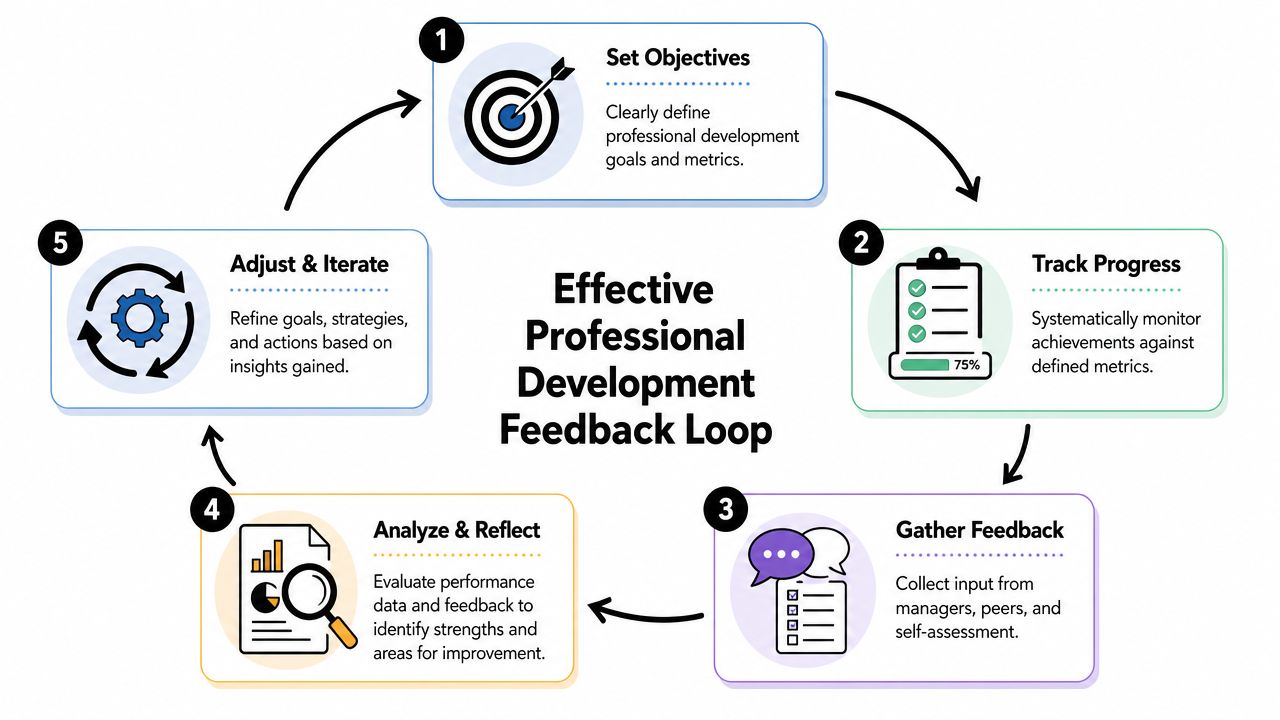
That's where most professional development tracking breaks down. People log activity, but they don't connect it to goals, daily practice, or review. The result is a record of effort without a clear line to growth. A better system turns learning into a loop: define what matters, log what you do, review what changed, and adjust fast.
Table of Contents
- Beyond the Checklist Why Systematic Tracking Matters
- Defining Your North Star From Vague Goals to Clear Objectives
- Choosing What to Measure Metrics That Signal Real Growth
- Building Your System Logging Activities and Time
- The Feedback Loop Running Effective Review Cadences
- Tools Templates and the Future of Development Tracking
Beyond the Checklist Why Systematic Tracking Matters
Professional development tracking is often treated like expense reporting. Necessary, slightly annoying, and mainly useful when someone else asks for proof. That mindset guarantees a weak system.
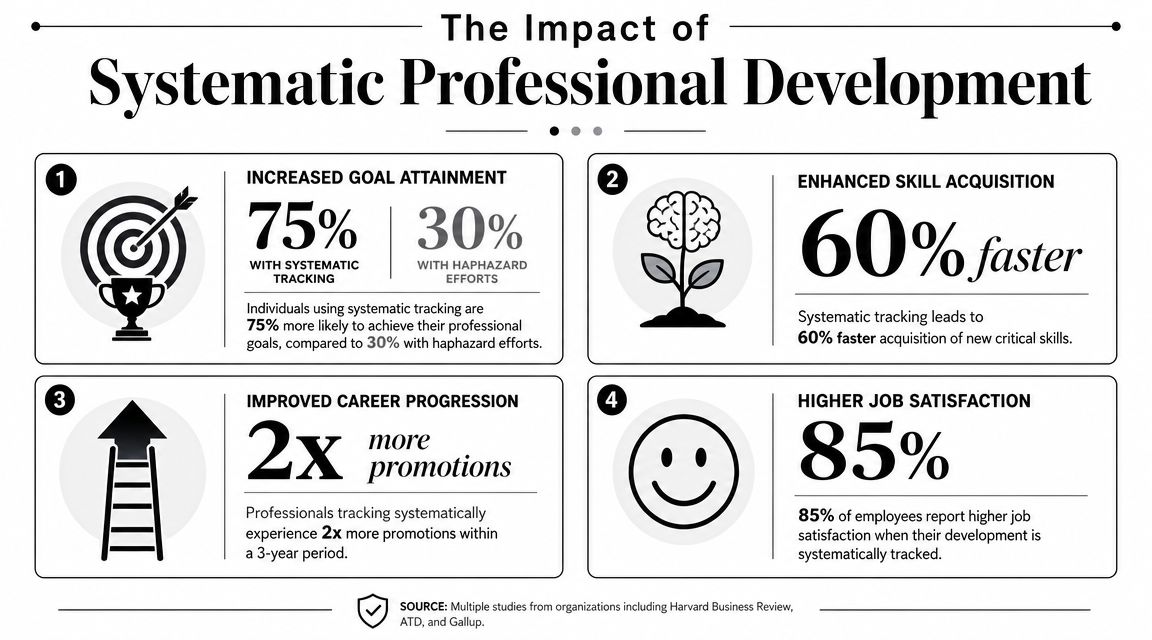
Tracking matters because training is already a major investment. In the U.S., companies spent $101.8 billion on employee training in 2023, and employees averaged 57 hours of training. Organizations that invest strategically in employee development report 11% greater profitability, while companies with extensive training programs report 218% higher income per employee than those without formalized training, according to employee training statistics compiled by Cross River Therapy. If that much time and money is already in play, informal tracking isn't good enough.
Tracking creates leverage, not paperwork
A checklist tells you what you attended. A system tells you what moved. That distinction matters.
When tracking is done well, you can answer questions that affect your career:
- Which skills are improving: not in theory, but in your real work output
- Where time is leaking: courses completed, but no behavior change afterward
- What compounds: coaching, practice, and reflection that keep paying back
- What should stop: learning activities that feel useful but don't change results
A lot of teams don't have this clarity. They know who showed up. They don't know who adopted the skill, who applied it under pressure, or who got materially better.
Practical rule: If your tracking system can't help you decide what to do differently next week, it's a storage system, not a development system.
Compliance is the floor, not the ceiling
Some industries learned this earlier because they had to. The USDA's Professional Standards Trainings and Tracker Tool was built to help school nutrition professionals track annual training hours required under the Healthy Hunger-Free Kids Act, and it formalized training records as an accountability mechanism rather than informal note-taking through the USDA Professional Standards Trainings and Tracker Tool. Even there, the system includes measurable administrative burden, with the USDA estimating 1 hour and 12 minutes per response.
That's useful context. Formal tracking exists because development has consequences. It affects compliance, performance, readiness, and retention. But copying a compliance model for your own growth is a mistake. If all you track is attendance and hours, you'll end up with cleaner records and the same skill gaps.
The better use of professional development tracking is personal advantage. It turns scattered learning into evidence. It helps you spot whether you're building capability or just collecting inputs. And once you have that loop in place, development stops feeling random.
Defining Your North Star From Vague Goals to Clear Objectives
Most development plans fail before the first course starts. The goal is too broad. “Become a better leader.” “Get stronger at sales.” “Be more strategic.” Those aren't objectives. They're directions.

A workable system starts with a role shift you care about. Not what sounds impressive. Not what your peers are posting about. The role shift.
Start with a role shift, not a learning wish list
Say a founder wants to “get better at sales.” That's still too fuzzy to track. A shift might be: move from founder-led instinct selling to a repeatable sales process the team can use.
That role shift produces clearer development targets. Instead of one vague goal, the founder now has a portfolio of objectives:
- CRM discipline: log deals consistently and use pipeline stages correctly
- Discovery quality: ask better questions and diagnose buyer pain early
- Objection handling: respond without rushing into discounting or overexplaining
- Call review: identify what worked and what broke in live conversations
- Sales management: create a process another rep could follow
That's the level where professional development tracking starts to work. Each objective has an observable behavior attached to it.
Turn ambitions into trackable objectives
A practical system should follow a KPI stack: define SMART goals, capture a pre-training baseline, run mid-course check-ins, then compare post-training results against on-the-job indicators such as productivity, error rates, or retention, as described in this guide to maximizing ROI on professional development programs.
For an individual, that stack can look like this:
Write the ambition plainly
Example: “I want to become a stronger sales leader.”Translate it into capability areas
Example: pipeline management, negotiation, coaching reps, forecasting.Define one visible behavior per capability
Example: “I run a weekly pipeline review using the same criteria for every deal.”Set a baseline before training starts
What happens today? What do your notes, calls, or workflow already show?Name the proof of progress
What would make you say, “yes, I'm better at this now”?
If you need help turning broad aspirations into something operational, this overview of goal-setting frameworks is useful because it forces you to pick a structure instead of relying on motivation.
A second rule matters here. Separate learning goals from performance goals. Learning goals focus on the skill you're trying to build. Performance goals focus on the work result you expect that skill to influence. If you merge them too early, you'll confuse a weak market, a messy process, and a genuine skill gap.
Don't track “improve executive presence.” Track “lead Monday staff meeting without script reliance” or “deliver concise project updates with a clear recommendation.”
That distinction is why some of the best leadership planning now blends reflection with structured planning support. Resources like Setting 2026 leadership goals with AI are useful because they push goals out of the abstract and into specific operating behaviors.
A short reset can help if you're stuck. Ask:
- What role am I trying to grow into
- What would that person do consistently that I don't yet do
- What evidence would show I've closed that gap
Put those answers on paper before you track a single hour. Otherwise you'll build a neat record of motion with no real direction.
Here's a useful walkthrough of this planning mindset in another format:
Choosing What to Measure Metrics That Signal Real Growth
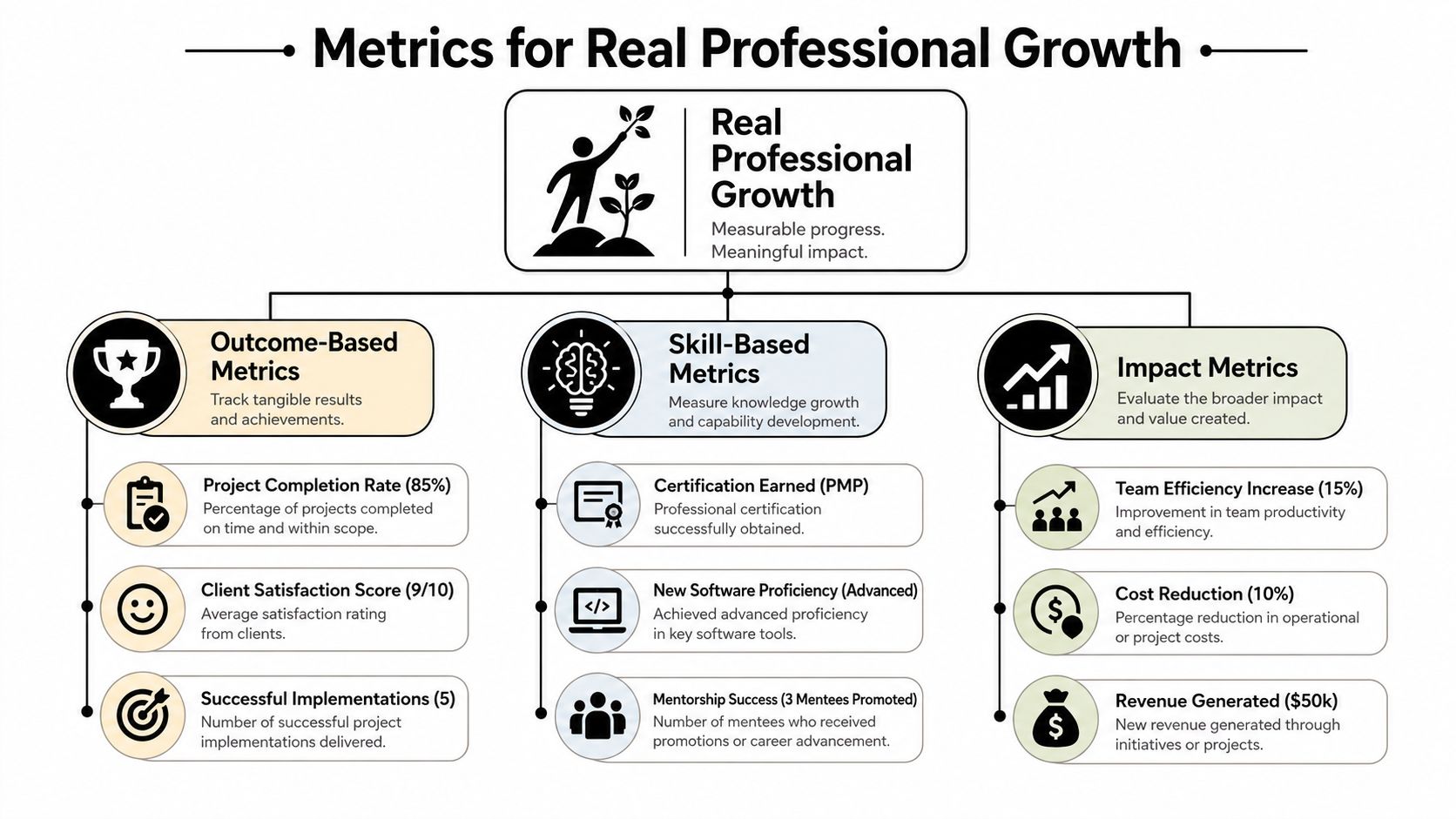
The easiest thing to measure in professional development tracking is activity. Hours spent. Courses finished. Books read. Certificates earned.
Those metrics aren't useless. They're just incomplete. If you stop there, you'll confuse participation with progress.
Research on professional development has pushed this point clearly. Effective development should be evaluated with multiple outcome sources beyond attendance. The question shifts from “Did someone attend?” to “Did anything change?”, with more emphasis on transfer into day-to-day work, as discussed in Hanover Research's paper on professional development for personalized learning practices.
The three levels of useful metrics
I like to sort metrics into three levels. Not because the model is fancy, but because it prevents self-deception.
| Level | What it measures | Example |
|---|---|---|
| Activity | What you did | Attended a negotiation workshop, practiced role-play twice |
| Output | What you produced | Rewrote proposal template, ran five structured discovery calls |
| Outcome | What changed | Better call quality, fewer errors, stronger close discipline |
The mistake is treating activity metrics as proof. They're only evidence that you started.
A stronger dashboard includes all three, but weights them differently:
- Activity metrics keep consistency visible
- Output metrics show whether learning turned into action
- Outcome metrics test whether action changed real work
If you manage your own growth analytically, this is close to running small experiments. You're making a hypothesis: “If I improve this skill and practice it in this context, these work indicators should move.”
Build a small dashboard, not a data warehouse
A common pitfall is tracking too much and reviewing too little. Start with a narrow set of indicators tied to one objective.
For example, if your objective is better objection handling in sales, your dashboard might include:
- Activity: number of calls reviewed
- Output: number of objections tagged and response patterns rewritten
- Outcome: manager or self-rating on how calmly and clearly objections were handled in live calls
If your objective is stronger project leadership, your signals might be:
- Activity: time spent preparing decision memos
- Output: memos delivered with recommendation and trade-off summary
- Outcome: whether meetings end with decisions instead of recycled debate
A useful rule is to keep one primary outcome metric, a few supporting output metrics, and just enough activity logging to maintain honesty. If you want a stronger framework for connecting work effort to actual impact, this guide to productivity measurement is worth reading because it sharpens the difference between busyness and value.
The best metric is usually the one that feels slightly uncomfortable to track. That's often the one closest to reality.
Some outcomes are qualitative. That's fine. Not every important change shows up as a clean number. Better stakeholder handling, clearer writing, or stronger coaching often need rubrics, scorecards, or structured notes. What matters is consistency. If you define the criteria up front and review them the same way each time, the signal becomes usable.
Building Your System Logging Activities and Time
A development plan dies from friction more often than from bad intentions. If logging takes too long, you won't do it. If the system is too loose, you'll fill it with vague notes you never use.
Good professional development tracking sits in the middle. Fast enough to maintain. Structured enough to review.
Pick the tool you will actually open
I've seen three methods work repeatedly: a paper notebook, a spreadsheet, and a dedicated tracking app. None is universally best. The right one depends on how you already work.
| Method | Pros | Cons | Best For |
|---|---|---|---|
| Notebook | Fast capture, low distraction, easy for reflection | Hard to search, harder to summarize over time | People who think well by writing and want a simple offline habit |
| Spreadsheet | Flexible, sortable, easy to build custom fields | Can become messy, easy to abandon if overbuilt | Managers, operators, and anyone who wants a light dashboard |
| Dedicated app | Reminders, templates, recurring logs, easier trend review | Another tool to maintain, can feel rigid | People who already use digital systems daily |
Use the smallest tool that still gives you visibility. If a notes app and a weekly spreadsheet review are enough, use that. If you need prompts and recurring workflows, an app may help. Don't upgrade tools to avoid doing the work.
A lot of people also benefit from understanding the difference between logging tasks and logging time. This explainer on what time tracking is is useful because development work often disappears inside the day unless you give it a clear record.
Use a log format that forces clarity
A good log entry should take a minute or two. It should also answer more than “what did I do?”
Use fields like these:
- Date: when the activity happened
- Objective: which development goal this supports
- Activity: what you did
- Time spent: enough detail to spot patterns later
- Key insight: what you learned or noticed
- Application: where you'll use it next
- Evidence: link to call notes, draft, meeting outcome, or feedback
- Next step: the smallest follow-up action
That last field matters most. A lot of logs become dead archives because they capture learning but not transfer.
Here's an example of a stronger entry:
Objective: Improve objection handling
Activity: Reviewed one recorded sales call and tagged buyer pushback moments
Key insight: I answer too early and stop diagnosing once price comes up
Application: In tomorrow's calls, ask one more question before responding
Evidence: Call summary and revised response script
Next step: Review whether that change happened in the next two calls
Notice what's missing. No diary writing. No motivational fluff. Just a useful record.
Keep the cadence lightweight
Logging doesn't need to happen in a giant end-of-week memory dump. That usually produces fiction. Short entries right after the work are better.
Use a simple rhythm:
- After the activity: capture the facts and immediate insight
- End of day: clean up incomplete notes
- End of week: tag patterns across entries
If you're disciplined, the system starts creating its own value. You'll notice recurring bottlenecks, repeated excuses, and skills that improve only when tied to real practice. That's when logging stops feeling administrative and starts acting like a mirror.
The Feedback Loop Running Effective Review Cadences
Tracking without review is just collection. The review process is where professional development tracking becomes useful. Through this process, you separate effort from progress, identify drag, and decide what to change.
The strongest systems use fixed cadences. Not because calendars are magical, but because reflection gets skipped when it has to compete with urgent work.
A daily check keeps the system alive
The daily review should be short. Five minutes is enough if the logging is clean.
Ask:
- What development action did I complete today
- Did I apply a skill in live work, or only consume information
- What needs to happen tomorrow while the insight is still fresh
This is not the place for big strategic reflection. It's maintenance. You're keeping the loop unbroken.
Review works best when it ends with one concrete adjustment, not a vague promise to “focus more.”
Weekly and quarterly reviews create course correction
The weekly review does the heavier lifting. Set aside enough time to look across entries, not just at one day in isolation.
A strong weekly review includes:
Pattern check
What objectives got real attention, and which ones lived only on the plan?Time check
Did time allocation match stated priorities?Transfer check
Where did learning show up in actual work?Friction check
What made practice harder than expected?Next-week adjustment
What gets doubled down on, reduced, or redesigned?
For managers building team systems, coaching cadence matters here too. If you want examples of how structured coaching rhythms reinforce review loops, this piece on how to build sales coaching programs is a helpful reference because it shows how practice, observation, and follow-up need to connect.
The quarterly review is different. It's less about habit and more about direction. Use a longer block to ask harder questions:
- Are these still the right objectives
- Did the work environment change
- Which skill bets paid off
- What should be dropped entirely
- What evidence shows actual growth
Retention is one of the better long-range signals that development is working. A review of continuing professional development found participants were 11% more likely to remain in their jobs than non-participants, with 67% vs. 56% remaining in one eight-year cohort, according to this systematic review of continuing professional development and workforce outcomes. That doesn't mean every learning program causes people to stay. It does mean persistence is a stronger benchmark than mere attendance.
Use your review to update the system itself
Individuals often review the goal and forget to review the tracking method. That's a miss.
If your logs are too vague, tighten the fields. If you're capturing too much detail and avoiding the habit, simplify. If an objective produces no visible evidence after repeated cycles, the problem may be the goal design, not your discipline.
A healthy system gets sharper over time. The review process should improve both your skills and the mechanism you use to track them.
Tools Templates and the Future of Development Tracking
A mature professional development tracking system doesn't live in a separate universe from work. It pulls signals from the places where work already happens: your calendar, project board, notes, call recordings, docs, and review conversations.
Embed tracking into work instead of adding another chore
The most reliable setups reduce manual effort. That can mean simple habits such as linking a learning objective to a recurring meeting note, or more integrated workflows such as pulling practice notes from a CRM, a project tool, or a call review process.
A few practical examples:
- Project work: tag deliverables to a development objective
- Meetings: add one reflection prompt to your recurring agenda
- Coaching: keep action items and observed behavior in the same place
- Content and training: save artifacts, not just completion records
For L&D teams, format matters too. If part of your system includes internal enablement content, this guide to creating training videos for L&D is useful because clear, reusable instruction makes it easier to connect learning assets to later practice and review.
Adaptive systems will replace static logs
Static tracking assumes development happens in isolated events. Attend workshop. Mark complete. Move on. That model is getting old fast.
The pressure is simple: skill needs are changing faster, and development has to keep up. The World Economic Forum reported that 39% of workers' core skills are expected to change by 2030, as cited in this discussion of job-embedded professional development and changing skill demands. If that projection is even close to your reality, a once-a-quarter spreadsheet won't be enough.
Adaptive systems work differently. They capture iteration. They make room for coaching notes, revisions, practice cycles, and changing priorities. They're less interested in whether you “completed learning” and more interested in whether you can use a new skill under real conditions.
That shift matters for individuals too. The future of professional development tracking isn't a prettier log. It's a connected operating loop that asks, repeatedly: what are you trying to improve, what did you do, what changed, and what should happen next?
Build that loop now and your system will still hold up when your role, tools, and required skills change around you.
Keep going with Beyond Time
These Beyond Time tools turn scattered learning into a clear development loop you can review every week.
- Personal Development Plan Generator — Build a structured plan around skills that actually matter.
- Career Roadmap Planner — Map the milestones between where you are and where you're going.
- Personal Development Plan Template: Complete Guide — Fill a real template instead of starting from a blank page.
- AI-Native Goal Tracking Explained — See how AI can surface patterns your manual log would miss.
If you want a system that connects goals, milestones, routines, and time tracking into one development loop, Beyond Time by Tribble Software Private Limited is built for that job. It turns high-level objectives into structured action plans, ties them to daily execution, and adds AI-supported review so you can see what's working and where momentum is breaking.
Put this into practice
Free tools that match this article.
Goal Setting Worksheet
Turn a vague goal into milestones, habits, blockers, and a weekly review plan.
Try Goal WorksheetCareerCareer Roadmap Planner
Plan your career progression with AI-powered roadmaps, skill gap analysis, and actionable milestones.
Try Career PlannerPersonal DevelopmentPersonal Development Plan Generator
Generate a personalized development plan with quarterly milestones, skill gaps, and daily habits tailored to your goals.
Try Development PlanGoal SettingSMART Goal Validator
Instantly validate your goals against the SMART framework and get actionable improvement suggestions.
Try SMART ValidatorKeep exploring this topic
Beyond Time for professionals
Plan career goals, weekly execution, and focused work in one system.
Career roadmap guide
Translate long-term professional growth into concrete milestones.
Goal setting guide
Start with the fundamentals of setting goals that turn into action.
Goal frameworks compared
Choose between SMART goals, OKRs, BHAGs, and 12-week goals.
Related Articles
A Goal Planning Template That Actually Works: OKR Method
Stop just setting goals. Use our OKR-based goal planning template to turn big ambitions into a daily action plan. Includes a free downloadable template.
Difference Between Short and Long Term Goals: A 2026 Guide
Learn the core difference between short and long term goals. This guide covers time horizons, purpose, and how to connect your vision to daily actions.
What Is the Difference Between Tactics and Strategy?
Learn what is the difference between tactics and strategy. This guide clarifies their scope and timeline, with examples, connecting vision to action for 2026
Weekly Goal Tracker: How to Plan and Achieve Your Goals
Design a weekly goal tracker that works. This guide shows you how to connect big objectives to daily tasks, build a tracker, and use AI to stay on course.
Master Your Estimated Completion Date in 2026
Calculate and manage an accurate, motivating estimated completion date. Our 2026 guide covers formulas, tracking, and common pitfalls to help you achieve goals.
What Is a Work Plan? Your 2026 Guide to Success
Discover what is a work plan and how to craft one effectively in 2026. Learn components, examples, and mistakes to turn your goals into reality.